Thank you for visiting SNEWPapers!
Sign up free
Editorial
August 5, 1814
Daily National Intelligencer
Washington, District Of Columbia
What is this article about?
Editorial defends the American republican government against critics who favor restoring absolute monarchy in Europe, like Ferdinand VII in Spain, and accuses them of hypocrisy regarding British practices. It highlights US neutrality and resistance to British naval aggressions during Napoleonic wars, earning international respect.
Clipping
OCR Quality
95%
Excellent
Full Text
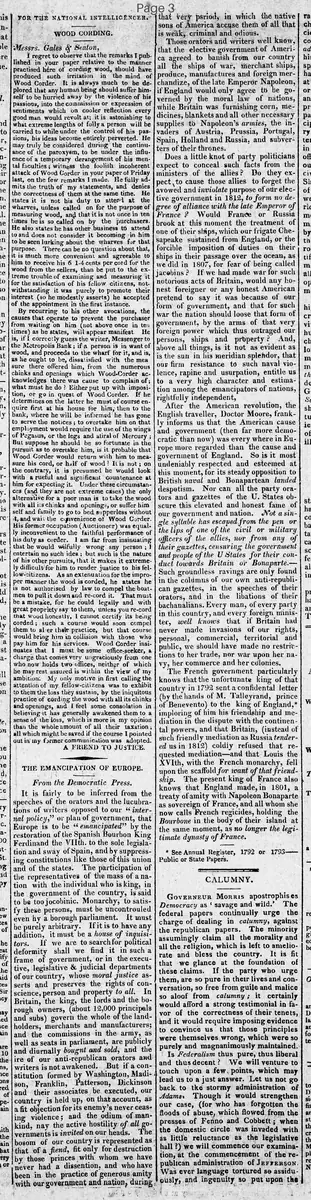
THE EMANCIPATION OF EUROPE.
From the Democratic Press.
It is fairly to be inferred from the speeches of the orators and the lucubrations of writers opposed to our "internal policy," or plan of government, that Europe is to be "emancipated" by the restoration of the Spanish Bourbon King Ferdinand the VIIth. to the sole legislation and sway of Spain, and by suppressing constitutions like those of this union and of the states. The participation of the representatives of the mass of a nation with the individual who is king, in the government of the country, is said to be too jacobinic. Monarchy, to satisfy these persons, must be uncontrouled even by a borough parliament. It must be purely arbitrary. If it is to have any addition, it must be a house of inquisitors. If we are to search for political deformity shall we find it in such a frame of government, or in the executive, legislative & judicial departments of our country, whose moral justice asserts and preserves the rights of conscience, person and property to all. In Britain, the king, the lords and the borough owners, (about 12,000 principals and subs) govern the whole of the landholders, merchants and manufacturers; and the commissions in the army, as well as seats in parliament, are publicly and diurnally bought and sold, and the ire of our anti-republican orators and writers is not awakened. But if a constitution formed by Washington, Madison, Franklin, Patterson, Dickinson and their associates be executed, our country is held up, on that account, as a fit object for its enemy's never ceasing violence; and the odium of mankind, nay the active hostility of all governments is invited on our heads. The bosom of our country is represented as that of a fiend, fit only for destruction by those princes with whom we have never had a dissention, and who have been in the practice of generous amity with our government and nation, during that very period, in which the native sons of America accuse them of all that is weak, criminal and odious.
Those orators and writers well know that the elective government of America agreed to banish from our country all the ships of war, merchant ships, produce, manufactures and foreign merchandize, of the late Emperor Napoleon, if England would only agree to be governed by the moral law of nations, while Britain was furnishing corn, medicines, blankets and all other necessary supplies to Napoleon's armies, the invaders of Austria, Prussia, Portugal, Spain, Holland and Russia. and subverters of their thrones.
Does a little knot of party politicians expect to conceal such facts from the ministers of the allies? Do they expect, to cause those allies to forget the avowed and inviolate purpose of our elective government in 1812, to form no degree of alliance with the late Emperor of France ? Would France or Russia brook at this moment the treatment of one of their ships, which our frigate Chesapeake sustained from England; or the forcible imposition of duties on their ships in their passage over the ocean, as we did in 1807, for fear of being called jacobins ? If we had made war for such notorious acts of Britain, would any honest foreigner or any honest American pretend to say it was because of our form of government, and that for such war the nation should loose that form of government, by the arms of that very foreign power which thus outraged our persons, ships and property ? And, above all things, is it not as evident as is the sun in his meridian splendor, that our firm resistance to such naval violence, rapine and usurpation, entitle us to a very high character and estimation among the emancipators of nations, rightfully independent,
After the American revolution, the English traveller, Doctor Moore, frankly informs us that the American cause and government (then far more democratic than now) was every where in Europe more regarded than the cause and government of England. So is it most undeniably respected and esteemed at this moment, for its steady opposition to British naval and Bonapartean landed despotism. Nor can all the party orators and gazettes of the U. States obscure this elevated and honest fame of our government and nation. Not a single syllable has escaped from the pen or the lips of one of the civil or military officers of the allies, nor from any of their gazettes, censuring the government and people of the U States for their conduct towards Britain or Bonaparte.—Such groundless ravings are only found in the columns of our own anti-republican gazettes, in the speeches of their orators, and in the libations of their bachanalians. Every man, of every party in this country, and every foreign minister, well knows that if Britain had never made invasions of our rights, personal, commercial, territorial and public, we should have made no restrictions to her trade, nor war upon her navy, her commerce and her colonies.
The French government particularly knows that the unfortunate king of that country in 1792 sent a confidential letter (by the hands of M. Talleyrand, prince of Benevento) to the king of England,* imploring of him his friendship and mediation in the dispute with the continental powers, and that Britain, (instead of such friendly mediation as Russia tendered us in 1812) coldly refused that requested mediation—and that Louis the XVIth, with the French monarchy, fell upon the scaffold for want of that friendship. The present king of France also knows that England made, in 1801, a treaty of amity with Napoleon Bonaparte as sovereign of France, and all whom she now calls French regicides, holding the Bourbons in the body of their island at the same moment, as no longer the legitimate dynasty of France.
* See Annual Register, 1792 or 1793—Public or State Papers.
From the Democratic Press.
It is fairly to be inferred from the speeches of the orators and the lucubrations of writers opposed to our "internal policy," or plan of government, that Europe is to be "emancipated" by the restoration of the Spanish Bourbon King Ferdinand the VIIth. to the sole legislation and sway of Spain, and by suppressing constitutions like those of this union and of the states. The participation of the representatives of the mass of a nation with the individual who is king, in the government of the country, is said to be too jacobinic. Monarchy, to satisfy these persons, must be uncontrouled even by a borough parliament. It must be purely arbitrary. If it is to have any addition, it must be a house of inquisitors. If we are to search for political deformity shall we find it in such a frame of government, or in the executive, legislative & judicial departments of our country, whose moral justice asserts and preserves the rights of conscience, person and property to all. In Britain, the king, the lords and the borough owners, (about 12,000 principals and subs) govern the whole of the landholders, merchants and manufacturers; and the commissions in the army, as well as seats in parliament, are publicly and diurnally bought and sold, and the ire of our anti-republican orators and writers is not awakened. But if a constitution formed by Washington, Madison, Franklin, Patterson, Dickinson and their associates be executed, our country is held up, on that account, as a fit object for its enemy's never ceasing violence; and the odium of mankind, nay the active hostility of all governments is invited on our heads. The bosom of our country is represented as that of a fiend, fit only for destruction by those princes with whom we have never had a dissention, and who have been in the practice of generous amity with our government and nation, during that very period, in which the native sons of America accuse them of all that is weak, criminal and odious.
Those orators and writers well know that the elective government of America agreed to banish from our country all the ships of war, merchant ships, produce, manufactures and foreign merchandize, of the late Emperor Napoleon, if England would only agree to be governed by the moral law of nations, while Britain was furnishing corn, medicines, blankets and all other necessary supplies to Napoleon's armies, the invaders of Austria, Prussia, Portugal, Spain, Holland and Russia. and subverters of their thrones.
Does a little knot of party politicians expect to conceal such facts from the ministers of the allies? Do they expect, to cause those allies to forget the avowed and inviolate purpose of our elective government in 1812, to form no degree of alliance with the late Emperor of France ? Would France or Russia brook at this moment the treatment of one of their ships, which our frigate Chesapeake sustained from England; or the forcible imposition of duties on their ships in their passage over the ocean, as we did in 1807, for fear of being called jacobins ? If we had made war for such notorious acts of Britain, would any honest foreigner or any honest American pretend to say it was because of our form of government, and that for such war the nation should loose that form of government, by the arms of that very foreign power which thus outraged our persons, ships and property ? And, above all things, is it not as evident as is the sun in his meridian splendor, that our firm resistance to such naval violence, rapine and usurpation, entitle us to a very high character and estimation among the emancipators of nations, rightfully independent,
After the American revolution, the English traveller, Doctor Moore, frankly informs us that the American cause and government (then far more democratic than now) was every where in Europe more regarded than the cause and government of England. So is it most undeniably respected and esteemed at this moment, for its steady opposition to British naval and Bonapartean landed despotism. Nor can all the party orators and gazettes of the U. States obscure this elevated and honest fame of our government and nation. Not a single syllable has escaped from the pen or the lips of one of the civil or military officers of the allies, nor from any of their gazettes, censuring the government and people of the U States for their conduct towards Britain or Bonaparte.—Such groundless ravings are only found in the columns of our own anti-republican gazettes, in the speeches of their orators, and in the libations of their bachanalians. Every man, of every party in this country, and every foreign minister, well knows that if Britain had never made invasions of our rights, personal, commercial, territorial and public, we should have made no restrictions to her trade, nor war upon her navy, her commerce and her colonies.
The French government particularly knows that the unfortunate king of that country in 1792 sent a confidential letter (by the hands of M. Talleyrand, prince of Benevento) to the king of England,* imploring of him his friendship and mediation in the dispute with the continental powers, and that Britain, (instead of such friendly mediation as Russia tendered us in 1812) coldly refused that requested mediation—and that Louis the XVIth, with the French monarchy, fell upon the scaffold for want of that friendship. The present king of France also knows that England made, in 1801, a treaty of amity with Napoleon Bonaparte as sovereign of France, and all whom she now calls French regicides, holding the Bourbons in the body of their island at the same moment, as no longer the legitimate dynasty of France.
* See Annual Register, 1792 or 1793—Public or State Papers.
What sub-type of article is it?
Foreign Affairs
Partisan Politics
Constitutional
What keywords are associated?
European Emancipation
American Republic
Monarchist Criticism
British Naval Aggression
Napoleonic Wars
Us Foreign Policy
Constitutional Rights
What entities or persons were involved?
Ferdinand Vii
Napoleon Bonaparte
Washington
Madison
Franklin
Patterson
Dickinson
Britain
France
Louis Xvi
Talleyrand
Editorial Details
Primary Topic
Defense Of American Republicanism Against European Monarchist Restoration
Stance / Tone
Strongly Pro Republican And Anti Monarchist
Key Figures
Ferdinand Vii
Napoleon Bonaparte
Washington
Madison
Franklin
Patterson
Dickinson
Britain
France
Louis Xvi
Talleyrand
Key Arguments
Restoration Of Absolute Monarchy In Europe Like Ferdinand Vii's Spain Suppresses Constitutions And Is Arbitrary.
American Government Preserves Rights Unlike British System Where Parliament Seats Are Bought And Sold.
Us Opposed British Naval Aggressions And Napoleonic Invasions Without Allying With France.
Critics Hypocritically Attack Us Republic While Ignoring British Flaws.
Us Resistance To Violations Earns International Respect, Not Censure From Allies.
Historical Facts Show Britain's Refusal To Aid France In 1792 And Treaty With Napoleon In 1801.