Thank you for visiting SNEWPapers!
Sign up free
The Massachusetts Spy, And Worcester County Advertiser
Worcester, Worcester County, Massachusetts
What is this article about?
An opinion essay from the National Intelligencer urges U.S. citizens to treat Native American tribes like the Cherokees, Creeks, and Choctaws as human beings entitled to treaty protections, opposing their forced removal. It calls for petitions to Congress, public remonstrance, and prayers to avert national dishonor and injustice.
Merged-components note: Long article on the Indian question from the National Intelligencer, continued across pages with sequential reading orders and coherent text flow on the same subject.
Clippings
1 of 2
OCR Quality
Full Text
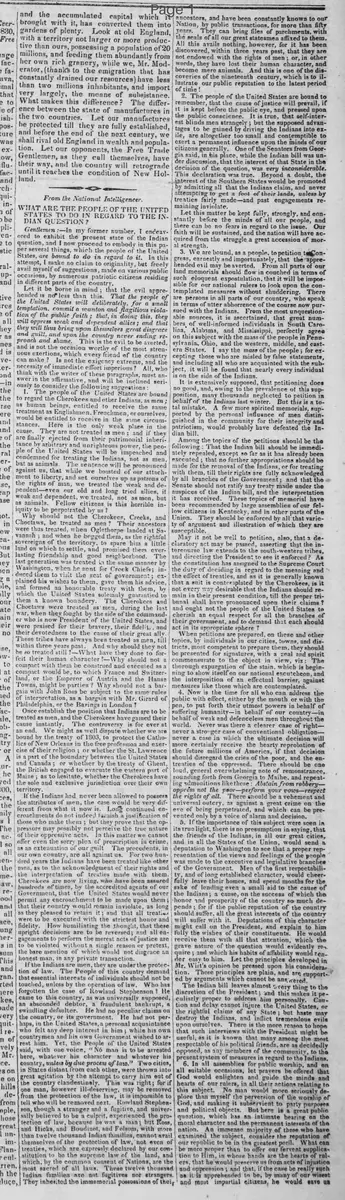
WHAT ARE THE PEOPLE OF THE UNITED
STATES TO DO IN REGARD TO THE IN-
DIAN QUESTION?
Gentlemen:—In my former number, I endeavored to exhibit the present state of the Indian question, and I now proceed to embody in this paper several things, which the people of the United States, are bound to do in regard to it. In this attempt, I make no claim to originality, but freely avail myself of suggestions, made on various public occasions, by numerous patriotic citizens residing in different parts of the country.
Let it be borne in mind; that the evil apprehended is no less than this. That the people of the United States will deliberately, for a small temptation, commit a wanton and flagitious violation of the public faith; that, in doing this, they will oppress weak and dependent allies; and that they will thus bring upon themselves great disgrace and guilt, and upon the country never ending reproach and shame. This is the evil to be averted, and is not the occasion worthy of the most strenuous exertions, which every friend of the country can make? Is not the exigency extreme, and the necessity of immediate effort imperious? All, who think with the writer of these paragraphs, must answer in the affirmative, and will be inclined seriously to consider the following suggestions:
1. The people of the United States are bound to regard the Cherokees and other Indians, as men; as human beings, entitled to receive the same treatment as Englishmen, Frenchmen, or ourselves, would be entitled to receive in the same circumstances. Here is the only weak place in the cause. They are not treated as men; and if they are finally ejected from their patrimonial inheritance by arbitrary and unrighteous power, the people of the United States will be impeached and condemned for treating the Indians, not as men, but as animals. The sentence will be pronounced against us, that while we boasted of our attachment to liberty, and set ourselves up as patrons of the rights of man, we treated the weak and dependent—even our old and long tried allies, if weak and dependent, we treated, not as men, but as animals. Fellow citizens is this horrible iniquity to be perpetrated by us?
Why should not the Cherokees, Creeks, and Choctaws, be treated as men? Their ancestors were thus treated, when Oglethorpe landed at Savannah; and when he begged them, as the rightful sovereigns of the territory, to spare him a little land on which to settle, and promised them everlasting friendship and good neighborhood. The last generation was treated in the same manner by Washington, when he sent for Creek Chiefs; induced them to visit the seat of government; explained his wishes to them, gave them his advice, and formed an honorable treaty with them, by which the United States solemnly guaranteed to them a known boundary. The Cherokees and Choctaws were treated as men, during the last war, when they fought by the side of the commander who is now President of the United States, and were praised for their bravery, their fidelity, and their devotedness to the cause of their great ally. These tribes have always been treated as men, till within three years past. And why should they not be so treated still?—What have they done to forfeit their human character?—Why should not a compact with them be construed and executed as a compact would be, to which France and Switzerland, or the Emperor of Austria and the Hanse Towns, might be parties? Why should not a bargain with John Ross be subject to the same rules of interpretation, as a bargain with Mr. Girard of Philadelphia, or the Barings in London?
Once establish the position that Indians are to be treated as men, and the Cherokees have gained their cause instantly. The controversy is for ever at an end. We might as well dispute whether we are bound by the treaty of 1803, to protect the Catholics of New Orleans in the free profession and exercise of their religion; or whether the St. Lawrence is a part of the boundary between the United States and Canada; or whether by the treaty of Ghent, the British engaged to evacuate the eastern part of Maine; as to hesitate, whether the Cherokees have the sole and exclusive jurisdiction over their own territory.
If the Indians had never been allowed to possess the attributes of men, the case would be very different from what it now is. Long continued encroachments do not indeed furnish a justification of those who make them; but they prove that the oppressors may possibly not perceive the true nature of their oppressive acts. In this matter we cannot offer even the sorry plea of prescription in crime, as an extenuation of our guilt. The precedents, in our own country, are all against us. For two hundred years the Indians have been treated like other men, as to the acknowledgment of their rights and the interpretation of treaties made with them. Cherokees are now living, who have been assured hundreds of times, by the accredited agents of our Government, that the United States would never permit any encroachment to be made upon them; that their country would remain inviolate, as long as they pleased to retain it; and that all treaties were to be executed with the strictest honor and fidelity. How humiliating the thought, that these upright decisions are to be reversed; and all engagements to perform the merest acts of justice are to be violated without a single reason or pretext, the bare mention of which would not disgrace an honest man, in any private transaction.
If the Indians are men, they are under the protection of law. The People of this country demand that essential interests of individuals should not be touched, unless by the operation of law. Who has forgotten the case of Rowland Stephenson? He came to this country, as was universally supposed, an absconded debtor, a fraudulent bankrupt, a swindling defaulter. He had no peculiar claims on the country, or its government. He had not perhaps, in the United States, a personal acquaintance who felt any deep interest in him; while his own countrymen and his own Government wished to arrest him. Yet, the People of the United States said, with one voice, "No man is to be arrested here, whatever his character and whatever his country, unless by due process of law." Two cities, in States distant from each other, were thrown into great agitation by the attempt to carry him out of the country clandestinely. This was right; for if one man, however ill-deserving, may be removed from the protection of the law, it is impossible to tell who will be removed next. Rowland Stephenson, though a stranger and a fugitive, and universally believed to be a culprit, experienced the protection of law, because he was a man; but Ross, and Hicks, and Boudinot, and Folsom, with more than twelve thousand Indian families, cannot avail themselves of the protection of law, not even of treaties, which are expressly declared by our constitution to be the supreme law of the land, and which, by the common consent of Nations, are the most sacred of all laws. These twelve thousand Indian families are not fugitives nor strangers. They inherited the immemorial possessions of their ancestors, and have been constantly known to our Nation, by public transactions, for more than fifty years. They can bring files of parchments, with the seals of all our great statesmen affixed to them. All this avails nothing, however, for it has been discovered, within three years past, that they are not endowed with the rights of men; or, in other words, they have lost their human character, and become mere animals. And this is one of the discoveries of the nineteenth century, which is to illustrate our public reputation to the latest period of time!
2. The people of the United States are bound to remember, that the cause of justice will prevail, if it is kept before the public eye, and pressed upon the public conscience. It is true, that self-interest blinds men strangely; but the supposed advantages to be gained by driving the Indians into exile, are altogether too small and contemptible to exert a permanent influence upon the minds of our citizens generally. One of the Senators from Georgia said, in his place, while the Indian bill was under discussion, that the interest of that State in the decision of the question, was very inconsiderable. This declaration was true. Beyond a doubt, the interest of the Southern States would be promoted by admitting all that the Indians claim, and never attempting to get a foot of their lands, unless by treaties fairly made—and past engagements remaining inviolate.
Let this matter be kept fully, strongly, and constantly before the minds of all our people, and there can be no fears in regard to the issue. Our faith will be sustained, and the nation will have acquired from the struggle a great accession of moral strength.
3. We are bound, as a people, to petition the Congress, earnestly and importunately, that the apprehended evil may be averted. From all parts of our land memorials should flow in couched in terms of such eloquent expostulation, that it will be impossible for our national rulers to look upon the contemplated measures without shuddering. There are persons in all parts of our country, who speak in terms of utter abhorrence of the course now pursued with the Indians. From the most unquestionable sources, it is ascertained, that great numbers of well-informed individuals in South Carolina, Alabama, and Mississippi, perfectly agree on this subject with the mass of the people in Pennsylvania, Ohio, and the western, middle, and eastern States. I say the mass of the people; for excepting those who are misled by false statements, and including all who are acquainted with the subject, it will be found that nearly every individual is on the side of the Indians.
It is extensively supposed, that petitioning does no good, and, owing to the prevalence of this supposition, many thousands neglected to petition in behalf of the Indians last winter. But this is a total mistake. A few more spirited memorials, supported by the personal influence of men distinguished in the community for their integrity and patriotism, would probably have defeated the Indian bill.
Among the topics of the petitions should be the following: That the Indian bill should be immediately repealed, except so far as it has already been executed; that no further appropriations should be made for the removal of the Indians, or for treating with them, till their rights are fully acknowledged by all branches of the Government; and that the Senate should not ratify any treaty made under the auspices of the Indian bill, and the interpretation it has received. These topics of memorial have been recommended by large assemblies of our fellow citizens in Kentucky, and in other parts of the Union. They should be enforced by all that variety of argument and illustration of which they are susceptible.
May it not be well to petition, also, that a declaratory act may be passed, asserting that the intercourse law extends to the south-western tribes, and directing the President, to see it enforced? As the constitution has assigned to the Supreme Court the duty of deciding in regard to the meaning and the effect of treaties, and as it is generally known that a suit is contemplated by the Cherokees, is it not every way desirable that the Indians should remain in their present condition, till the proper tribunal shall have pronounced upon their claims? and ought not the people of the United States to cherish an equal respect for all the branches of their government, and to demand that each should act in its appropriate sphere?
When petitions are prepared, on these and other topics, by individuals in our cities, towns, and districts, most competent to prepare them, they should be presented for signatures, with a zeal and spirit commensurate to the object in view, viz: The thorough expurgation of the stain, which is beginning to show itself on our national escutcheon, and the interposition of an effectual barrier, against measures like those which are contemplated.
4. Now is the time for all who can address the public with effect, either by the mouth or with the pen, to put forth their utmost powers in behalf of suffering humanity—in behalf of our country—in behalf of weak and defenceless men throughout the world. Never was there a clearer case of right—never a stronger case of conventional obligation—never a case in which the ultimate decision will more certainly receive the hearty reprobation of the future millions of America, if that decision should disregard the cries of the poor, and the entreaties of the oppressed. There should be one loud, general overwhelming note of remonstrance, sounding forth from Georgia to Maine, and repeating admonitions like these: Abstain from robbery—oppress not the poor—perform your vows—respect the rights of all. There should be a vehement and universal outcry, as against a great crime on the eve of being perpetrated, and which can be prevented only by a voice of alarm and decision.
5. If the importance of this subject were seen in its true light, there is no presumption in saying, that the friends of the Indians, in all our great cities, and in all the States of the Union, would send a deputation to Washington to see that a proper representation of the views and feelings of the people was made to the executive and legislative branches of the Government. Men of the first respectability, and of long established character, would cheerfully leave their homes, and spend months for the sake of lending even a small aid to the cause of the Indians; a cause, on the success of which the honor and prosperity of the country so much depends; for if the public reputation of the country should suffer, all the great interests of the country will suffer with it. Deputations of this character might call on the President, and explain to him fully the wishes of their constituents. He would receive them with all that attention, which the grave nature of the question would evidently require; and which his habits of affability would render easy to him. Let the principles developed in Mr. Wirt's opinion be pressed upon his consideration. These principles are plain, and are supported by arguments which cannot be answered.
The Indian bill leaves almost every thing to the discretion of the President; and this makes it peculiarly proper to address him personally. Caution and delay cannot injure the United States, or the rightful claims of any State; but haste may destroy the Indians, and inflict tremendous evils upon ourselves. There is the more reason to hope that such interviews with the President might be useful, as it is known that many among the most respectable of his political friends, are as decidedly opposed, as any members of the community, to the present system of measures in regard to the Indians.
6. In all assemblies or public worship, and on all suitable occasions, let prayers be offered that God would enlighten and guide the minds and hearts of our rulers, in all their actions relating to this subject. No man would more seriously deplore than myself the perversion of the worship of God, and making it subservient to party purposes and political objects. But here is a great public question, which has an intimate bearing on the moral character and the permanent interests of the nation. An immense majority of those who have examined the subject, consider the reputation of our republic to be in the greatest peril. What can be more proper than to offer our fervent supplication to Him, in whose hands are the hearts of rulers, that he would preserve us from acts of injustice and oppression; and that, if the case be really such as it is apprehended to be, by many of our wisest and most impartial citizens, he would save us
The Massachusetts
From the amazing guilt, and both ourselves and posterity from the intolerable shame into which there seems such a desperate and unaccountable disposition to plunge. Let the people every where pray, in the language of Daniel to Nebuchadnezzar, that our rulers may shew mercy to the poor, if it may be a lengthening of their tranquillity. It is needless to say, that all prayers for our rulers should be offered with an unaffected and serious desire, that they may execute the duties of their stations in such a manner as to secure for themselves an honorable reputation, and for their country the favor of Heaven.
7. The people of the United States are bound to oppose the contemplated measures, in every legal and constitutional way. The methods by which the true nature of these measures may be made apparent, and by which the necessity of acting justly, and humanely, and generously, towards the Indians may be enforced, are too various to be enumerated here. In a word, every thing which is practicable, should be done, to bring the whole community to a sense of what is truly honorable to ourselves as a nation, and truly just to our dependent allies. No people ever had a better opportunity to obtain a durable name for justice and benevolence towards acknowledged inferiors, (to whom we are yet under great obligations,) than the people of the United States have at the present moment.
These things the people of the United States are bound to do; and if these things are done, the Indians will be saved, the cause of reproach will be removed, and increased confidence will be reposed in the virtue of a free people. But if a contrary result should be witnessed, it will be owing to the apathy of those who should have shown spirit and zeal. "The future Tacitus of our country, after holding up to the abhorrence of mankind the principal agents, by whose arts and sophistries a majority of the rulers, and many of the people, were beguiled and misled, will say, that, as the Indians had conscience, and law, and argument, and every plea of humanity, and every dictate of justice and religion, on their side, their cause could never have been lost, except by the culpable negligence and apathy of those who knew what was right, but would not make timely and adequate exertions to defend it. Then the bitter tears of repenting millions will be unavailing, and we must stand convicted of being faithless to our engagements, and of oppressing the poor, who cried to us in vain for deliverance, though we had solemnly and expressly promised to hear and protect them; and the conviction will be recorded against us, and blazoned forth, in letters of fire, to our everlasting confusion, and for the warning of all people in generations to come.
William Penn.
What sub-type of article is it?
What themes does it cover?
What keywords are associated?
What entities or persons were involved?
Where did it happen?
Story Details
Key Persons
Location
United States, Cherokee Territory, Georgia, Savannah, South Carolina, Alabama, Mississippi, Pennsylvania, Ohio, Kentucky, Washington
Event Date
Within Three Years Past, Last Winter
Story Details
The essay argues that Americans must treat Native American tribes as human beings with rights under treaties, recalling historical fair dealings by Oglethorpe and Washington. It warns of national dishonor from forced removal, urges petitions to repeal the Indian bill, public outcry, deputations to the President, prayers, and legal opposition to honor treaties and protect Indian lands.