Thank you for visiting SNEWPapers!
Sign up free
Literary
September 8, 1841
The Rhode Islander
Newport, Newport County, Rhode Island
What is this article about?
Short story of Agnes Fitzroy, who harbors unrequited love for Edward Trehearn while living with her family in Gloucestershire. Edward proposes to her cousin Jane Douglas, whom Agnes attends as bridesmaid. Heartbroken, Agnes succumbs to consumption and dies soon after, her secret love buried with her.
Merged-components note: Continuation of the story 'First and Last Love' across pages, based on sequential reading order and connecting text content.
Clippings
1 of 2
OCR Quality
95%
Excellent
Full Text
From the London Ladies' Gazette of Fashion for August, 1841.
First and Last Love.
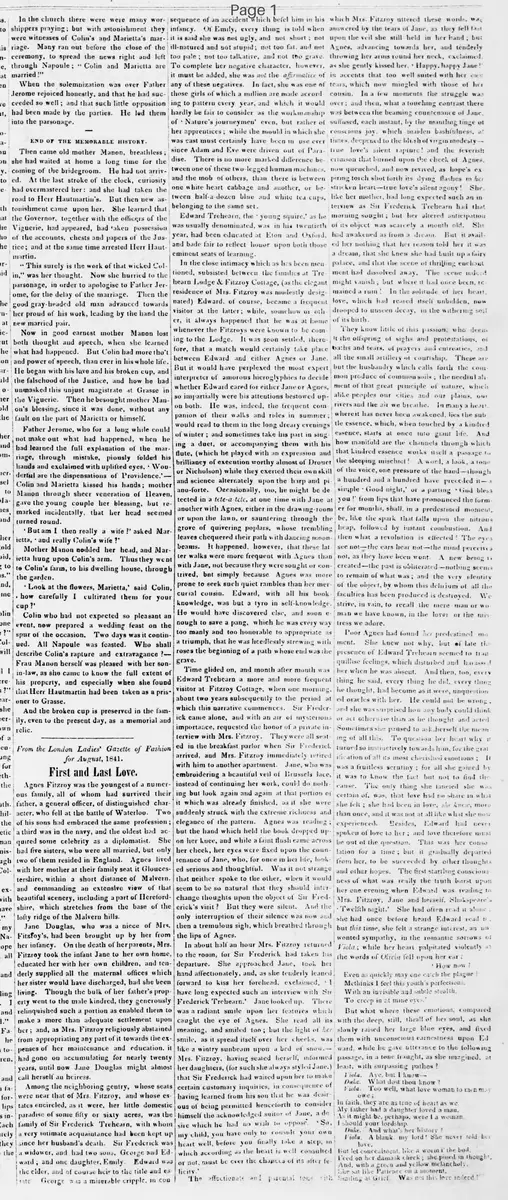
Agnes Fitzroy was the youngest of a numerous family, all of whom had survived their father, a general officer, of distinguished character, who fell at the battle of Waterloo. Two of his sons had embraced the same profession; a third was in the navy, and the oldest had acquired some celebrity as a diplomatist. She had five sisters, who were all married, but only two of them resided in England. Agnes lived with her mother at their family seat in Gloucestershire, within a short distance of Malvern, and commanding an extensive view of that beautiful scenery, including a part of Herefordshire, which stretches from the base of the lofty ridge of the Malvern hills.
Jane Douglas, who was a niece of Mrs. Fitzroy's, had been brought up by her from her infancy. On the death of her parents, Mrs. Fitzroy took the infant Jane to her own home, educated her with her own children, and tenderly supplied all the maternal offices which her sister would have discharged, had she been living. Though the bulk of her father's property went to the male kindred, they generously relinquished such a portion as enabled them to make a more than adequate settlement upon her; and, as Mrs. Fitzroy religiously abstained from appropriating any part of it towards the expenses of her maintenance and education, it had gone on accumulating for nearly twenty years, until now Jane Douglas might almost call herself an heiress.
Among the neighboring gentry, whose seats were near that of Mrs. Fitzroy, and whose estates encircled, as it were, her little domestic paradise of some fifty or sixty acres, was the family of Sir Frederick Trehearn, with whom a very intimate acquaintance had been kept up since her husband's death. Sir Frederick was a widower, and had two sons, George and Edward: and one daughter, Emily, Edward was the elder, and of course heir to the title and estate.
George was a miserable cripple, in consequence of an accident which befell him in his infancy. Of Emily, every thing is told when it is said she was not ugly, and not short; not ill-natured and not stupid; not too fat, and not too pale; not too talkative, and not too grave. To complete her negative character, however, it must be added, she was not the affirmative of any of these negatives. In fact, she was one of those girls of which a million are made according to pattern every year, and which it would hardly be fair to consider as the workmanship of 'Nature's journeymen' even, but rather of her apprentices; while the mould in which she was cast must certainly have been in use ever since Adam and Eve were driven out of Paradise. There is no more marked difference between one of these two-legged human machines, and the job of others, than there is between one white heart cabbage and another, or between half-a-dozen blue and white tea cups, belonging to the same set.
Edward Trehearn, the 'young squire,' as he was usually denominated, was in his twentieth year, had been educated at Eton and Oxford, and bade fair to reflect honor upon both those eminent seats of learning.
In the close intimacy which, as has been mentioned, subsisted between the families at Trehearn Lodge & Fitzroy Cottage, (as the elegant residence of Mrs. Fitzroy was modestly designated) Edward, of course, became a frequent visitor at the latter; while, somehow or other, it always happened that he was at home whenever the Fitzroys were known to be coming to the Lodge. It was soon settled, therefore, that a match would certainly take place between Edward and either Agnes or Jane.
But it would have perplexed the most expert interpreter of amorous hieroglyphics to decide whether Edward cared for either Jane or Agnes, so impartially were his attentions bestowed upon both. He was, indeed, the frequent companion of their walks and rides in summer; would read to them in the long dreary evenings of winter; and sometimes take his part in singing a duet, or accompanying them with his flute, (which he played with an expression and brilliancy of execution worthy almost of Drouet or Nicholson) while they exerted their own skill and science alternately upon the harp and piano-forte.
Occasionally, too, he might be detected in a tete-a-tete, at one time with Jane at another with Agnes, either in the drawing-room or upon the lawn, or sauntering through the grove of quivering poplars, whose trembling leaves chequered their path with dancing moon-beams. It happened, however, that these latter walks were more frequent with Agnes than with Jane, not because they were sought or contrived, but simply because Agnes was more prone to seek such quiet rambles than her mercurial cousin. Edward, with all his book knowledge, was but a tyro in self-knowledge.
He would have discovered else, and soon enough to save a pang, which he was every way too manly and too honorable to appropriate as a triumph, that he was heedlessly strewing with roses the beginning of a path whose end was the grave.
Time glided on, and month after month was Edward Trehearn a more and more frequent visitor at Fitzroy Cottage, when one morning, about two years subsequently to the period at which this narrative commences. Sir Frederick came alone, and with an air of mysterious importance, requested the honor of a private interview with Mrs. Fitzroy. They were all seated in the breakfast parlor when Sir Frederick arrived, and Mrs. Fitzroy immediately retired with him to another apartment. Jane, who was embroidering a beautiful veil of Brussels lace, instead of continuing her work, could do nothing but look again and again at that portion of it which was already finished, as if she were suddenly struck with the extreme richness and elegance of the pattern. Agnes was reading: but the hand which held the book dropped upon her knee, and while a faint flush came across her cheek, her eyes were fixed upon the countenance of Jane, who, for once in her life, looked serious and thoughtful. Was it not strange that neither spoke to the other, when it would seem to be so natural that they should interchange thoughts upon the object of Sir Frederick's visit? But they were silent. And the only interruption of their silence was now and then a tremulous sigh, which breathed through the lips of Agnes.
In about half an hour Mrs. Fitzroy returned to the room, for Sir Frederick had taken his departure. She approached Jane, took her hand affectionately, and, as she tenderly leaned forward to kiss her forehead, exclaimed, "I have long expected such an interview with Sir Frederick Trehearn."
Jane looked up. There was a radiant smile upon her features which caught the eye of Agnes. She read all its meaning, and smiled too; but the light of her smile, as it spread itself over her cheeks, was like a wintry sunbeam upon a bed of snow.
Mrs. Fitzroy, having seated herself, informed her daughters, (for such she always styled Jane.) that Sir Frederick had waited upon her to make certain customary inquiries, in consequence of having learned from his son that he was desirous of being permitted henceforth to consider himself the acknowledged suitor of Jane, a desire which he had no wish to oppose. So, my child, you have only to consult your own heart well, before you finally take a step, in which according as the heart is well consulted or not, must be ever the chances of its after felicity.
The affectionate and parental tone in which Mrs. Fitzroy uttered these words, was answered by the tears of Jane, as they fell fast upon the veil she still held in her hand: but Agnes, advancing towards her, and tenderly throwing her arms round her neck, exclaimed as she gently kissed her, "Happy, happy Jane!" in accents that too well suited with her own tears, which now mingled with those of her cousin. In a few moments the struggle was over; and then, what a touching contrast there was between the beaming countenance of Jane, suffused, each instant, by the mantling tinge of conscious joy, which maiden bashfulness, at times, deepened to the blush of virgin modesty—true love's silent rapture! and the feverish crimson that burned upon the cheek of Agnes, now quenched, and now revived, as hope's expiring torch shot forth its dying flashes in her stricken heart—true love's silent agony! She, like her mother, had long expected such an interview as Sir Frederick Trehearn had that morning sought; but her altered anticipation of its object was scarcely a month old. She had awakened as from a dream. But it availed her nothing that her reason told her it was a dream, that she knew she had built up a fairy palace, and that the scene of thrilling enchantment had dissolved away. The scene indeed might vanish, but where it had once been, there remained a ruin. In the solitude of her heart, love, which had reared itself unbidden, now drooped to unseen decay, in the withering seal of its birth.
They know little of this passion, who deem it the offspring of sighs and protestations, of oaths and tears, of prayers and entreaties, and all the small artillery of courtship. These are but the husbandry which calls forth the common produce of common soils; the needful aliment of that great principle of nature, which alike peoples our cities and our plains, our rivers and the air we breathe. In many a heart where it has never been awakened, lies the subtle essence, which, when touched by a kindred essence, starts at once into giant life. And how manifold are the channels through which that kindred essence works itself a passage to the sleeping mischief! A word, a look, a tone of the voice, one pressure of the hand—though a hundred and a hundred have preceded it—simple 'Good night,' or a parting 'God bless you!' from lips that have pronounced the formula for months, shall, in a predestined moment, be, like the spark that falls upon the nitrous heap, followed by instant combustion. And then what a revolution is effected! The eyes see not—the ears hear not—the mind perceives not, as they have been wont. A new being is created—the past is obliterated—nothing seems to remain of what was; and the very identity of the object, by whom thus delirium of all the faculties has been produced is destroyed. We strive, in vain, to recall the mere man or woman we have known, in the deity or the mistress we adore.
Poor Agnes had found her predestined moment. She knew not why, but of late the presence of Edward Trehearn seemed to tranquillize feelings, which disturbed and harassed her when he was absent. And then, too, every thing he said, every thing he did, every thing he thought, had become as it were, unquestioned oracles with her. He could not be wrong, and she was surprised how anybody could think or act otherwise than as he thought and acted.
Sometimes she paused to ask herself the meaning of all this. To question her heart why it turned so instinctively towards him, for the gratification of all its most cherished emotions: it was a fruitless scrutiny; for all she gained by it was to know the fact but not to find the cause. The only thing she wanted she was certain of, was, that love had no share in what she felt; she had been in love, she knew, more than once, and it was not at all like what she now experienced. Besides, Edward had never spoken of love to her; and love therefore must be out of the question. This was her consolation for a time; but it gradually departed from her, to be succeeded by other thoughts and other hopes. The first startling consciousness of what was really the truth burst upon her one evening when Edward was reading to Mrs. Fitzroy, Jane and herself, Shakspeare's 'Twelfth night.' She had often read it alone. she had once before heard Edward read it. but this time, she felt a strange interest, an unwonted sympathy, in the romantic sorrows of Viola; while her heart palpitated violently as the words of Olivia fell upon her ear:
How now?
Even as quickly may one catch the plague
Methinks I feel this youth's perfections,
With an invisible and subtle stealth
To creep in at mine eyes.
But what were these emotions, compared with the deep, still, thrill of her soul, as she slowly raised her large blue eyes, and fixed them with unconscious earnestness upon Edward, while he gave utterance to the following passage, in a tone fraught, as she imagined, at least, with surpassing pathos?
Viola. Ay, but I know—
Duke. What dost thou know?
Viola. Too well what love women to men may owe;
In faith, they are as true of heart as we.
My father had a daughter loved a man,
As it might be, perhaps, were I a woman,
I should your lordship.
Duke. "And what's her history?"
Viola. A blank, my lord. She never told her love,
But let concealment, like a worm i' the bud,
Feed on her damask cheek; she pined in thought.
And, with a green and yellow melancholy,
She sat like Patience on a monument,
Laughing at grief.
The sigh that burst from the lips of Agnes, as her eyes dropped and she resumed the fancy work she was about, responded with mournful eloquence to the thrilling question. It was little more than a month after this evening that Sir Frederic Trehearn called upon Mrs. Fitzroy, and within the same period Agnes had fatally discovered that which caused his visit. No preparation can completely arm us against the shock of an anticipated blow when it really comes; and hence the brief struggle with herself which has been described. But that brief struggle was all. Agnes was too proud to confess a sorrow of her own creating. She could not stoop to acknowledge she had nourished not merely an unrequited, but an unsought, an undesired passion; and she was too noble-minded to disturb the happiness of one she so loved by the selfish obtrusion of her own wretchedness.
The bridal-morn came, and Agnes descended from her chamber a bride's-maid! She would have it so, in spite of all the fond entreaties of her mother to the contrary. And why were those fond entreaties urged? Alas! the grief that speaks not—that weeps not—that will not complain, but dwells in silence in the heart, is the grief which consumes the heart. The health of Agnes had gradually declined; and though she strove to conceal as well the symptoms as the cause of her increasing debility, she could not allay the anxious fears of her mother, as her wan face, painted with the hectic glow of a wasting fever, told
'How painful disappointment's cankered fang.
Withered the rose upon her maiden cheek.'
Mrs. Fitzroy had watched these symptoms with uneasiness, but without any serious apprehensions, till the rapid strides they latterly made inspired her with alarming thoughts of the danger they portended. In fact, there was but too much reason to dread that Agnes was becoming consumptive, if she were not so already. The languid glare of her full blue eyes, to which a frightful prominence was given from the hollowness produced by the wasting of the flesh round these orbits—the quick breathing, and the panting cough, brought on by the slightest motion—the wayward appetite, that now loathed, and now craved for food—and the laboring respiration, as well as the flushed face which followed every meal, together with the emaciated appearance of her whole frame, were tearful indications of the existence of that hopeless, though deceitful malady. Medical aid had been called in, but the most skilful remedies had failed to arrest its progress. Yet there were some days when a treacherous hope of amendment was held out, to be followed only by a more severe and searching relapse. It was in this delicate and dangerous crisis of her health, that the appointed wedding-day arrived: and hence it was, that both Mrs. Fitzroy and Jane earnestly dissuaded her from encountering the fatigue and excitement of the ceremony. But no! it was her wish, her prayer almost, that she should attend, and that she should be her cousin's only bride's maid. And she did so: and she was her only bride's maid: and she stood, like one entranced, before the altar: and when the ring was on the finger of Jane, she smiled, and in a whispered exclamation to her own breaking heart, she said, 'I have done well! I have triumphed over myself! I have calmly witnessed the consummation of a felicity which should have been my own; and now I may depart, and bury my secret with me.'—Jane was a happy bride, but Agnes felt that she was a happier bride's maid—for her last and hardest trial was over, save one, and that she prayed for as the end of all. Her prayer was heard. The moon, whose silver crescent rose pale and bright in the evening of that day which saw the nuptials of Jane Douglas, shed its waning beams upon the grave of Agnes Fitzroy! On the eleventh morning she died: but death stole over her so gently, that she was as one who sunk to sleep only in his grim embrace. And as she seemed to fall asleep, her finger dropped upon the melancholy but faithful picture of her own sad fate drawn with prophetic fidelity by one who, like herself, had bowed his head to the worm that preyed upon her youthful bloom.'
A volume of 'Kirk White's Poems' was in her hand: she had been reading his 'Fragment of an Eccentric Drama,' and the book lay open before her, where the Goddess of Consumption is supposed to speak. It was probably the last object upon which the dying eyes of Agnes had rested!
Reader! If I have shown you a picture of first love, which your heart recognises, you will know that such love is first and last.
First and Last Love.
Agnes Fitzroy was the youngest of a numerous family, all of whom had survived their father, a general officer, of distinguished character, who fell at the battle of Waterloo. Two of his sons had embraced the same profession; a third was in the navy, and the oldest had acquired some celebrity as a diplomatist. She had five sisters, who were all married, but only two of them resided in England. Agnes lived with her mother at their family seat in Gloucestershire, within a short distance of Malvern, and commanding an extensive view of that beautiful scenery, including a part of Herefordshire, which stretches from the base of the lofty ridge of the Malvern hills.
Jane Douglas, who was a niece of Mrs. Fitzroy's, had been brought up by her from her infancy. On the death of her parents, Mrs. Fitzroy took the infant Jane to her own home, educated her with her own children, and tenderly supplied all the maternal offices which her sister would have discharged, had she been living. Though the bulk of her father's property went to the male kindred, they generously relinquished such a portion as enabled them to make a more than adequate settlement upon her; and, as Mrs. Fitzroy religiously abstained from appropriating any part of it towards the expenses of her maintenance and education, it had gone on accumulating for nearly twenty years, until now Jane Douglas might almost call herself an heiress.
Among the neighboring gentry, whose seats were near that of Mrs. Fitzroy, and whose estates encircled, as it were, her little domestic paradise of some fifty or sixty acres, was the family of Sir Frederick Trehearn, with whom a very intimate acquaintance had been kept up since her husband's death. Sir Frederick was a widower, and had two sons, George and Edward: and one daughter, Emily, Edward was the elder, and of course heir to the title and estate.
George was a miserable cripple, in consequence of an accident which befell him in his infancy. Of Emily, every thing is told when it is said she was not ugly, and not short; not ill-natured and not stupid; not too fat, and not too pale; not too talkative, and not too grave. To complete her negative character, however, it must be added, she was not the affirmative of any of these negatives. In fact, she was one of those girls of which a million are made according to pattern every year, and which it would hardly be fair to consider as the workmanship of 'Nature's journeymen' even, but rather of her apprentices; while the mould in which she was cast must certainly have been in use ever since Adam and Eve were driven out of Paradise. There is no more marked difference between one of these two-legged human machines, and the job of others, than there is between one white heart cabbage and another, or between half-a-dozen blue and white tea cups, belonging to the same set.
Edward Trehearn, the 'young squire,' as he was usually denominated, was in his twentieth year, had been educated at Eton and Oxford, and bade fair to reflect honor upon both those eminent seats of learning.
In the close intimacy which, as has been mentioned, subsisted between the families at Trehearn Lodge & Fitzroy Cottage, (as the elegant residence of Mrs. Fitzroy was modestly designated) Edward, of course, became a frequent visitor at the latter; while, somehow or other, it always happened that he was at home whenever the Fitzroys were known to be coming to the Lodge. It was soon settled, therefore, that a match would certainly take place between Edward and either Agnes or Jane.
But it would have perplexed the most expert interpreter of amorous hieroglyphics to decide whether Edward cared for either Jane or Agnes, so impartially were his attentions bestowed upon both. He was, indeed, the frequent companion of their walks and rides in summer; would read to them in the long dreary evenings of winter; and sometimes take his part in singing a duet, or accompanying them with his flute, (which he played with an expression and brilliancy of execution worthy almost of Drouet or Nicholson) while they exerted their own skill and science alternately upon the harp and piano-forte.
Occasionally, too, he might be detected in a tete-a-tete, at one time with Jane at another with Agnes, either in the drawing-room or upon the lawn, or sauntering through the grove of quivering poplars, whose trembling leaves chequered their path with dancing moon-beams. It happened, however, that these latter walks were more frequent with Agnes than with Jane, not because they were sought or contrived, but simply because Agnes was more prone to seek such quiet rambles than her mercurial cousin. Edward, with all his book knowledge, was but a tyro in self-knowledge.
He would have discovered else, and soon enough to save a pang, which he was every way too manly and too honorable to appropriate as a triumph, that he was heedlessly strewing with roses the beginning of a path whose end was the grave.
Time glided on, and month after month was Edward Trehearn a more and more frequent visitor at Fitzroy Cottage, when one morning, about two years subsequently to the period at which this narrative commences. Sir Frederick came alone, and with an air of mysterious importance, requested the honor of a private interview with Mrs. Fitzroy. They were all seated in the breakfast parlor when Sir Frederick arrived, and Mrs. Fitzroy immediately retired with him to another apartment. Jane, who was embroidering a beautiful veil of Brussels lace, instead of continuing her work, could do nothing but look again and again at that portion of it which was already finished, as if she were suddenly struck with the extreme richness and elegance of the pattern. Agnes was reading: but the hand which held the book dropped upon her knee, and while a faint flush came across her cheek, her eyes were fixed upon the countenance of Jane, who, for once in her life, looked serious and thoughtful. Was it not strange that neither spoke to the other, when it would seem to be so natural that they should interchange thoughts upon the object of Sir Frederick's visit? But they were silent. And the only interruption of their silence was now and then a tremulous sigh, which breathed through the lips of Agnes.
In about half an hour Mrs. Fitzroy returned to the room, for Sir Frederick had taken his departure. She approached Jane, took her hand affectionately, and, as she tenderly leaned forward to kiss her forehead, exclaimed, "I have long expected such an interview with Sir Frederick Trehearn."
Jane looked up. There was a radiant smile upon her features which caught the eye of Agnes. She read all its meaning, and smiled too; but the light of her smile, as it spread itself over her cheeks, was like a wintry sunbeam upon a bed of snow.
Mrs. Fitzroy, having seated herself, informed her daughters, (for such she always styled Jane.) that Sir Frederick had waited upon her to make certain customary inquiries, in consequence of having learned from his son that he was desirous of being permitted henceforth to consider himself the acknowledged suitor of Jane, a desire which he had no wish to oppose. So, my child, you have only to consult your own heart well, before you finally take a step, in which according as the heart is well consulted or not, must be ever the chances of its after felicity.
The affectionate and parental tone in which Mrs. Fitzroy uttered these words, was answered by the tears of Jane, as they fell fast upon the veil she still held in her hand: but Agnes, advancing towards her, and tenderly throwing her arms round her neck, exclaimed as she gently kissed her, "Happy, happy Jane!" in accents that too well suited with her own tears, which now mingled with those of her cousin. In a few moments the struggle was over; and then, what a touching contrast there was between the beaming countenance of Jane, suffused, each instant, by the mantling tinge of conscious joy, which maiden bashfulness, at times, deepened to the blush of virgin modesty—true love's silent rapture! and the feverish crimson that burned upon the cheek of Agnes, now quenched, and now revived, as hope's expiring torch shot forth its dying flashes in her stricken heart—true love's silent agony! She, like her mother, had long expected such an interview as Sir Frederick Trehearn had that morning sought; but her altered anticipation of its object was scarcely a month old. She had awakened as from a dream. But it availed her nothing that her reason told her it was a dream, that she knew she had built up a fairy palace, and that the scene of thrilling enchantment had dissolved away. The scene indeed might vanish, but where it had once been, there remained a ruin. In the solitude of her heart, love, which had reared itself unbidden, now drooped to unseen decay, in the withering seal of its birth.
They know little of this passion, who deem it the offspring of sighs and protestations, of oaths and tears, of prayers and entreaties, and all the small artillery of courtship. These are but the husbandry which calls forth the common produce of common soils; the needful aliment of that great principle of nature, which alike peoples our cities and our plains, our rivers and the air we breathe. In many a heart where it has never been awakened, lies the subtle essence, which, when touched by a kindred essence, starts at once into giant life. And how manifold are the channels through which that kindred essence works itself a passage to the sleeping mischief! A word, a look, a tone of the voice, one pressure of the hand—though a hundred and a hundred have preceded it—simple 'Good night,' or a parting 'God bless you!' from lips that have pronounced the formula for months, shall, in a predestined moment, be, like the spark that falls upon the nitrous heap, followed by instant combustion. And then what a revolution is effected! The eyes see not—the ears hear not—the mind perceives not, as they have been wont. A new being is created—the past is obliterated—nothing seems to remain of what was; and the very identity of the object, by whom thus delirium of all the faculties has been produced is destroyed. We strive, in vain, to recall the mere man or woman we have known, in the deity or the mistress we adore.
Poor Agnes had found her predestined moment. She knew not why, but of late the presence of Edward Trehearn seemed to tranquillize feelings, which disturbed and harassed her when he was absent. And then, too, every thing he said, every thing he did, every thing he thought, had become as it were, unquestioned oracles with her. He could not be wrong, and she was surprised how anybody could think or act otherwise than as he thought and acted.
Sometimes she paused to ask herself the meaning of all this. To question her heart why it turned so instinctively towards him, for the gratification of all its most cherished emotions: it was a fruitless scrutiny; for all she gained by it was to know the fact but not to find the cause. The only thing she wanted she was certain of, was, that love had no share in what she felt; she had been in love, she knew, more than once, and it was not at all like what she now experienced. Besides, Edward had never spoken of love to her; and love therefore must be out of the question. This was her consolation for a time; but it gradually departed from her, to be succeeded by other thoughts and other hopes. The first startling consciousness of what was really the truth burst upon her one evening when Edward was reading to Mrs. Fitzroy, Jane and herself, Shakspeare's 'Twelfth night.' She had often read it alone. she had once before heard Edward read it. but this time, she felt a strange interest, an unwonted sympathy, in the romantic sorrows of Viola; while her heart palpitated violently as the words of Olivia fell upon her ear:
How now?
Even as quickly may one catch the plague
Methinks I feel this youth's perfections,
With an invisible and subtle stealth
To creep in at mine eyes.
But what were these emotions, compared with the deep, still, thrill of her soul, as she slowly raised her large blue eyes, and fixed them with unconscious earnestness upon Edward, while he gave utterance to the following passage, in a tone fraught, as she imagined, at least, with surpassing pathos?
Viola. Ay, but I know—
Duke. What dost thou know?
Viola. Too well what love women to men may owe;
In faith, they are as true of heart as we.
My father had a daughter loved a man,
As it might be, perhaps, were I a woman,
I should your lordship.
Duke. "And what's her history?"
Viola. A blank, my lord. She never told her love,
But let concealment, like a worm i' the bud,
Feed on her damask cheek; she pined in thought.
And, with a green and yellow melancholy,
She sat like Patience on a monument,
Laughing at grief.
The sigh that burst from the lips of Agnes, as her eyes dropped and she resumed the fancy work she was about, responded with mournful eloquence to the thrilling question. It was little more than a month after this evening that Sir Frederic Trehearn called upon Mrs. Fitzroy, and within the same period Agnes had fatally discovered that which caused his visit. No preparation can completely arm us against the shock of an anticipated blow when it really comes; and hence the brief struggle with herself which has been described. But that brief struggle was all. Agnes was too proud to confess a sorrow of her own creating. She could not stoop to acknowledge she had nourished not merely an unrequited, but an unsought, an undesired passion; and she was too noble-minded to disturb the happiness of one she so loved by the selfish obtrusion of her own wretchedness.
The bridal-morn came, and Agnes descended from her chamber a bride's-maid! She would have it so, in spite of all the fond entreaties of her mother to the contrary. And why were those fond entreaties urged? Alas! the grief that speaks not—that weeps not—that will not complain, but dwells in silence in the heart, is the grief which consumes the heart. The health of Agnes had gradually declined; and though she strove to conceal as well the symptoms as the cause of her increasing debility, she could not allay the anxious fears of her mother, as her wan face, painted with the hectic glow of a wasting fever, told
'How painful disappointment's cankered fang.
Withered the rose upon her maiden cheek.'
Mrs. Fitzroy had watched these symptoms with uneasiness, but without any serious apprehensions, till the rapid strides they latterly made inspired her with alarming thoughts of the danger they portended. In fact, there was but too much reason to dread that Agnes was becoming consumptive, if she were not so already. The languid glare of her full blue eyes, to which a frightful prominence was given from the hollowness produced by the wasting of the flesh round these orbits—the quick breathing, and the panting cough, brought on by the slightest motion—the wayward appetite, that now loathed, and now craved for food—and the laboring respiration, as well as the flushed face which followed every meal, together with the emaciated appearance of her whole frame, were tearful indications of the existence of that hopeless, though deceitful malady. Medical aid had been called in, but the most skilful remedies had failed to arrest its progress. Yet there were some days when a treacherous hope of amendment was held out, to be followed only by a more severe and searching relapse. It was in this delicate and dangerous crisis of her health, that the appointed wedding-day arrived: and hence it was, that both Mrs. Fitzroy and Jane earnestly dissuaded her from encountering the fatigue and excitement of the ceremony. But no! it was her wish, her prayer almost, that she should attend, and that she should be her cousin's only bride's maid. And she did so: and she was her only bride's maid: and she stood, like one entranced, before the altar: and when the ring was on the finger of Jane, she smiled, and in a whispered exclamation to her own breaking heart, she said, 'I have done well! I have triumphed over myself! I have calmly witnessed the consummation of a felicity which should have been my own; and now I may depart, and bury my secret with me.'—Jane was a happy bride, but Agnes felt that she was a happier bride's maid—for her last and hardest trial was over, save one, and that she prayed for as the end of all. Her prayer was heard. The moon, whose silver crescent rose pale and bright in the evening of that day which saw the nuptials of Jane Douglas, shed its waning beams upon the grave of Agnes Fitzroy! On the eleventh morning she died: but death stole over her so gently, that she was as one who sunk to sleep only in his grim embrace. And as she seemed to fall asleep, her finger dropped upon the melancholy but faithful picture of her own sad fate drawn with prophetic fidelity by one who, like herself, had bowed his head to the worm that preyed upon her youthful bloom.'
A volume of 'Kirk White's Poems' was in her hand: she had been reading his 'Fragment of an Eccentric Drama,' and the book lay open before her, where the Goddess of Consumption is supposed to speak. It was probably the last object upon which the dying eyes of Agnes had rested!
Reader! If I have shown you a picture of first love, which your heart recognises, you will know that such love is first and last.
What sub-type of article is it?
Prose Fiction
What themes does it cover?
Love Romance
Death Mortality
What keywords are associated?
Unrequited Love
First Love
Consumption
Marriage
Heartbreak
Literary Details
Title
First And Last Love
Key Lines
She, Like Her Mother, Had Long Expected Such An Interview As Sir Frederick Trehearn Had That Morning Sought; But Her Altered Anticipation Of Its Object Was Scarcely A Month Old. She Had Awakened As From A Dream.
They Know Little Of This Passion, Who Deem It The Offspring Of Sighs And Protestations, Of Oaths And Tears, Of Prayers And Entreaties, And All The Small Artillery Of Courtship.
Viola. A Blank, My Lord. She Never Told Her Love, But Let Concealment, Like A Worm I' The Bud, Feed On Her Damask Cheek; She Pined In Thought. And, With A Green And Yellow Melancholy, She Sat Like Patience On A Monument, Laughing At Grief.
The Bridal Morn Came, And Agnes Descended From Her Chamber A Bride's Maid!
Reader! If I Have Shown You A Picture Of First Love, Which Your Heart Recognises, You Will Know That Such Love Is First And Last.