Thank you for visiting SNEWPapers!
Sign up free
Story
June 5, 1925
El Dorado Daily News
El Dorado, Union County, Arkansas
What is this article about?
Washington columnist Charles P. Stewart asserts that President Coolidge will seek re-election in 1928 if popular, dismissing two-term precedent concerns due to his partial first term. He notes Coolidge's signals through spokesmen and contrasts with Roosevelt and Taft's situations.
Clipping
OCR Quality
95%
Excellent
Full Text
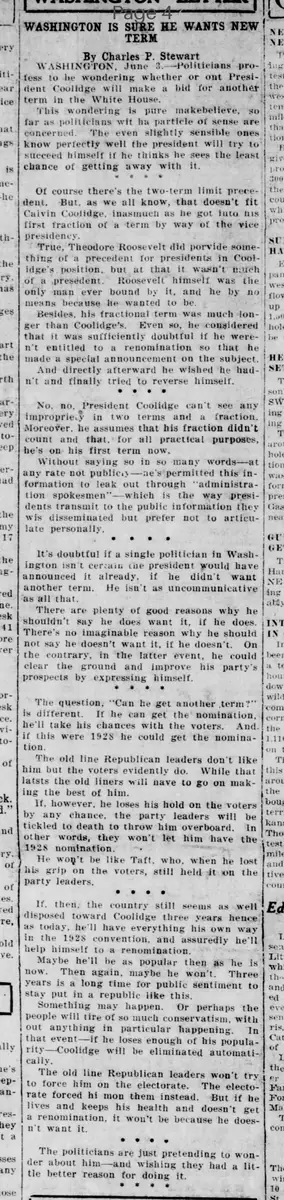
WASHINGTON IS SURE HE WANTS NEW TERM
By Charles P. Stewart
WASHINGTON, June 3.-Politicians profess to be wondering whether or not President Coolidge will make a bid for another term in the White House.
This wondering is pure makebelieve, so far as politicians with a particle of sense are concerned. The even slightly sensible ones know perfectly well the president will try to succeed himself if he thinks he sees the least chance of getting away with it.
Of course there's the two-term limit precedent. But, as we all know, that doesn't fit Calvin Coolidge, inasmuch as he got into his first fraction of a term by way of the vice presidency.
True, Theodore Roosevelt did provide something of a precedent for presidents in Coolidge's position, but at that it wasn't much of a precedent. Roosevelt himself was the only man ever bound by it, and he by no means because he wanted to be.
Besides, his fractional term was much longer than Coolidge's. Even so, he considered that it was sufficiently doubtful if he weren't entitled to a renomination so that he made a special announcement on the subject.
And directly afterward he wished he hadn't and finally tried to reverse himself.
No, no. President Coolidge can't see any impropriety in two terms and a fraction.
Moreover, he assumes that his fraction didn't count and that, for all practical purposes, he's on his first term now.
Without saying so in so many words--at any rate not publicly--he's permitted this information to leak out through "administration spokesmen"--which is the way presidents transmit to the public information they wish disseminated but prefer not to articulate personally.
It's doubtful if a single politician in Washington isn't certain the president would have announced it already, if he didn't want another term. He isn't as uncommunicative as all that.
There are plenty of good reasons why he shouldn't say he does want it, if he does.
There's no imaginable reason why he should not say he doesn't want it, if he doesn't. On the contrary, in the latter event, he could clear the ground and improve his party's prospects by expressing himself.
The question, "Can he get another term?" is different. If he can get the nomination, he'll take his chances with the voters. And, if this were 1924 he could get the nomination.
The old line Republican leaders don't like him but the voters evidently do. While that lasts the old liners will have to go on making the best of him.
If, however, he loses his hold on the voters by any chance, the party leaders will be tickled to death to throw him overboard. In other words, they won't let him have the 1928 nomination.
He won't be like Taft, who, when he lost his grip on the voters, still held it on the party leaders.
If, then, the country still seems as well disposed toward Coolidge three years hence as today, he'll have everything his own way in the 1928 convention, and assuredly he'll help himself to a renomination.
Maybe he'll be as popular then as he is now. Then again, maybe he won't. Three years is a long time for public sentiment to stay put in a republic like this.
Something may happen. Or perhaps the people will tire of so much conservatism, without anything in particular happening. In that event if he loses enough of his popularity--Coolidge will be eliminated automatically.
The old line Republican leaders won't try to force him on the electorate. The electorate forced him on them instead. But if he lives and keeps his health and doesn't get a renomination, it won't be because he doesn't want it.
The politicians are just pretending to wonder about him--and wishing they had a little better reason for doing it.
By Charles P. Stewart
WASHINGTON, June 3.-Politicians profess to be wondering whether or not President Coolidge will make a bid for another term in the White House.
This wondering is pure makebelieve, so far as politicians with a particle of sense are concerned. The even slightly sensible ones know perfectly well the president will try to succeed himself if he thinks he sees the least chance of getting away with it.
Of course there's the two-term limit precedent. But, as we all know, that doesn't fit Calvin Coolidge, inasmuch as he got into his first fraction of a term by way of the vice presidency.
True, Theodore Roosevelt did provide something of a precedent for presidents in Coolidge's position, but at that it wasn't much of a precedent. Roosevelt himself was the only man ever bound by it, and he by no means because he wanted to be.
Besides, his fractional term was much longer than Coolidge's. Even so, he considered that it was sufficiently doubtful if he weren't entitled to a renomination so that he made a special announcement on the subject.
And directly afterward he wished he hadn't and finally tried to reverse himself.
No, no. President Coolidge can't see any impropriety in two terms and a fraction.
Moreover, he assumes that his fraction didn't count and that, for all practical purposes, he's on his first term now.
Without saying so in so many words--at any rate not publicly--he's permitted this information to leak out through "administration spokesmen"--which is the way presidents transmit to the public information they wish disseminated but prefer not to articulate personally.
It's doubtful if a single politician in Washington isn't certain the president would have announced it already, if he didn't want another term. He isn't as uncommunicative as all that.
There are plenty of good reasons why he shouldn't say he does want it, if he does.
There's no imaginable reason why he should not say he doesn't want it, if he doesn't. On the contrary, in the latter event, he could clear the ground and improve his party's prospects by expressing himself.
The question, "Can he get another term?" is different. If he can get the nomination, he'll take his chances with the voters. And, if this were 1924 he could get the nomination.
The old line Republican leaders don't like him but the voters evidently do. While that lasts the old liners will have to go on making the best of him.
If, however, he loses his hold on the voters by any chance, the party leaders will be tickled to death to throw him overboard. In other words, they won't let him have the 1928 nomination.
He won't be like Taft, who, when he lost his grip on the voters, still held it on the party leaders.
If, then, the country still seems as well disposed toward Coolidge three years hence as today, he'll have everything his own way in the 1928 convention, and assuredly he'll help himself to a renomination.
Maybe he'll be as popular then as he is now. Then again, maybe he won't. Three years is a long time for public sentiment to stay put in a republic like this.
Something may happen. Or perhaps the people will tire of so much conservatism, without anything in particular happening. In that event if he loses enough of his popularity--Coolidge will be eliminated automatically.
The old line Republican leaders won't try to force him on the electorate. The electorate forced him on them instead. But if he lives and keeps his health and doesn't get a renomination, it won't be because he doesn't want it.
The politicians are just pretending to wonder about him--and wishing they had a little better reason for doing it.
What sub-type of article is it?
Biography
Historical Event
What themes does it cover?
Fortune Reversal
Triumph
What keywords are associated?
Coolidge Renomination
Two Term Precedent
Republican Politics
Voter Popularity
1928 Election
What entities or persons were involved?
President Coolidge
Theodore Roosevelt
Taft
Charles P. Stewart
Where did it happen?
Washington
Story Details
Key Persons
President Coolidge
Theodore Roosevelt
Taft
Charles P. Stewart
Location
Washington
Event Date
June 3, 1924
Story Details
Columnist speculates Coolidge seeks 1928 renomination, viewing his partial term as not counting toward two-term limit, signaled via spokesmen; success depends on sustained voter popularity against party leaders' opposition.