Thank you for visiting SNEWPapers!
Sign up free
Story
November 8, 1856
Republican Vindicator
Staunton, Virginia
What is this article about?
Reflective essay on the symbolism of black crape mourning bands with white ribbons, signifying child deaths and evoking deep sympathy for bereaved parents' profound loss and shattered hopes.
Clipping
OCR Quality
98%
Excellent
Full Text
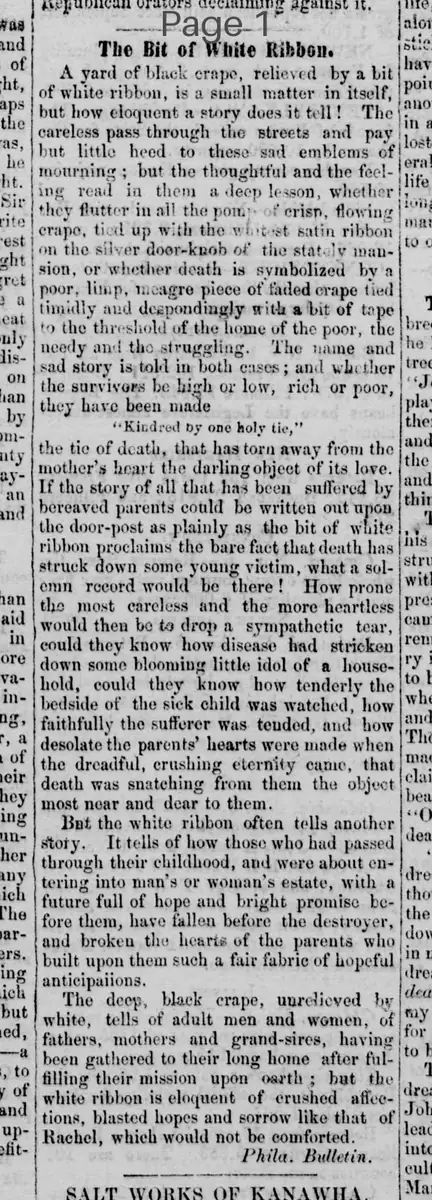
The Bit of White Ribbon.
A yard of black crape, relieved by a bit of white ribbon, is a small matter in itself, but how eloquent a story does it tell! The careless pass through the streets and pay but little heed to these sad emblems of mourning : but the thoughtful and the feeling read in them a deep lesson, whether they flutter in all the pomp of crisp, flowing crape, tied up with the whitest satin ribbon on the silver door-knob of the stately mansion, or whether death is symbolized by a poor, limp, meagre piece of faded crape tied timidly and despondingly with a bit of tape to the threshold of the home of the poor, the needy and the struggling. The name and sad story is told in both cases; and whether the survivors be high or low, rich or poor, they have been made
"Kindred by one holy tie,"
the tie of death, that has torn away from the mother's heart the darling object of its love. If the story of all that has been suffered by bereaved parents could be written out upon the door-post as plainly as the bit of white ribbon proclaims the bare fact that death has struck down some young victim, what a solemn record would be there! How prone the most careless and the more heartless would then be to drop a sympathetic tear, could they know how disease had stricken down some blooming little idol of a household, could they know how tenderly the bedside of the sick child was watched, how faithfully the sufferer was tended, and how desolate the parents' hearts were made when the dreadful, crushing reality came, that death was snatching from them the object most near and dear to them.
But the white ribbon often tells another story. It tells of how those who had passed through their childhood, and were about entering into man's or woman's estate, with a future full of hope and bright promise before them, have fallen before the destroyer, and broken the hearts of the parents who built upon them such a fair fabric of hopeful anticipations.
The deep, black crape, unrelieved by white, tells of adult men and women, of fathers, mothers and grand-sires, having been gathered to their long home after fulfilling their mission upon earth ; but the white ribbon is eloquent of crushed affections, blasted hopes and sorrow like that of Rachel, which would not be comforted.
Phila. Bulletin.
A yard of black crape, relieved by a bit of white ribbon, is a small matter in itself, but how eloquent a story does it tell! The careless pass through the streets and pay but little heed to these sad emblems of mourning : but the thoughtful and the feeling read in them a deep lesson, whether they flutter in all the pomp of crisp, flowing crape, tied up with the whitest satin ribbon on the silver door-knob of the stately mansion, or whether death is symbolized by a poor, limp, meagre piece of faded crape tied timidly and despondingly with a bit of tape to the threshold of the home of the poor, the needy and the struggling. The name and sad story is told in both cases; and whether the survivors be high or low, rich or poor, they have been made
"Kindred by one holy tie,"
the tie of death, that has torn away from the mother's heart the darling object of its love. If the story of all that has been suffered by bereaved parents could be written out upon the door-post as plainly as the bit of white ribbon proclaims the bare fact that death has struck down some young victim, what a solemn record would be there! How prone the most careless and the more heartless would then be to drop a sympathetic tear, could they know how disease had stricken down some blooming little idol of a household, could they know how tenderly the bedside of the sick child was watched, how faithfully the sufferer was tended, and how desolate the parents' hearts were made when the dreadful, crushing reality came, that death was snatching from them the object most near and dear to them.
But the white ribbon often tells another story. It tells of how those who had passed through their childhood, and were about entering into man's or woman's estate, with a future full of hope and bright promise before them, have fallen before the destroyer, and broken the hearts of the parents who built upon them such a fair fabric of hopeful anticipations.
The deep, black crape, unrelieved by white, tells of adult men and women, of fathers, mothers and grand-sires, having been gathered to their long home after fulfilling their mission upon earth ; but the white ribbon is eloquent of crushed affections, blasted hopes and sorrow like that of Rachel, which would not be comforted.
Phila. Bulletin.
What sub-type of article is it?
Curiosity
Tragedy
What themes does it cover?
Tragedy
Family
Misfortune
What keywords are associated?
Mourning Symbols
White Ribbon
Child Death
Bereavement
Parental Grief
Black Crape
Story Details
Story Details
Black crape with white ribbon symbolizes child death, conveying tales of parental grief, tender care during illness, and shattered hopes, contrasting with unrelieved crape for adult deaths.