Thank you for visiting SNEWPapers!
Sign up free
Tabor City Tribune
Tabor City, Columbus County, North Carolina
What is this article about?
Warning to farmers: 1947 farm income expected to fall 15% from 1946 due to rising costs and falling product prices. Urges economizing, efficiency, and adjustment to post-war normalcy amid risks of inefficiency, false prosperity, and debt pitfalls. (198 characters)
Clipping
OCR Quality
Full Text
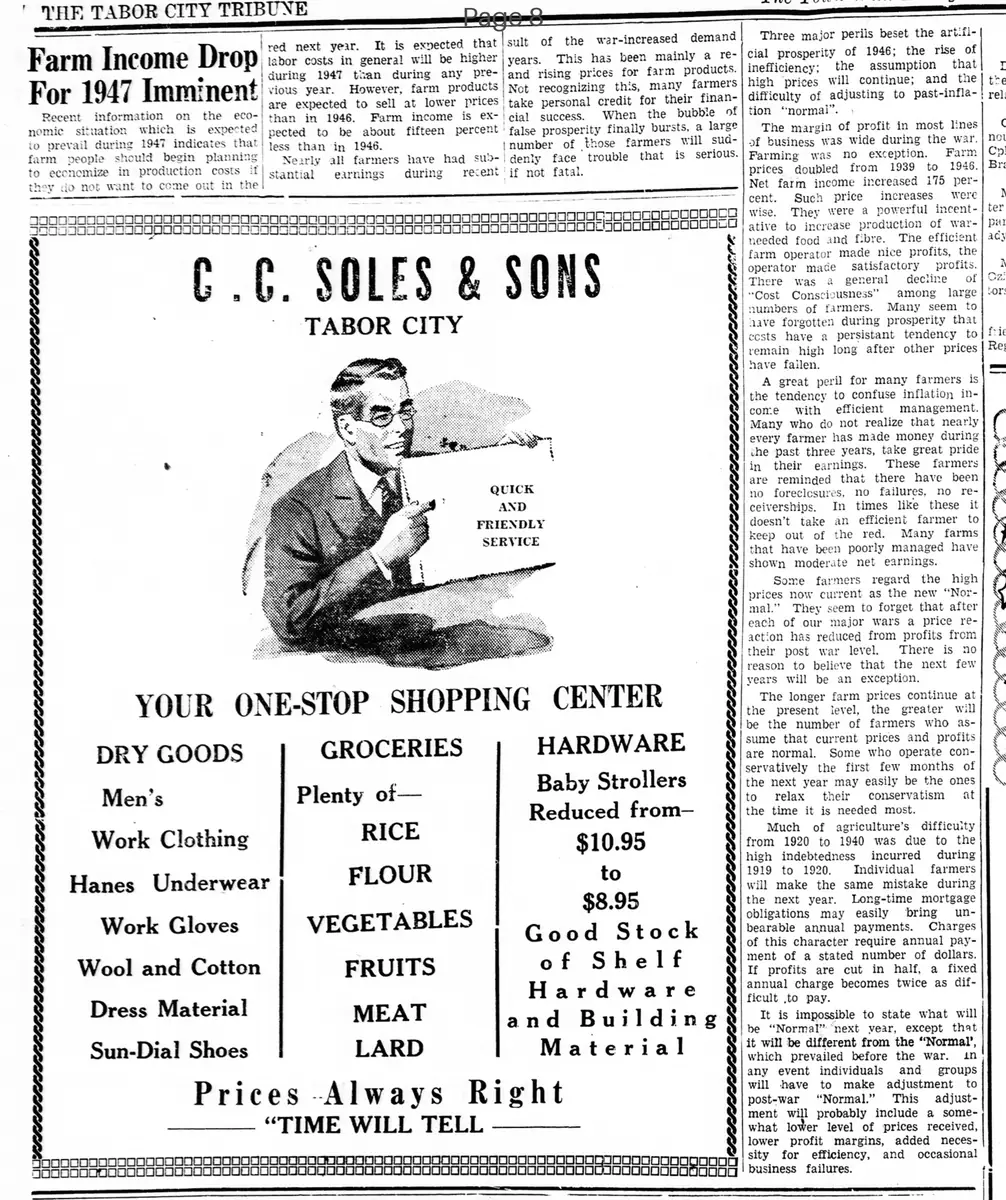
Recent information on the economic situation which is expected to prevail during 1947 indicates that farm people should begin planning to economize in production costs if they do not want to come out in the red next year. It is expected that labor costs in general will be higher during 1947 than during any previous year. However, farm products are expected to sell at lower prices than in 1946. Farm income is expected to be about fifteen percent less than in 1946.
Nearly all farmers have had substantial earnings during recent years. This has been mainly a result of the war-increased demand and rising prices for farm products. Not recognizing this, many farmers take personal credit for their financial success. When the bubble of false prosperity finally bursts, a large number of those farmers will suddenly face trouble that is serious, if not fatal.
Three major perils beset the artificial prosperity of 1946; the rise of inefficiency; the assumption that high prices will continue; and the difficulty of adjusting to post-inflation "normal".
The margin of profit in most lines of business was wide during the war. Farming was no exception. Farm prices doubled from 1939 to 1946. Net farm income increased 175 percent. Such price increases were wise. They were a powerful incentive to increase production of war-needed food and fibre. The efficient farm operator made nice profits, the average operator made satisfactory profits.
There was a general decline of "Cost Consciousness" among large numbers of farmers. Many seem to have forgotten during prosperity that costs have a persistent tendency to remain high long after other prices have fallen.
A great peril for many farmers is the tendency to confuse inflation income with efficient management. Many who do not realize that nearly every farmer has made money during the past three years, take great pride in their earnings. These farmers are reminded that there have been no foreclosures, no failures, no receiverships. In times like these it doesn't take an efficient farmer to keep out of the red. Many farms that have been poorly managed have shown moderate net earnings.
Some farmers regard the high prices now current as the new "Normal." They seem to forget that after each of our major wars a price reaction has reduced profits from their post war level. There is no reason to believe that the next few years will be an exception.
The longer farm prices continue at the present level, the greater will be the number of farmers who assume that current prices and profits are normal. Some who operate conservatively the first few months of the next year may easily be the ones to relax their conservatism at the time it is needed most.
Much of agriculture's difficulty from 1920 to 1940 was due to the high indebtedness incurred during 1919 to 1920. Individual farmers will make the same mistake during the next year. Long-time mortgage obligations may easily bring unbearable annual payments. Charges of this character require annual payment of a stated number of dollars. If profits are cut in half, a fixed annual charge becomes twice as difficult to pay.
It is impossible to state what will be "Normal" next year, except that it will be different from the "Normal", which prevailed before the war. In any event individuals and groups will have to make adjustment to post-war "Normal." This adjustment will probably include a somewhat lower level of prices received, lower profit margins, added necessity for efficiency, and occasional business failures.
What sub-type of article is it?
What keywords are associated?
Domestic News Details
Event Date
1947
Outcome
farm income expected to be about fifteen percent less than in 1946; potential serious trouble for many farmers including business failures.
Event Details
Recent information indicates farm people should plan to economize in production costs for 1947 due to higher labor costs and lower prices for farm products compared to 1946. Substantial earnings in recent years were due to war-increased demand and rising prices. Perils include rise of inefficiency, assumption of continuing high prices, and difficulty adjusting to post-inflation normal. Farm prices doubled from 1939 to 1946, net income increased 175 percent. Decline in cost consciousness; confusion of inflation income with efficient management; tendency to view current high prices as normal. Post-war price reactions expected. High indebtedness from 1919-1920 caused difficulties 1920-1940; similar mistakes possible. Adjustment to post-war normal will include lower prices, profit margins, need for efficiency, and occasional failures.