Thank you for visiting SNEWPapers!
Sign up free
Pawtucket Herald, And Independent Inquirer
Pawtucket, Providence County, Rhode Island
What is this article about?
Extract from the President's message on increased demand for U.S. grain due to European harvest shortages, expected revenue growth for 1829 exceeding 1828, public debt reduction, and advocacy for protective tariffs to balance foreign commercial restrictions on American agriculture, shipping, and manufacturing.
Clipping
OCR Quality
Full Text
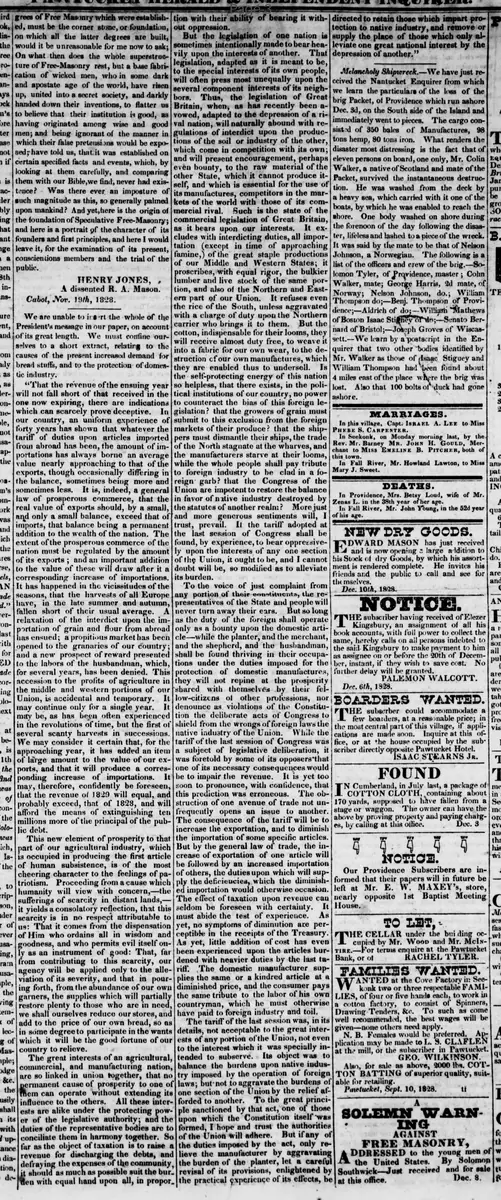
"That the revenue of the ensuing year will not fall short of that received in the one now expiring, there are indications which can scarcely prove deceptive. In our country, a uniform experience of forty years has shown that whatever the tariff of duties upon articles imported from abroad has been, the amount of importations has always borne an average value nearly approaching to that of the exports, though occasionally differing in the balance, sometimes being more and sometimes less. It is, indeed, a general law of prosperous commerce, that the real value of exports should, by a small, and only a small balance, exceed that of imports, that balance being a permanent addition to the wealth of the nation. The extent of the prosperous commerce of the nation must be regulated by the amount of its exports; and an important addition to the value of these will draw after it a corresponding increase of importations.
It has happened in the vicissitudes of the seasons, that the harvests of all Europe have, in the late summer and autumn, fallen short of their usual average. A relaxation of the interdict upon the importation of grain and flour from abroad has ensued; a propitious market has been opened to the granaries of our country; and a new prospect of reward presented to the labors of the husbandman, which, for several years, has been denied. This accession to the profits of agriculture in the middle and western portions of our Union, is accidental and temporary. It may continue only for a single year. It may be, as has been often experienced in the revolutions of time, but the first of several scanty harvests in succession. We may consider it certain that, for the approaching year, it has added an item of large amount to the value of our exports, and that it will produce a corresponding increase of importations. It may, therefore, confidently be foreseen, that the revenue of 1829 will equal, and probably exceed, that of 1828, and will afford the means of extinguishing ten millions more of the principal of the public debt.
This new element of prosperity to that part of our agricultural industry, which is occupied in producing the first article of human subsistence, is of the most cheering character to the feelings of patriotism. Proceeding from a cause which humanity will view with concern,--the sufferings of scarcity in distant lands,-- it yields a consolatory reflection, that this scarcity is in no respect attributable to us: That it comes from the dispensation of Him who ordains all in wisdom and goodness, and who permits evil itself only as an instrument of good: That, far from contributing to this scarcity, our agency will be applied only to the alleviation of its severity, and that in pouring forth, from the abundance of our own garners, the supplies which will partially restore plenty to those who are in need, we shall ourselves reduce our stores, and add to the price of our own bread, so as in some degree to participate in the wants which it will be the good fortune of our country to relieve.
The great interests of an agricultural, commercial, and manufacturing nation, are so linked in union together, that no permanent cause of prosperity to one of them can operate without extending its influence to the others. All these interests are alike under the protecting power of the legislative authority; and the duties of the representative bodies are to conciliate them in harmony together. So far as the object of taxation is to raise a revenue for discharging the debts, and defraying the expenses of the community, it should as much as possible suit the burden with equal hand upon all, in proportion with their ability of bearing it without oppression.
But the legislation of one nation is sometimes intentionally made to bear heavily upon the interests of another. That legislation, adapted as it is meant to be, to the special interests of its own people, will often press most unequally upon the several component interests of its neighbors. Thus, the legislation of Great Britain, when, as has recently been avowed, adapted to the depression of a rival nation, will naturally abound with regulations of interdict upon the productions of the soil or industry of the other, which come in competition with its own; and will present encouragement, perhaps even bounty, to the raw material of the other State, which it cannot produce itself, and which is essential for the use of its manufactures, competitors in the markets of the world with those of its commercial rival. Such is the state of the commercial legislation of Great Britain, as it bears upon our interests. It excludes with interdicting duties, all importation (except in time of approaching famine,) of the great staple productions of our Middle and Western States; it proscribes, with equal rigor, the bulkier lumber and live stock of the same portion, and also of the Northern and Eastern part of our Union, It refuses even the rice of the South, unless aggravated with a charge of duty upon the Northern carrier who brings it to them. But the cotton, indispensable for their looms, they will receive almost duty free, to weave it into a fabric for our own wear, to the destruction of our own manufactures, which they are enabled thus to undersell. Is the self-protecting energy of this nation so helpless, that there exists, in the political institutions of our country, no power to counteract the bias of this foreign legislation? that the growers of grain must submit to this exclusion from the foreign markets of their produce? that the shippers must dismantle their ships, the trade of the North stagnate at the wharves, and the manufacturers starve at their looms, while the whole people shall pay tribute to foreign industry to be clad in a foreign garb? that the Congress of the Union are impotent to restore the balance in favor of native industry destroyed by the statutes of another realm? More just and more generous sentiments will, I trust, prevail. If the tariff adopted at the last session of Congress shall be found, by experience, to bear oppressively upon the interests of any one section of the Union, it ought to be, and I cannot doubt will be, so modified as to alleviate its burden.
To the voice of just complaint from any portion of their constituents, the representatives of the State and people will never turn away their ears. But so long as the duty of the foreign shall operate only as a bounty upon the domestic article--while the planter, and the merchant, and the shepherd, and the husbandman, shall be found thriving in their occupations under the duties imposed for the protection of domestic manufactures, they will not repine at the prosperity shared with themselves by their fellow-citizens of other professions, nor denounce as violations of the Constitution the deliberate acts of Congress to shield from the wrongs of foreign laws the native industry of the Union. While the tariff of the last session of Congress was a subject of legislative deliberation, it was foretold by some of its opposers that one of its necessary consequences would be to impair the revenue. It is yet too soon to pronounce, with confidence, that this prediction was erroneous. The obstruction of one avenue of trade not unfrequently opens an issue to another. The consequence of the tariff will be to increase the exportation, and to diminish the importation of some specific articles. But by the general law of trade, the increase of exportation of one article will be followed by an increased importation of others, the duties upon which will supply the deficiencies, which the diminished importation would otherwise occasion. The effect of taxation upon revenue can seldom be foreseen with certainty. It must abide the test of experience. As yet, no symptoms of diminution are perceptible in the receipts of the Treasury. As yet, little addition of cost has even been experienced upon the articles burdened with heavier duties by the last tariff. The domestic manufacturer supplies the same or a kindred article at a diminished price, and the consumer pays the same tribute to the labor of his own countryman, which he must otherwise have paid to foreign industry and toil.
The tariff of the last session was, in its details, not acceptable to the great interests of any portion of the Union, not even to the interest which it was specially intended to subserve. Its object was to balance the burdens upon native industry imposed by the operation of foreign laws; but not to aggravate the burdens of one section of the Union by the relief afforded to another. To the great principle sanctioned by that act, one of those upon which the Constitution itself was formed, I hope and trust the authorities of the Union will adhere. But if any of the duties imposed by the act, only relieve the manufacturer by aggravating the burden of the planter, let a careful revisal of its provisions, enlightened by the practical experience of its effects, be directed to retain those which impart protection to native industry, and remove or supply the place of those which only alleviate one great national interest by the depression of another."
What sub-type of article is it?
What keywords are associated?
Domestic News Details
Event Date
1828 1829
Outcome
revenue of 1829 expected to equal or exceed 1828, enabling extinguishment of ten millions more of public debt principal.
Event Details
The President's message extract discusses European harvest shortages leading to increased U.S. grain exports, temporary agricultural prosperity in middle and western states, revenue predictions, and the need for tariff adjustments to protect domestic industry from British commercial restrictions while balancing interests across the Union.