Thank you for visiting SNEWPapers!
Sign up free
Editorial
August 17, 1836
Republican Herald
Providence, Providence County, Rhode Island
What is this article about?
This editorial critiques the proliferation of banks in the state, arguing they concentrate capital and power among a few directors, granting them monopolistic advantages in trade, influencing credit, and imposing losses on common creditors through preferred bank debts in bankruptcies.
Clipping
OCR Quality
95%
Excellent
Full Text
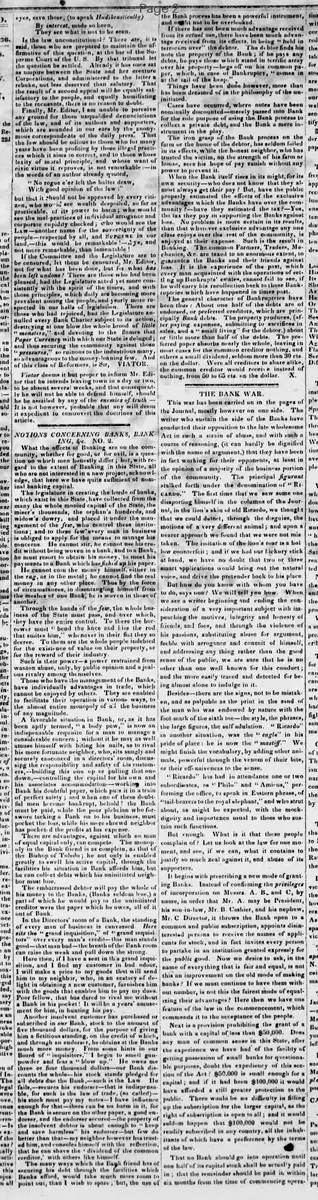
NOTIONS CONCERNING BANKS, BANKING, &c. NO. 2.
What the effects of Banking are on the community, whether for good, or for evil, is a question on which men honestly differ; but, with regard to the extent of Banking in this State, all who are not interested in a new project, acknowledge, that here we have quite sufficient of nominal banking capital.
The legislature in creating the horde of banks, which exist in this State, have collected from the many the whole monied capital of the State, the miser's thousands, the orphan's hundreds, and widow's dowry, and placed it under the management of the few, who control these institutions; and to these few every man in business is obliged to apply for the means to manage his concerns. He cannot stir, he cannot use his credit without being woven in a bank, and to a Bank, he must resort to obtain his money, to meet his payments to a Bank which has fished up his paper. He cannot coin the money himself, either in the rag, or in the metal; he cannot find the real money in any other place. Thus by the force of circumstances, in disentangling himself from the meshes of one Bank, he is woven in those of another.
Through the hands of the few, the whole business of the State must pass, and over which, they have the entire control. To these the borrower must "bend the knee and kiss the rod that smites him," whenever in their fiat they so decree. To them are the whole people indebted for the existence of value on their property, or for the reward of their industry.
Such is their power—a power restrained from wanton abuse, only, by public opinion and a jealous rivalry among themselves.
Those who have the management of the Banks, have individually advantages in trade, which cannot be enjoyed by others. They are enabled to facilitate their operation in various ways, to the almost entire monopoly of all the business of any magnitude.
A favorable situation in Bank, or, as it has been aptly termed, "a body pew," is now an indispensable requisite for a man to manage a considerable concern; without it he may as well amuse himself with biting his nails, as to rival his more fortunate neighbor, who, sits snugly and securely ensconced in a directors' room, discussing the responsibility and safety of his customers,—building this one up or pulling that one down,—controlling the capital for his own and his associates accommodation—working into Bank his doubtful paper, which puts it in a train of perfect safety; and when one of these doubtful men become bankrupt, behold! the Bank must be paid, while the poor plebeian who forswore tacking a Bank on to his business, must pocket the loss, while his more shrewd neighbor has pocketed the profits at his expense.
These are advantages, against which no man of equal capital only, can compete. The monopoly in the Bank friend is as complete, as that of the Bishop of Toledo; he not only is enabled greatly to swell his active capital, through the facilities his situation in Bank affords him, but he can collect debts which his uninitiated neighbor must lose.
The embarrassed debtor will pay the whole of his money to the Banks, (Banks seldom lose,) a part of which he would pay to the uninitiated creditor were the paper which he owes, all of it out of Bank.
In the Directors' room of a Bank, the standing of every man of business is canvassed. Here sits the "grand inquisition," of "grand inquisitors" over every man's credit—this man stands good—that man bad—the breath of the Bank room can raise the weak and pull down the strong.
Here then, if I have a seat in this grand inquisition, and I find my customer in bad odour, I will make a price to my goods that will send him to my neighbor, who, in an ecstasy of delight in obtaining a new customer, furnishes him with the goods that enables him to pay my dues. Poor fellow, that has dared to rival me without a Bank in his pocket! It will be a year's amusement for him, in hunting his pay.
Another insolvent customer has purchased or subscribed in our Bank, stock to the amount of five thousand dollars, for the purpose of giving him a fictitious standing, on the credit of which, and through an endorser, he obtains at the Banks much more money. From some hints in our Board of "inquisitors," I begin to smell gun powder and fear a "blow up." He owes me three or four thousand dollars—our Bank discounts the whole—his stock stands pledged for all debts due the Bank,—such is the Law! He fails,—secures his endorser—that is indispensable. for such is the law of trade, (so called)—his stock must pay my notes—I have influence enough for that—there can be no harm in it, for the Bank is secure on the other paper, a good endorser, and the endorser secured—the property of the insolvent debtor is about enough to "keep and save harmless" his endorser—but few do better than that—my neighbor however has trusted him, and consoles himself with the reflection, that he can shave the 'dividend of the common creditor,' with others like himself.
The many ways which the Bank friend has of securing his debt through the facilities which Banks afford, would take much more room to point out, than I wish to spare; but, the use of the Bank process has been a powerful instrument, and one not to be overlooked.
If there has not been much advantage received from its actual use, there have been much advantage received from its effects, in being "held in terrorem over" the debtor. The debtor finds his note the property of the Bank; if he pays any debts, he pays those which stand in terrific array over his property—begs off' on his common paper, which, in case of Bankruptcy, "comes in at the tail of the heap"
Things have been done however, more than has been dreamed of in the philosophy of the uninitiated.
Cases have occurred, where notes have been nominally discounted—merely passed into Bank for the sole purpose of using the Bank process to collect a private debt, and the Bank a mere instrument in the play.
The iron grasp of the Bank process on the farm or the home of the debtor, has seldom failed in its effects, while the honest neighbor, who has trusted the victim, on the strength of his farm or house, sees his hope of pay vanish without any power to prevent it.
When the Bank itself rises in its might, for its own security—who does not know that they almost always get their pay? But, have the public properly estimated the effects of the exclusive advantages which the Banks have over the community?—have they estimated the tax?—Yes, the tax they pay in supporting the Banks against loss. No problem is more certain in its results, than that whatever exclusive advantage any one class enjoys over the rest of the community, is enjoyed at their expense. Such is the result in Banking. The common Farmers, Traders, Mechanics, &c. are taxed to an enormous extent, to guarantee the Banks and their friends against loss. It is the experience of the past, which every man acquainted with the operations of setting up Bankrupts' estates, cannot fail to see, if he will carry his recollection back to those Bankruptcies which have happened in times past.
The general character of Bankruptcies have been thus: About one half of the debts are of endorsed, or preferred creditors, which are principally Bank debts. The property produces, (after paying expenses, submitting to sacrifices in sales, and a "small living" for the debtor.) about or little more than half of the debts. The preferred paper absorbs nearly the whole, leaving in most cases for the common creditor nothing, and others a small dividend, seldom more than 30 cts. on the dollar. Were all creditors to share alike, the common creditor would receive instead of nothing, from 50 to 65 cts. on the dollar.
What the effects of Banking are on the community, whether for good, or for evil, is a question on which men honestly differ; but, with regard to the extent of Banking in this State, all who are not interested in a new project, acknowledge, that here we have quite sufficient of nominal banking capital.
The legislature in creating the horde of banks, which exist in this State, have collected from the many the whole monied capital of the State, the miser's thousands, the orphan's hundreds, and widow's dowry, and placed it under the management of the few, who control these institutions; and to these few every man in business is obliged to apply for the means to manage his concerns. He cannot stir, he cannot use his credit without being woven in a bank, and to a Bank, he must resort to obtain his money, to meet his payments to a Bank which has fished up his paper. He cannot coin the money himself, either in the rag, or in the metal; he cannot find the real money in any other place. Thus by the force of circumstances, in disentangling himself from the meshes of one Bank, he is woven in those of another.
Through the hands of the few, the whole business of the State must pass, and over which, they have the entire control. To these the borrower must "bend the knee and kiss the rod that smites him," whenever in their fiat they so decree. To them are the whole people indebted for the existence of value on their property, or for the reward of their industry.
Such is their power—a power restrained from wanton abuse, only, by public opinion and a jealous rivalry among themselves.
Those who have the management of the Banks, have individually advantages in trade, which cannot be enjoyed by others. They are enabled to facilitate their operation in various ways, to the almost entire monopoly of all the business of any magnitude.
A favorable situation in Bank, or, as it has been aptly termed, "a body pew," is now an indispensable requisite for a man to manage a considerable concern; without it he may as well amuse himself with biting his nails, as to rival his more fortunate neighbor, who, sits snugly and securely ensconced in a directors' room, discussing the responsibility and safety of his customers,—building this one up or pulling that one down,—controlling the capital for his own and his associates accommodation—working into Bank his doubtful paper, which puts it in a train of perfect safety; and when one of these doubtful men become bankrupt, behold! the Bank must be paid, while the poor plebeian who forswore tacking a Bank on to his business, must pocket the loss, while his more shrewd neighbor has pocketed the profits at his expense.
These are advantages, against which no man of equal capital only, can compete. The monopoly in the Bank friend is as complete, as that of the Bishop of Toledo; he not only is enabled greatly to swell his active capital, through the facilities his situation in Bank affords him, but he can collect debts which his uninitiated neighbor must lose.
The embarrassed debtor will pay the whole of his money to the Banks, (Banks seldom lose,) a part of which he would pay to the uninitiated creditor were the paper which he owes, all of it out of Bank.
In the Directors' room of a Bank, the standing of every man of business is canvassed. Here sits the "grand inquisition," of "grand inquisitors" over every man's credit—this man stands good—that man bad—the breath of the Bank room can raise the weak and pull down the strong.
Here then, if I have a seat in this grand inquisition, and I find my customer in bad odour, I will make a price to my goods that will send him to my neighbor, who, in an ecstasy of delight in obtaining a new customer, furnishes him with the goods that enables him to pay my dues. Poor fellow, that has dared to rival me without a Bank in his pocket! It will be a year's amusement for him, in hunting his pay.
Another insolvent customer has purchased or subscribed in our Bank, stock to the amount of five thousand dollars, for the purpose of giving him a fictitious standing, on the credit of which, and through an endorser, he obtains at the Banks much more money. From some hints in our Board of "inquisitors," I begin to smell gun powder and fear a "blow up." He owes me three or four thousand dollars—our Bank discounts the whole—his stock stands pledged for all debts due the Bank,—such is the Law! He fails,—secures his endorser—that is indispensable. for such is the law of trade, (so called)—his stock must pay my notes—I have influence enough for that—there can be no harm in it, for the Bank is secure on the other paper, a good endorser, and the endorser secured—the property of the insolvent debtor is about enough to "keep and save harmless" his endorser—but few do better than that—my neighbor however has trusted him, and consoles himself with the reflection, that he can shave the 'dividend of the common creditor,' with others like himself.
The many ways which the Bank friend has of securing his debt through the facilities which Banks afford, would take much more room to point out, than I wish to spare; but, the use of the Bank process has been a powerful instrument, and one not to be overlooked.
If there has not been much advantage received from its actual use, there have been much advantage received from its effects, in being "held in terrorem over" the debtor. The debtor finds his note the property of the Bank; if he pays any debts, he pays those which stand in terrific array over his property—begs off' on his common paper, which, in case of Bankruptcy, "comes in at the tail of the heap"
Things have been done however, more than has been dreamed of in the philosophy of the uninitiated.
Cases have occurred, where notes have been nominally discounted—merely passed into Bank for the sole purpose of using the Bank process to collect a private debt, and the Bank a mere instrument in the play.
The iron grasp of the Bank process on the farm or the home of the debtor, has seldom failed in its effects, while the honest neighbor, who has trusted the victim, on the strength of his farm or house, sees his hope of pay vanish without any power to prevent it.
When the Bank itself rises in its might, for its own security—who does not know that they almost always get their pay? But, have the public properly estimated the effects of the exclusive advantages which the Banks have over the community?—have they estimated the tax?—Yes, the tax they pay in supporting the Banks against loss. No problem is more certain in its results, than that whatever exclusive advantage any one class enjoys over the rest of the community, is enjoyed at their expense. Such is the result in Banking. The common Farmers, Traders, Mechanics, &c. are taxed to an enormous extent, to guarantee the Banks and their friends against loss. It is the experience of the past, which every man acquainted with the operations of setting up Bankrupts' estates, cannot fail to see, if he will carry his recollection back to those Bankruptcies which have happened in times past.
The general character of Bankruptcies have been thus: About one half of the debts are of endorsed, or preferred creditors, which are principally Bank debts. The property produces, (after paying expenses, submitting to sacrifices in sales, and a "small living" for the debtor.) about or little more than half of the debts. The preferred paper absorbs nearly the whole, leaving in most cases for the common creditor nothing, and others a small dividend, seldom more than 30 cts. on the dollar. Were all creditors to share alike, the common creditor would receive instead of nothing, from 50 to 65 cts. on the dollar.
What sub-type of article is it?
Economic Policy
Legal Reform
What keywords are associated?
Banking
Monopoly
Bank Directors
Bankruptcies
Preferred Creditors
Economic Inequality
State Capital
What entities or persons were involved?
State Banks
Bank Directors
Legislature
Common Creditors
Farmers Traders Mechanics
Editorial Details
Primary Topic
Critique Of State Banking System And Its Monopolistic Effects
Stance / Tone
Strongly Critical Of Banks And Their Directors
Key Figures
State Banks
Bank Directors
Legislature
Common Creditors
Farmers Traders Mechanics
Key Arguments
Banks Concentrate The State's Capital In The Hands Of A Few Controllers
Bank Directors Gain Unfair Trade Advantages And Monopolize Business
Bank Processes Prioritize Bank Debts In Bankruptcies, Causing Losses To Common Creditors
Public Subsidizes Banks Through Guaranteed Protection Against Losses
Bankruptcies Show Preferred Bank Debts Absorb Most Assets, Leaving Little For Others