Thank you for visiting SNEWPapers!
Sign up free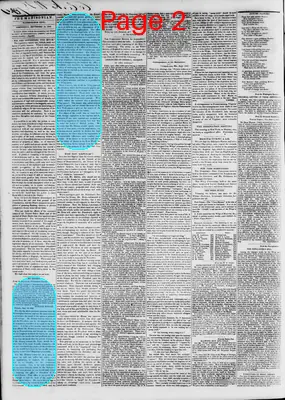
Story
September 14, 1842
The Daily Madisonian
Washington, District Of Columbia
What is this article about?
Horace Binney disavows his listed role as Vice President at a Philadelphia 'Indignation meeting' insulting President Tyler's office, prompting editorial criticism accusing him of implied support for undermining the Constitution and favoring monarchy, tied to Whig party tactics.
Clipping
OCR Quality
98%
Excellent
Full Text
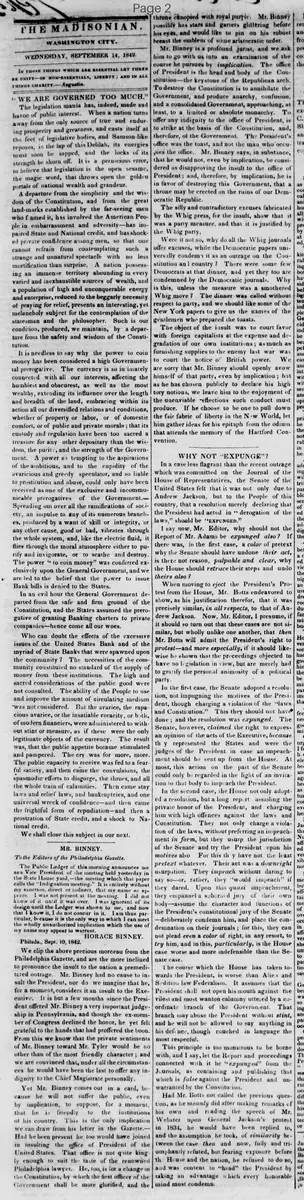
MR. BINNEY.
To the Editors of the Philadelphia Gazette.
The Public Ledger of this morning announces me as a Vice President of the meeting held yesterday in the State House yard,—the meeting which that paper calls the "Indignation meeting." It is entirely without my sanction, direct or indirect, that my name so appears. I was not present at the meeting. I did not know of it until it was over. I was ignorant of its design until the Ledger was shown to me, and now that I know it, I do not concur in it. I am thus particular, because it is the only way in which I can meet the wholly unauthorized implication which the use of my name may appear to warrant.
HORACE BINNEY.
Philada., Sept. 10, 1842
We clip the above precious morceau from the Philadelphia Gazette, and are the more inclined to pronounce the insult to the nation a premeditated outrage. Mr. Binney had no cause to insult the President, nor do we imagine that he, for a moment, considers it an insult to the Executive. It is but a few months since the President offered Mr. Binney a very important judgeship in Pennsylvania, and though the ex-member of Congress declined the honor, he yet felt grateful to the hands that had proffered the boon. From this we know that the private sentiments of Mr. Binney toward Mr. Tyler would be no other than of the most friendly character; and we are convinced that, under all the circumstances he would have been the last to offer any indignity to the Chief Magistrate personally.
Yet Mr. Binney comes out in a card, because he will not suffer the public, even by implication, to suppose, for a moment that he is friendly to the institutions of his country. This is the only implication we can draw from his letter in the Gazette.—Had he been present he too would have joined in insulting the office of President of the United States. That office is not quite kingly enough to suit the taste of the renowned Philadelphia lawyer. He, too, is for a change in the Constitution, by which the first officer of the Government shall be more glorified, and the throne canopied with royal purple. Mr. Binney possibly has stars and garters glittering before his eyes, and would like to pin on his robust breast the emblem of some aristocratic order.
Mr. Binney is a profound jurist, and we ask him to go with us into an examination of the course he pursues by implication. The office of President is the head and body of the Constitution—the keystone of the Republican arch. To destroy the Constitution is to annihilate the Government, and produce anarchy, confusion, and a consolidated Government, approaching, at least, to a limited or absolute monarchy. To offer any indignity to the office of President, is to strike at the basis of the Constitution, and, therefore, of the Government. The President's office was the toast, and not the man who occupies the office. Mr. Binney says, in substance, that he would not, even by implication, be considered as disapproving the insult to the office of President; and, therefore, by implication, he is in favor of destroying this Government, that a throne may be erected on the ruins of our Democratic Republic.
The silly and contradictory excuses fabricated by the Whig press, for the insult, show that it was a party measure, and that it is justified by the Whig party. Were it not so, why do all the Whig journals offer excuses, while the Democratic papers universally condemn it as an outrage on the Constitution and country? There were some few Democrats at that dinner, and yet they too are condemned by the Democratic journals. Why is this, unless the measure was a smothered Whig move? The dinner was called without respect to party, and we should like some of the New York papers to give us the names of the gentlemen who prepared the toasts.
The object of the insult was to court favor with foreign capitalists at the expense and degradation of our own institutions; as much as furnishing supplies to the enemy last war was to court the notice of British power. We are sorry that Mr. Binney should openly avow himself of that party, even by implication; but as he has chosen publicly to declare his high tory notions, we leave him to the enjoyment of the unenviable reflections such conduct must produce. If he choose to be one to pull down the fair fabric of liberty in the New World, let him gather ideas for his epitaph from the odium that attends the memory of the Hartford Convention.
To the Editors of the Philadelphia Gazette.
The Public Ledger of this morning announces me as a Vice President of the meeting held yesterday in the State House yard,—the meeting which that paper calls the "Indignation meeting." It is entirely without my sanction, direct or indirect, that my name so appears. I was not present at the meeting. I did not know of it until it was over. I was ignorant of its design until the Ledger was shown to me, and now that I know it, I do not concur in it. I am thus particular, because it is the only way in which I can meet the wholly unauthorized implication which the use of my name may appear to warrant.
HORACE BINNEY.
Philada., Sept. 10, 1842
We clip the above precious morceau from the Philadelphia Gazette, and are the more inclined to pronounce the insult to the nation a premeditated outrage. Mr. Binney had no cause to insult the President, nor do we imagine that he, for a moment, considers it an insult to the Executive. It is but a few months since the President offered Mr. Binney a very important judgeship in Pennsylvania, and though the ex-member of Congress declined the honor, he yet felt grateful to the hands that had proffered the boon. From this we know that the private sentiments of Mr. Binney toward Mr. Tyler would be no other than of the most friendly character; and we are convinced that, under all the circumstances he would have been the last to offer any indignity to the Chief Magistrate personally.
Yet Mr. Binney comes out in a card, because he will not suffer the public, even by implication, to suppose, for a moment that he is friendly to the institutions of his country. This is the only implication we can draw from his letter in the Gazette.—Had he been present he too would have joined in insulting the office of President of the United States. That office is not quite kingly enough to suit the taste of the renowned Philadelphia lawyer. He, too, is for a change in the Constitution, by which the first officer of the Government shall be more glorified, and the throne canopied with royal purple. Mr. Binney possibly has stars and garters glittering before his eyes, and would like to pin on his robust breast the emblem of some aristocratic order.
Mr. Binney is a profound jurist, and we ask him to go with us into an examination of the course he pursues by implication. The office of President is the head and body of the Constitution—the keystone of the Republican arch. To destroy the Constitution is to annihilate the Government, and produce anarchy, confusion, and a consolidated Government, approaching, at least, to a limited or absolute monarchy. To offer any indignity to the office of President, is to strike at the basis of the Constitution, and, therefore, of the Government. The President's office was the toast, and not the man who occupies the office. Mr. Binney says, in substance, that he would not, even by implication, be considered as disapproving the insult to the office of President; and, therefore, by implication, he is in favor of destroying this Government, that a throne may be erected on the ruins of our Democratic Republic.
The silly and contradictory excuses fabricated by the Whig press, for the insult, show that it was a party measure, and that it is justified by the Whig party. Were it not so, why do all the Whig journals offer excuses, while the Democratic papers universally condemn it as an outrage on the Constitution and country? There were some few Democrats at that dinner, and yet they too are condemned by the Democratic journals. Why is this, unless the measure was a smothered Whig move? The dinner was called without respect to party, and we should like some of the New York papers to give us the names of the gentlemen who prepared the toasts.
The object of the insult was to court favor with foreign capitalists at the expense and degradation of our own institutions; as much as furnishing supplies to the enemy last war was to court the notice of British power. We are sorry that Mr. Binney should openly avow himself of that party, even by implication; but as he has chosen publicly to declare his high tory notions, we leave him to the enjoyment of the unenviable reflections such conduct must produce. If he choose to be one to pull down the fair fabric of liberty in the New World, let him gather ideas for his epitaph from the odium that attends the memory of the Hartford Convention.
What sub-type of article is it?
Historical Event
Deception Fraud
What themes does it cover?
Deception
Justice
Moral Virtue
What keywords are associated?
Horace Binney
Indignation Meeting
President Tyler
Whig Party
Constitution Insult
Philadelphia Gazette
What entities or persons were involved?
Horace Binney
Mr. Tyler
Where did it happen?
Philadelphia
Story Details
Key Persons
Horace Binney
Mr. Tyler
Location
Philadelphia
Event Date
Sept. 10, 1842
Story Details
Horace Binney publicly disavows unauthorized use of his name as Vice President at an 'Indignation meeting' that insulted the office of President Tyler; editorial accuses him of implied support for constitutional undermining and Whig party tactics favoring monarchy.