Thank you for visiting SNEWPapers!
Sign up free
Story
April 7, 1956
The Miami Times
Miami, Dade County, Florida
What is this article about?
Article by Kelsey "Kit" Collie advising high school seniors on whether to attend college, emphasizing purposeful planning, varied reasons for going, and that college is an opportunity requiring effort and ability, part one of a four-week series.
Clipping
OCR Quality
100%
Excellent
Full Text
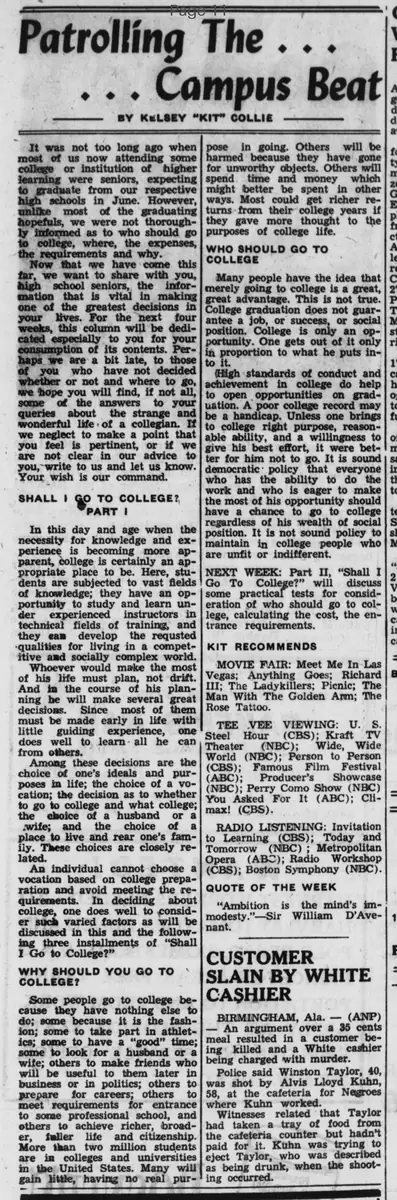
Patrolling The Campus Beat
BY KELSEY "KIT" COLLIE
It was not too long ago when most of us now attending some college or institution of higher learning were seniors, expecting to graduate from our respective high schools in June. However unlike most of the graduating hopefuls, we were not thoroughly informed as to who should go to college, where, the expenses, the requirements and why.
Now that we have come this far, we want to share with you, high school seniors, the information that is vital in making one of the greatest decisions in your lives. For the next four weeks, this column will be dedicated especially to you for your consumption of its contents. Perhaps we are a bit late to those of you who have not decided whether or not and where to go, we hope you will find, if not all, some of the answers to your queries about the strange and wonderful life of a collegian. If we neglect to make a point that you feel is pertinent, or if we are not clear in our advice to you, write to us and let us know. Your wish is our command.
SHALL I GO TO COLLEGE?
PART I
In this day and age when the necessity for knowledge and experience is becoming more apparent, college is certainly an appropriate place to be. Here, students are subjected to vast fields of knowledge; they have an opportunity to study and learn under experienced instructors in technical fields of training, and they can develop the required qualities for living in a competitive and socially complex world.
Whoever would make the most of his life must plan, not drift. And in the course of his planning he will make several great decisions. Since most of them must be made early in life with little guiding experience, one does well to learn all he can from others.
Among these decisions are the choice of one's ideals and purposes in life; the choice of a vocation; the decision as to whether to go to college and what college; the choice of a husband or a wife; and the choice of a place to live and rear one's family. These choices are closely related.
An individual cannot choose a vocation based on college preparation and avoid meeting the requirements. In deciding about college, one does well to consider such varied factors as will be discussed in this and the following three installments of "Shall I Go to College?"
WHY SHOULD YOU GO TO COLLEGE?
Some people go to college because they have nothing else to do; some because it is the fashion; some to take part in athletics; some to have a "good" time; some to look for a husband or a wife; others to make friends who will be useful to them later in business or in politics; others to prepare for careers; others to meet requirements for entrance to some professional school, and others to achieve richer, broader, fuller life and citizenship.
More than two million students are in colleges and universities in the United States. Many will gain little, having no real purpose in going. Others will be harmed because they have gone for unworthy objects. Others will spend time and money which might better be spent in other ways. Most could get richer returns from their college years if they gave more thought to the purposes of college life.
WHO SHOULD GO TO COLLEGE
Many people have the idea that merely going to college is a great, great advantage. This is not true. College graduation does not guarantee a job, or success, or social position. College is only an opportunity. One gets out of it only in proportion to what he puts into it.
High standards of conduct and achievement in college do help to open opportunities on graduation. A poor college record may be a handicap. Unless one brings to college right purpose, reasonable ability, and a willingness to give his best effort, it were better for him not to go. It is sound democratic policy that everyone who has the ability to do the work and who is eager to make the most of his opportunity should have a chance to go to college regardless of his wealth or social position. It is not sound policy to maintain in college people who are unfit or indifferent.
NEXT WEEK: Part II. "Shall I Go To College?" will discuss some practical tests for consideration of who should go to college, calculating the cost, the entrance requirements.
BY KELSEY "KIT" COLLIE
It was not too long ago when most of us now attending some college or institution of higher learning were seniors, expecting to graduate from our respective high schools in June. However unlike most of the graduating hopefuls, we were not thoroughly informed as to who should go to college, where, the expenses, the requirements and why.
Now that we have come this far, we want to share with you, high school seniors, the information that is vital in making one of the greatest decisions in your lives. For the next four weeks, this column will be dedicated especially to you for your consumption of its contents. Perhaps we are a bit late to those of you who have not decided whether or not and where to go, we hope you will find, if not all, some of the answers to your queries about the strange and wonderful life of a collegian. If we neglect to make a point that you feel is pertinent, or if we are not clear in our advice to you, write to us and let us know. Your wish is our command.
SHALL I GO TO COLLEGE?
PART I
In this day and age when the necessity for knowledge and experience is becoming more apparent, college is certainly an appropriate place to be. Here, students are subjected to vast fields of knowledge; they have an opportunity to study and learn under experienced instructors in technical fields of training, and they can develop the required qualities for living in a competitive and socially complex world.
Whoever would make the most of his life must plan, not drift. And in the course of his planning he will make several great decisions. Since most of them must be made early in life with little guiding experience, one does well to learn all he can from others.
Among these decisions are the choice of one's ideals and purposes in life; the choice of a vocation; the decision as to whether to go to college and what college; the choice of a husband or a wife; and the choice of a place to live and rear one's family. These choices are closely related.
An individual cannot choose a vocation based on college preparation and avoid meeting the requirements. In deciding about college, one does well to consider such varied factors as will be discussed in this and the following three installments of "Shall I Go to College?"
WHY SHOULD YOU GO TO COLLEGE?
Some people go to college because they have nothing else to do; some because it is the fashion; some to take part in athletics; some to have a "good" time; some to look for a husband or a wife; others to make friends who will be useful to them later in business or in politics; others to prepare for careers; others to meet requirements for entrance to some professional school, and others to achieve richer, broader, fuller life and citizenship.
More than two million students are in colleges and universities in the United States. Many will gain little, having no real purpose in going. Others will be harmed because they have gone for unworthy objects. Others will spend time and money which might better be spent in other ways. Most could get richer returns from their college years if they gave more thought to the purposes of college life.
WHO SHOULD GO TO COLLEGE
Many people have the idea that merely going to college is a great, great advantage. This is not true. College graduation does not guarantee a job, or success, or social position. College is only an opportunity. One gets out of it only in proportion to what he puts into it.
High standards of conduct and achievement in college do help to open opportunities on graduation. A poor college record may be a handicap. Unless one brings to college right purpose, reasonable ability, and a willingness to give his best effort, it were better for him not to go. It is sound democratic policy that everyone who has the ability to do the work and who is eager to make the most of his opportunity should have a chance to go to college regardless of his wealth or social position. It is not sound policy to maintain in college people who are unfit or indifferent.
NEXT WEEK: Part II. "Shall I Go To College?" will discuss some practical tests for consideration of who should go to college, calculating the cost, the entrance requirements.
What sub-type of article is it?
Advice Column
Educational Guide
What keywords are associated?
College Decision
Higher Education
Vocation Choice
Personal Planning
Student Advice
What entities or persons were involved?
Kelsey "Kit" Collie
Story Details
Key Persons
Kelsey "Kit" Collie
Story Details
Advice column for high school seniors on deciding whether to go to college, discussing purposes, who should attend, and factors to consider, with parts on ideals, vocation, and opportunities.