Thank you for visiting SNEWPapers!
Sign up free
Story
September 29, 1880
New Ulm Weekly Review
New Ulm, Brown County, Minnesota
What is this article about?
Article advising lady travelers on handling baggage, with anecdotes of mishaps like a separated young lady spending night in station-house, exploding trunk in Boston, Russian countess's stolen laces leading to lawsuit victory, and other legal cases on baggage liability.
Clipping
OCR Quality
95%
Excellent
Full Text
A Lady's Baggage.
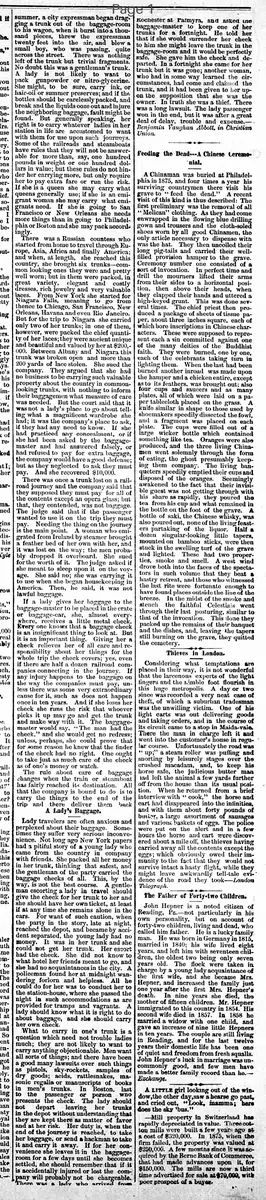
Lady travelers are often anxious and perplexed about their baggage. Sometimes they suffer very serious inconvenience. Not long ago New York papers had a pitiful story of a young lady who came from the country in company with friends. She packed all her money in her trunk, thinking that safest, and the gentleman of the party carried the baggage checks of all. This, by the way, is not the best course. A gentleman escorting a lady in travel should give the check for her trunk to her and she should have her own ticket, at least if at any time she remains alone in the cars. For want of such caution, when the party in the story, late at night, reached the depot, and became by accident separated, the young lady had no money. It was in her trunk and she could not get her trunk. Her escort had the check. She did not know to what hotel her friends meant to go, and she had no acquaintances in the city. A policeman found her at midnight wandering forlorn and helpless. All he could do for her was to conduct her to the station-house, where she passed the night in such accommodations as are provided for tramps and vagrants. A lady should know what it is right to do about baggage, and she should carry her own check.
What to carry in one's trunk is a question which need not trouble ladies much; they are not likely to want to carry anything objectionable. Men want all sorts of things; and there have been a good many lawsuits over such things as pistols, sky-rockets, samples of dry goods; acids, rattlesnakes, masonic regalia or manuscripts of books in men's trunks. In Boston, last summer, a city expressman began dragging a trunk out of the baggage-room to his wagon, when it burst into a thousand pieces, threw the expressman twenty feet into the air, and blew a small boy, who was passing, quite across the street. There was nothing left of the trunk but trivial fragments. No doubt this was a gentleman's trunk. A lady is not likely to want to pack gunpowder or nitro-glycerine. She might, to be sure, carry ink, or hair-oil or summer preserves; and if the bottles should be carelessly packed, and break and the liquids ooze out and injure the neighboring baggage, fault might be found. But generally speaking, her right is to carry whatever ladies in her station in life are accustomed to want with them for use upon such journeys.
Some of the railroads and steamboats have rules that they will not be answerable for more than, say, one hundred pounds in weight or one hundred dollars in value; but these rules do not hinder her carrying more, but only require her to pay extra fare or run the risk. If she is a queen she may carry what queens generally use; if she is an emigrant woman she may carry what emigrants need. If she is going to San Francisco or New Orleans she needs more things than in going to Philadelphia or Boston and she may pack accordingly.
There was a Russian countess who started from home to travel through Europe, Asia, Africa and finally America; and when, at length, she reached this country, she brought six trunks—common looking ones they were and pretty well worn; but in them were packed, in great variety, elegant and costly dresses, rich jewelry and very valuable laces. From New York she started for Niagara Falls, meaning to go from thence to Chicago, San Francisco, New Orleans, Havana and even Rio Janeiro. But for the trip to Niagara she carried only two of her trunks; in one of them, however, were packed the chief quantity of her laces; they were ancient unique and beautiful and valued by her at $200,000. Between Albany and Niagara this trunk was broken open and more than 200 yards of lace stolen. She sued the company. They argued that she had no business to be carrying such valuable property about the country in common-looking trunks, with nothing to inform their baggagemen what measure of care was needed. But the court said that it was not a lady's place to go about telling what a magnificent wardrobe she had; it was the company's place to ask, if they had any need to know. If she had practiced any concealment, or if she had been asked by the baggage-master and had answered falsely, or had refused to pay for extra baggage, the company would have a good defense; but as they neglected to ask they must pay. And she recovered $10,000.
There was once a trunk lost on a railroad journey and the company said that they supposed they must pay for all of the contents except an opera glass; but that, they contended, was not baggage. The judge said that if the passenger wanted to use it on the trip they must pay. Needing the thing on the journey is the main point. A woman who emigrated from Ireland by steamer brought a feather bed of her own with her, and it was lost on the way; the men probably dropped it overboard. She sued for the worth of it. The judge asked if she meant to sleep upon it on the voyage. She said no; she was carrying it to use when she began housekeeping in America. Then, he said, it was not lawful baggage.
If a lady gives her baggage to the baggage-master to be placed in the car or baggage-car, she, almost everywhere, receives a little metal check. Every one knows that a baggage check is an insignificant thing to look at. But it is an important thing. Giving her a check relieves her of all care and responsibility about her things for the whole trip the check covers; yes, even if there are half a dozen railroad companies connecting in the journey. If any injury happens to the baggage on the way the companies must pay, unless there was some very extraordinary cause for it, such as does not happen once in ten years. And if she loses her check she runs the risk that whoever picks it up may go and get the trunk and make way with it. The baggage-master would say, "The man had the check," and she would get no redress; unless, perhaps, she could prove that for some reason he knew that the finder of the check had no right. One ought to take just as much care of the check as of one's money or watch.
The rule about care of baggage changes when the train or steamboat has fairly reached its destination. All that the company is bound to do is to carry the things to the end of the trip and there deliver them back to the passenger or person who presents the check. The lady should not depart leaving her trunks in the depot without understanding that they are kept there as matter of favor and at her risk. Her duty is, when the end of the journey is reached, to take her baggage, or send a hackman to take it and carry it away. If for her convenience she leaves it in the baggage-room for a few days until she becomes settled, she should remember that if it is accidentally injured or lost the company will probably not be chargeable.
There was a lady who arrived from Rochester at Palmyra, and asked the baggage-master to keep one of her trunks for a fortnight. He told her that if she would surrender her check to him she might leave the trunk in the baggage-room and it would be perfectly safe. She gave him the check and departed. In a fortnight she came for her trunk but it was gone; another woman, who had in some way learned the circumstances, had come and claimed the trunk, and it had been given to her upon the supposition that she was the owner. In truth she was a thief. There was a long lawsuit. The lady passenger won in the end, but it was after a great deal of delay, trouble and expense.— Benjamin Vaughan Abbott, in Christian Union.
Lady travelers are often anxious and perplexed about their baggage. Sometimes they suffer very serious inconvenience. Not long ago New York papers had a pitiful story of a young lady who came from the country in company with friends. She packed all her money in her trunk, thinking that safest, and the gentleman of the party carried the baggage checks of all. This, by the way, is not the best course. A gentleman escorting a lady in travel should give the check for her trunk to her and she should have her own ticket, at least if at any time she remains alone in the cars. For want of such caution, when the party in the story, late at night, reached the depot, and became by accident separated, the young lady had no money. It was in her trunk and she could not get her trunk. Her escort had the check. She did not know to what hotel her friends meant to go, and she had no acquaintances in the city. A policeman found her at midnight wandering forlorn and helpless. All he could do for her was to conduct her to the station-house, where she passed the night in such accommodations as are provided for tramps and vagrants. A lady should know what it is right to do about baggage, and she should carry her own check.
What to carry in one's trunk is a question which need not trouble ladies much; they are not likely to want to carry anything objectionable. Men want all sorts of things; and there have been a good many lawsuits over such things as pistols, sky-rockets, samples of dry goods; acids, rattlesnakes, masonic regalia or manuscripts of books in men's trunks. In Boston, last summer, a city expressman began dragging a trunk out of the baggage-room to his wagon, when it burst into a thousand pieces, threw the expressman twenty feet into the air, and blew a small boy, who was passing, quite across the street. There was nothing left of the trunk but trivial fragments. No doubt this was a gentleman's trunk. A lady is not likely to want to pack gunpowder or nitro-glycerine. She might, to be sure, carry ink, or hair-oil or summer preserves; and if the bottles should be carelessly packed, and break and the liquids ooze out and injure the neighboring baggage, fault might be found. But generally speaking, her right is to carry whatever ladies in her station in life are accustomed to want with them for use upon such journeys.
Some of the railroads and steamboats have rules that they will not be answerable for more than, say, one hundred pounds in weight or one hundred dollars in value; but these rules do not hinder her carrying more, but only require her to pay extra fare or run the risk. If she is a queen she may carry what queens generally use; if she is an emigrant woman she may carry what emigrants need. If she is going to San Francisco or New Orleans she needs more things than in going to Philadelphia or Boston and she may pack accordingly.
There was a Russian countess who started from home to travel through Europe, Asia, Africa and finally America; and when, at length, she reached this country, she brought six trunks—common looking ones they were and pretty well worn; but in them were packed, in great variety, elegant and costly dresses, rich jewelry and very valuable laces. From New York she started for Niagara Falls, meaning to go from thence to Chicago, San Francisco, New Orleans, Havana and even Rio Janeiro. But for the trip to Niagara she carried only two of her trunks; in one of them, however, were packed the chief quantity of her laces; they were ancient unique and beautiful and valued by her at $200,000. Between Albany and Niagara this trunk was broken open and more than 200 yards of lace stolen. She sued the company. They argued that she had no business to be carrying such valuable property about the country in common-looking trunks, with nothing to inform their baggagemen what measure of care was needed. But the court said that it was not a lady's place to go about telling what a magnificent wardrobe she had; it was the company's place to ask, if they had any need to know. If she had practiced any concealment, or if she had been asked by the baggage-master and had answered falsely, or had refused to pay for extra baggage, the company would have a good defense; but as they neglected to ask they must pay. And she recovered $10,000.
There was once a trunk lost on a railroad journey and the company said that they supposed they must pay for all of the contents except an opera glass; but that, they contended, was not baggage. The judge said that if the passenger wanted to use it on the trip they must pay. Needing the thing on the journey is the main point. A woman who emigrated from Ireland by steamer brought a feather bed of her own with her, and it was lost on the way; the men probably dropped it overboard. She sued for the worth of it. The judge asked if she meant to sleep upon it on the voyage. She said no; she was carrying it to use when she began housekeeping in America. Then, he said, it was not lawful baggage.
If a lady gives her baggage to the baggage-master to be placed in the car or baggage-car, she, almost everywhere, receives a little metal check. Every one knows that a baggage check is an insignificant thing to look at. But it is an important thing. Giving her a check relieves her of all care and responsibility about her things for the whole trip the check covers; yes, even if there are half a dozen railroad companies connecting in the journey. If any injury happens to the baggage on the way the companies must pay, unless there was some very extraordinary cause for it, such as does not happen once in ten years. And if she loses her check she runs the risk that whoever picks it up may go and get the trunk and make way with it. The baggage-master would say, "The man had the check," and she would get no redress; unless, perhaps, she could prove that for some reason he knew that the finder of the check had no right. One ought to take just as much care of the check as of one's money or watch.
The rule about care of baggage changes when the train or steamboat has fairly reached its destination. All that the company is bound to do is to carry the things to the end of the trip and there deliver them back to the passenger or person who presents the check. The lady should not depart leaving her trunks in the depot without understanding that they are kept there as matter of favor and at her risk. Her duty is, when the end of the journey is reached, to take her baggage, or send a hackman to take it and carry it away. If for her convenience she leaves it in the baggage-room for a few days until she becomes settled, she should remember that if it is accidentally injured or lost the company will probably not be chargeable.
There was a lady who arrived from Rochester at Palmyra, and asked the baggage-master to keep one of her trunks for a fortnight. He told her that if she would surrender her check to him she might leave the trunk in the baggage-room and it would be perfectly safe. She gave him the check and departed. In a fortnight she came for her trunk but it was gone; another woman, who had in some way learned the circumstances, had come and claimed the trunk, and it had been given to her upon the supposition that she was the owner. In truth she was a thief. There was a long lawsuit. The lady passenger won in the end, but it was after a great deal of delay, trouble and expense.— Benjamin Vaughan Abbott, in Christian Union.
What sub-type of article is it?
Journey
Curiosity
What themes does it cover?
Misfortune
Justice
Social Manners
What keywords are associated?
Baggage Handling
Lady Travelers
Trunk Theft
Railroad Lawsuit
Travel Advice
Baggage Check
What entities or persons were involved?
Young Lady From Country
Russian Countess
Lady From Rochester
Where did it happen?
New York, Boston, Niagara Falls, Railroads And Steamboats In America
Story Details
Key Persons
Young Lady From Country
Russian Countess
Lady From Rochester
Location
New York, Boston, Niagara Falls, Railroads And Steamboats In America
Story Details
Advice for ladies on managing travel baggage, including carrying own checks and tickets, what to pack, liability rules, and anecdotes of separations, explosions, thefts, and lawsuits over lost or stolen items.