Thank you for visiting SNEWPapers!
Sign up free
Virginia Argus
Richmond, Virginia
What is this article about?
This editorial examines post-war British military reinforcements in India, questioning motives like army reorganization or Oude intervention, while providing historical context on the Mogul empire's decline, British alliances in Oude, and the East India Company's military evolution from trade guards to a major force.
Merged-components note: Continuation of the opinion piece 'POLITICAL VIEWS. No. I.' from the Aurora, discussing foreign politics and history in Asia/India; relabeled to editorial as it is analytical and opinionated rather than straight foreign news.
Clippings
1 of 2
OCR Quality
Full Text
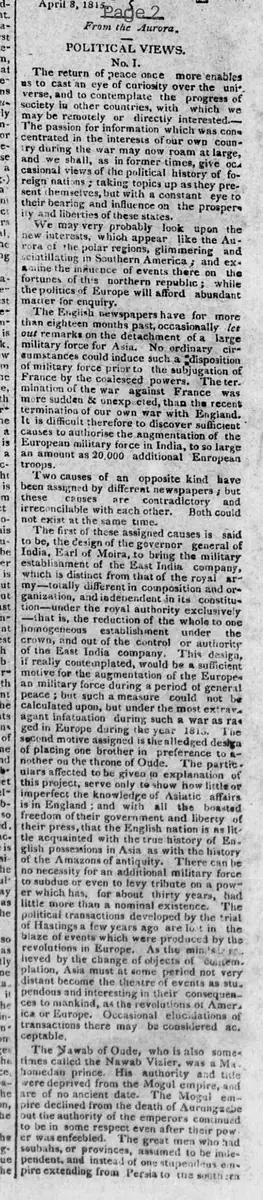
POLITICAL VIEWS.
No. I.
The return of peace once more enables us to cast an eye of curiosity over the universe, and to contemplate the progress of society in other countries, with which we may be remotely or directly interested.—The passion for information which was concentrated in the interests of our own country during the war may now roam at large, and we shall, as in former times, give occasional views of the political history of foreign nations; taking topics up as they present themselves, but with a constant eye to their bearing and influence on the prosperity and liberties of these states.
We may very probably look upon the new interests, which appear like the Aurora of the polar regions, glimmering and scintillating in Southern America; and examine the influence of events there on the fortunes of this northern republic; while the politics of Europe will afford abundant matter for enquiry.
The English newspapers have for more than eighteen months past, occasionally let out remarks on the detachment of a large military force for Asia. No ordinary circumstances could induce such a disposition of military force prior to the subjugation of France by the coalesced powers. The termination of the war against France was more sudden & unexpected, than the recent termination of our own war with England. It is difficult therefore to discover sufficient Causes to authorise the augmentation of the European military force in India, to so large an amount as 20,000 additional European troops.
Two causes of an opposite kind have been assigned by different newspapers; but these causes are contradictory and irreconcilable with each other. Both could not exist at the same time.
The first of these assigned causes is said to be, the design of the governor general of India, Earl of Moira, to bring the military establishment of the East India company, which is distinct from that of the royal army—totally different in composition and organization, and independent in its constitution—under the royal authority exclusively—that is, the reduction of the whole to one homogeneous establishment under the crown, and out of the control or authority of the East India company. This design, if really contemplated, would be a sufficient motive for the augmentation of the European military force during a period of general peace; but such a measure could not be calculated upon, but under the most extravagant infatuation during such a war as raged in Europe during the year 1814. The second motive assigned is the alledged design of placing one brother in preference to another on the throne of Oude. The particulars affected to be given (o explanation of this project, serve only to show how little or imperfect the knowledge of Asiatic affairs is in England; and with all the boasted freedom of their government and liberty of their press, that the English nation is as little acquainted with the true history of English possessions in Asia as with the history of the Amazons of antiquity. There can be no necessity for an additional military force to subdue or even to levy tribute on a power which has, or about thirty years, had little more than a nominal existence. The political transactions developed by the trial of Hastings a few years ago are lost in the blaze of events which were produced by the revolutions in Europe. As the minister's relieved by the change of objects of contemplation, Asia must at some period not very distant become the theatre of events as stupendous and interesting in their consequences to mankind, as the revolutions of America or Europe. Occasional elucidations of transactions there may be considered acceptable,
The Nawab of Oude, who is also sometimes Called the Nawab Vizier, was a Mahomedan prince. His authority and title were deprived from the Mogul empire, and are of no ancient date. The Mogul empire declined from the death of Aurungzebe out the authority of the emperors continued to be in some respect even after their power was enfeebled. The great men who had soubahs, or provinces, assumed to be independent, and instead of one stupendous empire extending from Persia to the southern
The Capes of Hindostan, presented a multitude of independent princes with various proportions of dominion. Hindostan very closely resembled the German empire before its dissolution. The grand Chamberlain, the Cup-bearer, &c. all became principals, aspiring to equal rank or asserting total independence of the emperor. In the Mogul emperor, the nomination to all vacancies of distinction continued; and the Nawab of Arcot, Mahomed Ali, celebrated in the infamous annals of English tyranny, as well as the Sujah ul Dowlah, Nawab of Oude, were appointed by Shah-Allum, the last of the Mogul emperors, at the very same time that the same Mogul invested the English East India company with the diwani (or deputy ship) of Bengal. The English stipulated with the Mogul to pay him for this trust, an annual revenue of twenty-six lacks of rupees, or nearly a million and a half of dollars. This was about the period of the close of the seven years war or peace of 1763.
In 1772, the British refused any longer to pay the stipend to the Mogul their patron; they continued nevertheless to coin money in his name, and probably do to this moment; but they had found time and means to become stronger than their benefactor, and they sacrificed him.
It was by means of an alliance with the Nawab of Oude, this Sujah ul Dowla, that the British were enabled to set the other powers faithful to the Mogul, at defiance. He held the rank of vizier of the empire, and the rule over those delightful regions which the warm fancy of Burke never exaggerated in his description: the Countries of Oude, Rohilcund, and the beauteous city and country of Allahabad. The richness of that country may be estimated by its revenue at that period, which was 15,000,000 of dollars per annum.
Sujah ul Dowla was the grandson of an adventurer from Khorasan, of the name of Mir Nasseer; and had been in arms against the British: upon forming an alliance with them he was aided in extirpating the Rohillas by the British; and annexed their territory to those which he had previously held by the Mogul grant.
Asoph ul Dowla succeeded his father (who died at Fyzabad about the year 1775) - but he possessed neither the intrepid character of the natives of Khorassan, nor the address of his immediate progenitor, he had given himself up to the effeminating passions, and lived in a continual round of sensuality - the British government found in the abuses which surrounded a weak administration, pretexts for extending their protection to him; and some regiments were sent to his aid to secure him against injuries. He was, in 1790, a mere cipher in his own capital of Lucknow. He had the exterior of oriental magnificence; elephants, several hundred fine horses, and as many women, in his zenana; the Naubul, or drum of state, moved always before him and the heralds, according to the ceremonies of Asia, proclaimed that the Nawab Vizier, cousin to the moon, was approaching, &c.
He died in 1792, leaving no progeny; he had adopted a youth, who according to the Mahomedan laws, was entitled to all the rights of natural kindred. But this youth displayed an energy of character that alarmed the agents of the British government. It was apprehended that he was not partial to his protectors, and that he manifested a disposition to walk without support. Means were taken to provoke him into anger, and the means taken were but too successful; for, finding the snares which were laid for him, he determined to make a signal example, and trust to fortune, rather than be a prisoner of state. He put to death the whole English agency at Lucknow and crossed the Ganges. The brother of Asoph ul Dowla, who had early adapted himself to English apparel, food and vices, drank wine, eat pork, and swore in plain English, was appointed by the British government vizier of the Mogul empire! But his English habits did not long secure him; about the year 1801, he was relieved from the cares of government, and the honorable East India Company, with their usual good nature, planted a few thousand regulars, horse, foot and artillery, in those provinces - merely to carry on the cultivation.
This view of the actual state of Oude only a few years ago, would seem to discountenance any idea of exigency for European troops in that quarter. In fact native troops are competent to every such service; and the English government can whenever they think fit, levy an army of three or four hundred thousand effective soldiers without the least difficulty. The idea held forth in the English papers of fifteen millions sterling being hoarded by a Nawab, is one of those vagaries with which the lorded mind of John Bull is always dazzled, and which is sure to mitigate any outrage which it may be thought necessary to cover with the mercenary cloak.
The other cause assigned; that is the design to incorporate the army of the company, with that of the British King, would appear probable, had it not been suggested before the termination of the war against France. It is nevertheless possible that it may be contemplated, as it certainly was meditated under the administration of Pitt, and had excited the greatest agitation in India, particularly in Bengal, during the years 1790, 1791, 1792, and 1793, and was only partially settled into a suspicious quietude, in 1794 and 1795.
The alarming events which took place on the Coromandel coast about six years ago, and for which so many officers of eminence for talents and services, were arrested and thrown out of military commission, arose out of this system. Should it be renewed, as is alleged in the English papers, it is not possible to foresee the whole extent of the consequences. Should this design be really in the purpose of Earl Moira, and the English government; unquestionably according to the ideas entertained by mere English politicians, a force of European troops would be the means they would resort to to accomplish it.
We shall therefore offer a short sketch of the history of the military establishment of the East India company in Asia, with occasional anecdotes, because, while it adds to the stock of general information, it may be serviceable in the elucidation of such events as may arise out of this design.
The first military force of the English in India were a few armed watchmen about their factories and to guard their commercial warehouses against midnight depredations. The custom of Asia had formed every where precedents for such guards, and whether under the name of Peons or Sebundies, they are always armed; for contrary to the idea expressed by Voltaire, that "the Asiatics are strangers to arms;" the fact is, that there is no Asiatic, Hindu, or Mahomedan, who does not pride himself on being an expert swordsman, and they always travel armed.
With the augmentation of territorial possession, and the extension of commerce, the East India company enlarged its military: a bungalow, or thatched house surrounded by a fence, on an elbow of the Hooghly river, allowed for a warehouse, was at first 120 feet long: it was spacious, and it so happened, that the position was, of all others in the 24 pergunnahs, or townships, the only one which, in a course of one hundred and fifty miles, completely commanded the channel of the Hooghly, and a west view of about 5 miles of the reach leading up to Calcutta, and a northern view of the same river from its descent in front of the new city, the position itself being near the eastern angle.
This bungalow soon assumed the figure of two sides, and at length of three sides of a square of bungalows or houses built of bamboo and mats, and thatched with a delicate straw; in process of time a ditch around the bungalows was considered more secure than a fence; and the waters of the Ganges surrounded this spacious factory: some how, in excavating this ditch the earth was thrown outward, and it formed a sloping bank such as would have been purposely if it was intended to construct a glacis to a regular work. The factory became too limited for the increase of trade: and the natives settled in huts so close, that it became inconvenient, and they were prevailed upon to construct their huts at three quarters of a mile distant on every side from the factory: which by another strange accident happened to leave a sufficient space for that beautiful esplanade which at present surrounds the fortress of Fort William.
In short by successive improvements, from the construction of redoubts to cover the flanks of this factory against an incursion of the Mahrattas; and from distaste to the Portuguese fortification in Calcutta, in which is the celebrated Black Hole, (which is a room on the floor level with the street) the bungalow grew up to a military work of brick, above two miles in circuit: and from a few watchmen to a garrison of ten thousand men.
What sub-type of article is it?
What keywords are associated?
What entities or persons were involved?
Editorial Details
Primary Topic
British Military Deployments In India And Historical Context Of Oude
Stance / Tone
Critical Analysis Of British Imperial Actions
Key Figures
Key Arguments