Thank you for visiting SNEWPapers!
Sign up free
The Times News
Hendersonville, Henderson County, North Carolina
What is this article about?
Rep. Maury Maverick (D-Tex.) proposes agenda adoption and six-month session limits starting Nov. 15 in alternate years to boost congressional productivity and avoid 'do-nothing' label, citing recent bill failures and summer adjournment excuses.
Merged-components note: Merged continuation of Maverick plan story from page 1 to page 3; relabeled second part from story to domestic_news.
Clippings
1 of 2
OCR Quality
Full Text
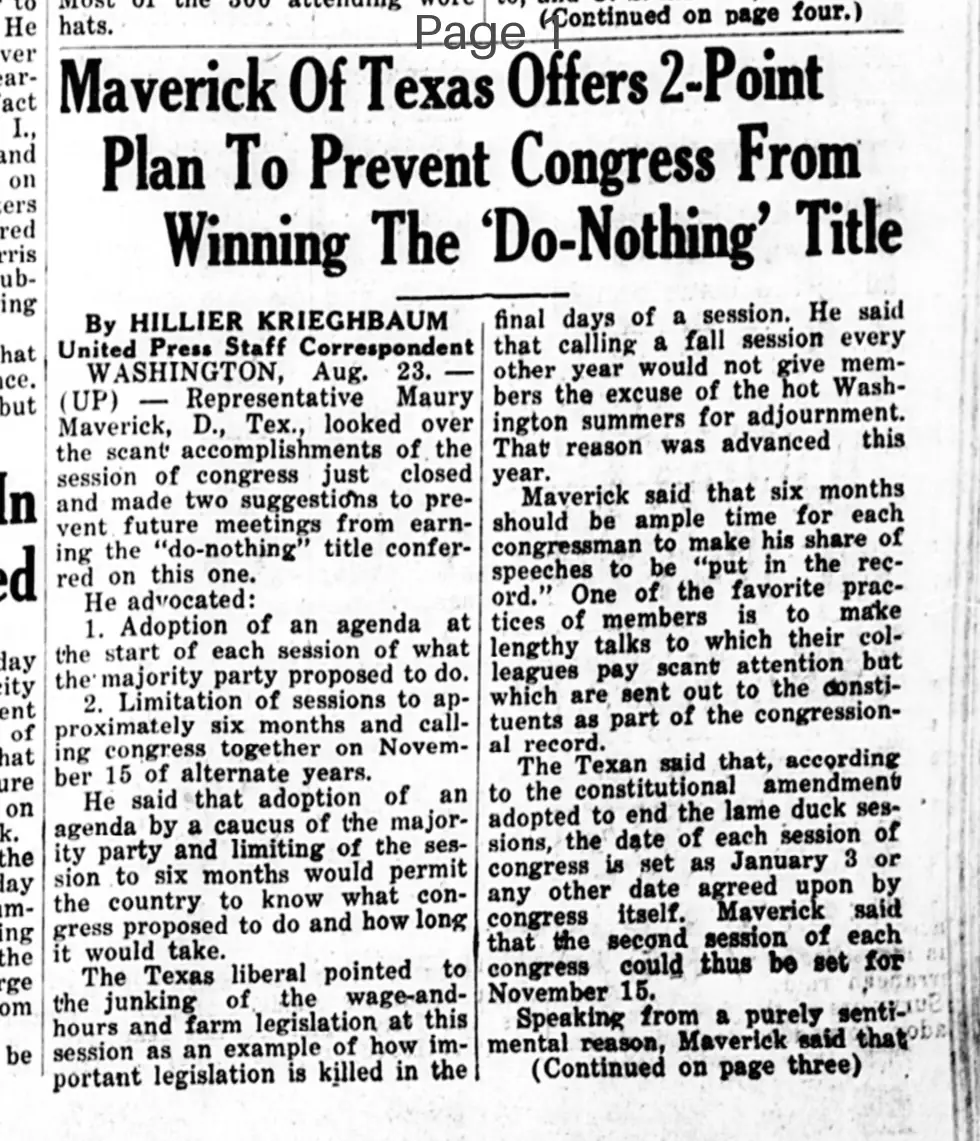
By HILLIER KRIEGHBAUM United Press Staff Correspondent WASHINGTON, Aug. 23. (UP) - Representative Maury Maverick, D., Tex., looked over the scant accomplishments of the session of congress just closed and made two suggestions to prevent future meetings from earning the "do-nothing" title conferred on this one. He advocated: 1. Adoption of an agenda at the start of each session of what the majority party proposed to do. 2. Limitation of sessions to approximately six months and calling congress together on November 15 of alternate years. He said that adoption of an agenda by a caucus of the majority party and limiting of the session to six months would permit the country to know what congress proposed to do and how long it would take. The Texas liberal pointed to the junking of the wage-and-hours and farm legislation at this session as an example of how important legislation is killed in the final days of a session. He said that calling a fall session every other year would not give members the excuse of the hot Washington summers for adjournment. That reason was advanced this year. Maverick said that six months should be ample time for each congressman to make his share of speeches to be "put in the record." One of the favorite practices of members is to make lengthy talks to which their colleagues pay scant attention but which are sent out to the constituents as part of the congressional record. The Texan said that, according to the constitutional amendment adopted to end the lame duck sessions, the date of each session of congress is set as January 3 or any other date agreed upon by congress itself. Maverick said that the second session of each congress could thus be set for November 15. Speaking from a purely sentimental reason, Maverick said that (Continued on page three)
MAVERICK OFFERS PLAN TO ASSURE ACTION BY SOLONS
(Continued from page one)
he had to leave each year on Christmas day to drive up to Washington from Texas in time for the January 3 opening. He explained that he missed spring away from home each year and felt that every congressman would be a better representative if he had a whole year-round background of how his district lived.
Thus, he said, the second session of each congress could begin on November 15 and quit late in March or early in April.
READ THE WANT ADS.
What sub-type of article is it?
What keywords are associated?
What entities or persons were involved?
Where did it happen?
Domestic News Details
Primary Location
Washington
Event Date
Aug. 23
Key Persons
Event Details
Representative Maury Maverick, D., Tex., proposed two suggestions to prevent future Congress sessions from earning the 'do-nothing' title: 1. Adoption of an agenda at the start of each session outlining what the majority party proposes to do. 2. Limitation of sessions to approximately six months, with Congress called together on November 15 of alternate years. He highlighted the junking of wage-and-hours and farm legislation as an example of important bills killed in final days, and noted that fall sessions would avoid excuses like hot Washington summers. Maverick argued six months is ample for speeches and that alternate-year scheduling aligns with the constitutional amendment ending lame duck sessions, allowing better representation with a full year home.