Thank you for visiting SNEWPapers!
Sign up free
Virginia Argus
Richmond, Virginia
What is this article about?
A 1806 republication of a 1804 diplomatic dispatch by US Secretary of State James Madison to Minister James Monroe argues against British impressment of American and foreign seamen from neutral vessels on the high seas, citing violations of international law, treaties, and justice, as a reason for declining a recent treaty draft.
Clipping
OCR Quality
Full Text
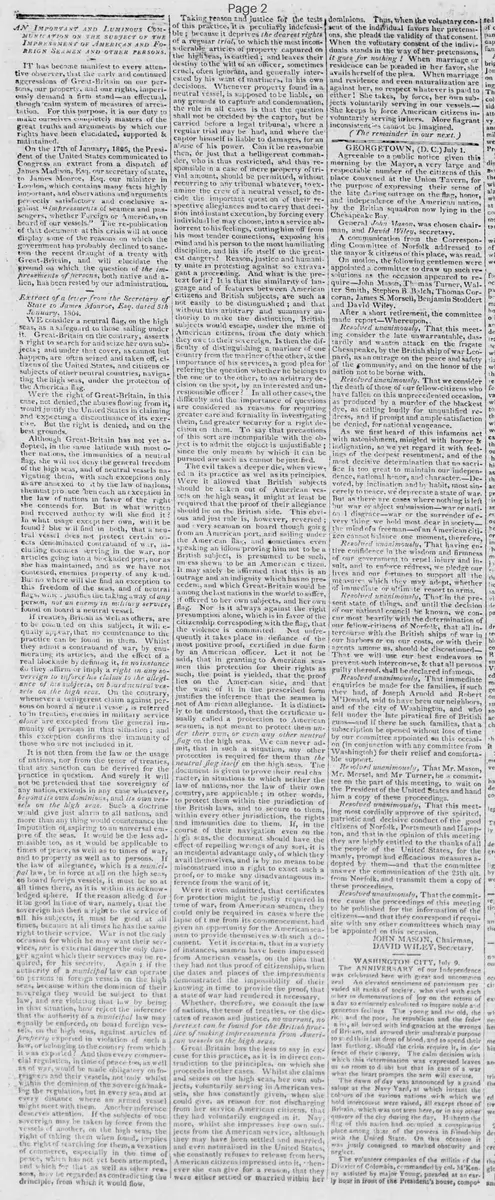
It has become manifest to every attentive observer, that the early and continued aggressions of Great-Britain on our persons, our property, and our rights, imperiously demand a firm stand—an effectual, though calm system of measures of arrestation. For this purpose, it is our duty to make ourselves completely masters of the great truths and arguments by which our rights have been elucidated, supported & maintained.
On the 17th of January, 1806, the President of the United States communicated to Congress an extract from a dispatch of James Madison, Esq. our secretary of state, to James Monroe, Esq. our minister in London, which contains many facts highly important, and observations and arguments perfectly satisfactory and conclusive against "impressments of seamen and passengers, whether Foreign or American, on board of our vessels." The re-publication of that document at this crisis will at once display some of the reasons on which the government has probably declined to sanction the recent draught of a treaty with Great-Britain, and will elucidate the ground on which the question of the impressments of persons, both native and alien, has been rested by our administration.
Extract of a letter from the Secretary of State to James Monroe, Esq. dated 5th January, 1804.
We consider a neutral flag, on the high seas, as a safeguard to those sailing under it. Great-Britain on the contrary, asserts a right to search for and seize her own subjects; and under that cover, as cannot but happen, are often seized and taken off, citizens of the United States, and citizens or subjects of other neutral countries, navigating the high seas, under the protection of the American flag.
Were the right of Great-Britain, in this case, not denied, the abuses flowing from it, would justify the United States in claiming and expecting a discontinuance of its exercise. But the right is denied, and on the best grounds.
Although Great-Britain has not yet adopted, in the same latitude with most other nations, the immunities of a neutral flag, she will not deny the general freedom of the high seas, and of neutral vessels navigating them, with such exceptions only as are annexed to it by the law of nations, she must produce her each an exception in the law of nations in favor of the right she contends for. But in what written and received authority will she find it? In what usage except her own, will it be found? She will find in both, that a neutral vessel does not protect certain objects denominated contraband of war, including enemies serving in the war, nor articles going into a blockaded port, nor as she has maintained, and as we have not contested, enemies property of any kind. But no where will she find an exception to this freedom of the seas, and of neutral flags, which justifies the taking away of any person, not an enemy in military service, found on board a neutral vessel.
If treaties, British as well as others, are to be consulted on this subject, it will equally appear, that no countenance to the practice can be found in them. Whilst they admit a contraband of war, by enumerating its articles, and the effect of a real blockade by defining it, in no instance do they affirm or imply a right in any sovereign to enforce his claims to the allegiance of his subjects, on board neutral vessels on the high seas. On the contrary, whenever a belligerent claim against persons on board a neutral vessel, is referred to in treaties, enemies in military service alone are excepted from the general immunity of persons in that situation; and this exception confirms the immunity of those who are not included in it.
It is not then from the law or the usage of nations, nor from the tenor of treaties, that any sanction can be derived for the practice in question. And surely it will not be pretended that the sovereignty of any nation, extends in any case whatever, beyond its own dominions, and its own vessels on the high seas. Such a doctrine would give just alarm to all nations, and more than any thing would countenance the imputation of aspiring to a universal empire of the seas. It would be the less admissible too, as it would be applicable to times of peace, as well as to times of war, and to property as well as to persons. If the law of allegiance, which is a municipal law, be in force at all on the high seas, on board foreign vessels, it must be so at all times there, as it is within its acknowledged sphere. If the reason alleged for it be good in time of war, namely, that the sovereign has then a right to the service of all his subjects, it must be good at all times, because at all times he has the same right to their service. War is not the only occasion for which he may want their services, nor is external danger the only danger against which their services may be required, for his security. Again; if the authority of a municipal law can operate on persons in foreign vessels on the high seas, because within the dominion of their sovereign they would be subject to that law, and are violating that law by being in that situation, how reject the inference that the authority of a municipal law may equally be enforced, on board foreign vessels, on the high seas, against articles of property exported in violation of such a law, or belonging to the country from which it was exported? And thus every commercial regulation, in time of peace too, as well as of war, would be made obligatory on foreigners and their vessels, not only whilst within the dominion of the sovereign making the regulation, but in every sea, and at every distance where an armed vessel might meet with them. Another inference deserves attention. If the subjects of one sovereign may be taken by force from the vessels of another, on the high seas, the right of taking them when found, implies the right of searching for them, a vexation of commerce, especially in the time of peace, which has not yet been attempted, and which for that as well as other reasons, may be regarded as contradicting the principle, from which it would flow.
Taking reason and justice for the tests of this practice, it is peculiarly indefensible; because it deprives the dearest rights of a regular trial, to which the most inconsiderable articles of property captured on the high seas, is entitled; and leaves their destiny to the will of an officer, sometimes cruel, often ignorant, and generally interested by his want of mariners, in his own decisions. Whenever property found in a neutral vessel, is supposed to be liable, on any grounds to capture and condemnation, the rule in all cases is that the question shall not be decided by the captor, but be carried before a legal tribunal, where a regular trial may be had, and where the captor himself is liable to damages, for an abuse of his power. Can it be reasonable then, or just that a belligerent commander, who is thus restricted, and thus responsible in a case of mere property of trivial amount, should be permitted, without recurring to any tribunal whatever, to examine the crew of a neutral vessel, to decide the important question of their respective allegiances and to carry that decision into instant execution, by forcing every individual he may choose, into a service abhorrent to his feelings, cutting him off from his most tender connections, exposing his mind and his person to the most humiliating discipline, and his life itself to the greatest dangers? Reason, justice and humanity unite in protesting against so extravagant a proceeding. And what is the pretext for it? It is that the similarity of language and of features between American citizens and British subjects, are such as not easily to be distinguished; and that without this arbitrary and summary authority to make the distinction, British subjects would escape, under the name of American citizens, from the duty which they owe to their sovereign. Is then the difficulty of distinguishing a mariner of one country from the mariner of the other, & the importance of his services, a good plea for referring the question whether he belongs to the one or to the other, to an arbitrary decision on the spot, by an interested and irresponsible officer? In all other cases, the difficulty and the importance of questions are considered as reasons for requiring greater care and formality in investigating them, and greater security for a right decision on them. To say that precautions of this sort are incompatible with the object is to admit the object is unjustifiable; since the only means by which it can be pursued are such as cannot be justified.
The evil takes a deeper die, when viewed in its practice as well as its principles. Were it allowed that British subjects should be taken out of American vessels on the high seas, it might at least be required that the proof of their allegiance should lie on the British side. This obvious and just rule is, however, reversed; and every seaman on board though going from an American port, and sailing under the American flag, and sometimes even speaking an idiom proving him not to be a British subject, is presumed to be such, unless shewn to be an American citizen. It may safely be affirmed that this is an outrage and an indignity which has no precedent, and which Great-Britain would be among the last nations in the world to suffer, if offered to her own subjects, and her own flag. Nor is it always against the right presumption alone, which is in favor of the citizenship corresponding with the flag, that the violence is committed. Not unfrequently it takes place in defiance of the most positive proof, certified in due form by an American officer. Let it not be said, that in granting to American seamen this protection for their rights as such, the point is yielded, that the proof lies on the American side, and that the want of it in the prescribed form justifies the inference that the seaman is not of American allegiance. It is distinctly to be understood, that the certificate usually called a protection to American seamen, is not meant to protect them under their own, or even any other neutral flag on the high seas. We can never admit, that in such a situation, any other protection is required for them than the neutral flag itself on the high seas. The document is given to prove their real character, in situations to which neither the law of nations, nor the law of their own country, are applicable; in other words, to protect them within the jurisdiction of the British laws, and to secure to them, within every other jurisdiction, the rights and immunities due to them. If, in the course of their navigation even on the high seas, the document should have the effect of repelling wrongs of any sort, it is an incidental advantage only, of which they avail themselves, and is by no means to be misconstrued into a right to exact such a proof, or to make any disadvantageous inference from the want of it.
Were it even admitted, that certificates for protection might be justly required in time of war, from American seamen, they could only be required in cases where the lapse of time from its commencement, had given an opportunity for the American seamen to provide themselves with such a document. Yet it is certain, that in a variety of instances, seamen have been impressed from American vessels, on the plea that they had not this proof of citizenship, when the dates and places of the impressments demonstrated the impossibility of their knowing in time to provide the proof, that a state of war had rendered it necessary.
Whether, therefore, we consult the law of nations, the tenor of treaties, or the dictates of reason and justice, no warrant, no pretext can be found for the British practice of making impressments from American vessels on the high seas.
Great Britain has the less to say in excuse for this practice, as it is in direct contradiction to the principles, on which she proceeds in other cases. Whilst she claims and seizes on the high seas, her own subjects, voluntarily serving in American vessels, she has constantly given, when she could give, as reason for not discharging from her service American citizens, that they had voluntarily engaged in it. Nay, more, whilst she impresses her own subjects from the American service, although they may have been settled and married, and even naturalised in the United States, she constantly refuses to release from hers, American citizens impressed into it, whenever she can give for a reason, that they were either settled or married within her dominions. Thus, when the voluntary consent of the individual favors her pretensions, she pleads the validity of that consent. When the voluntary consent of the individuals stands in the way of her pretensions, it goes for nothing! When marriage or residence can be pleaded in her favor, she avails herself of the plea. When marriage and residence and even naturalization are against her, no respect whatever is paid to either! She takes, by force, her own subjects voluntarily serving in our vessels.--She keeps by force American citizens involuntarily serving in hers. More flagrant inconsistencies cannot be imagined.
(The remainder in our next.)
What sub-type of article is it?
What keywords are associated?
What entities or persons were involved?
Where did it happen?
Foreign News Details
Primary Location
High Seas
Event Date
5th January, 1804; 17th Of January, 1806
Key Persons
Outcome
arguments against british impressment practice; grounds for declining recent treaty with great britain
Event Details
Extract from Madison's letter details US position that neutral flag protects seamen on high seas; denies British right to search and seize subjects from American vessels; cites law of nations, treaties, reason, and justice; highlights inconsistencies in British practices and abuses in impressment.