Thank you for visiting SNEWPapers!
Sign up free
Knoxville Daily Chronicle
Knoxville, Knox County, Tennessee
What is this article about?
U.S. Congress proceedings on April 21 in Washington: Senate reports and debates on naval tobacco purchases, Key West wharf, North Pacific railroad, pension for scout Jesse F. Phares (passed), Geneva award bill (postponed), Arctic expedition, southern railways, and army appropriation. House debates deficiency bill debate limit (withdrawn), agriculture resolution with tariff amendment and discussion.
Merged-components note: Merged sequential Senate and House congressional proceedings into a single domestic news component on government activities.
Clipping
OCR Quality
Full Text
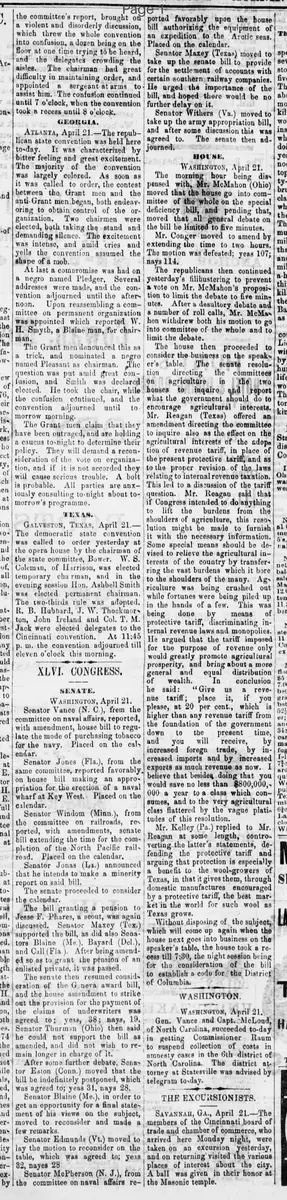
SENATE.
WASHINGTON, April 21.
Senator Vance (N. C.), from the committee on naval affairs, reported, with amendment, house bill to regulate the mode of purchasing tobacco for the navy. Placed on the calendar.
Senator Jones (Fla.), from the same committee, reported favorably on house bill making an appropriation for the erection of a naval wharf at Key West. Placed on the calendar.
Senator Windom (Minn.), from the committee on railroads, reported, with amendments, senate bill extending the time for the completion of the North Pacific railroad. Placed on the calendar.
Senator Jonas (La.) announced that he intends to make a minority report on said bill.
The senate proceeded to consider the calendar.
The bill granting a pension to Jesse F. Phares, a scout, was again discussed. Senator Maxey (Tex.) supported the bill, as did also Senators Blaine (Me.), Bayard (Del.), and Call (Fla.). After being amended so as to grant the pension of an enlisted private, it was passed.
The senate then resumed consideration of the Geneva award bill, and the house amendment to strike out the provision for the payment of the claims of underwriters was agreed to: yeas, 38; nays, 19.
Senator Thurman (Ohio) then said he could not support the bill as amended, and did not wish to remain longer in charge of it.
After some further debate, Senator Eaton (Conn.) moved that the bill be indefinitely postponed, which was agreed to; yeas 31, nays 28.
Senator Blaine (Me.), in order to get an opportunity for a final statement of his views on the subject, moved to reconsider and made a few remarks.
Senator Edmunds (Vt.) moved to lay the motion to reconsider on the table, which was agreed to; yeas 32, nays 28.
Senator McPherson (N. J.), from the committee on naval affairs reported favorably upon the house bill authorizing the equipment of an expedition to the Arctic seas. Placed on the calendar.
Senator Maxey (Texas) moved to take up the senate bill to provide for the settlement of accounts with certain southern railway companies.
He urged the importance of the bill, and hoped there would be no further delay on it.
Senator Withers (Va.) moved to take up the army appropriation bill, and after some discussion this was agreed to.
The senate then adjourned.
HOUSE.
WASHINGTON, April 21.
The morning hour being dispensed with, Mr. McMahon (Ohio) moved that the house go into committee of the whole on the special deficiency bill, and pending that, moved that all general debate on the bill be limited to five minutes.
Mr. Conger moved to amend by extending the time to two hours.
The motion was defeated; yeas 107; nays 114.
The republicans then continued yesterday's filibustering to prevent a vote on Mr. McMahon's proposition to limit the debate to five minutes. After a desultory debate and a number of roll calls, Mr. McMahon withdrew both his motion to go into committee of the whole and to limit the debate.
The house then proceeded to consider the business on the speaker's table. The senate resolution directing the committees on agriculture in the two houses to inquire and report what the government should do to encourage agricultural interests.
Mr. Reagan (Texas) offered an amendment directing the committee to inquire also as the effect on the agricultural interests of the adoption of revenue tariff, in place of the present protective tariff, and as to the proper revision of the laws relating to internal revenue taxation.
This led to a discussion of the tariff question. Mr. Reagan said that if Congress intended to do anything to lift the burdens from the shoulders of agriculture, this resolution might be made to furnish it with the necessary information.
Some special means should be devised to relieve the agricultural interests of the country by transferring the vast burdens which it bore to the shoulders of the many. Agriculture was being crushed out while fortunes were being piled up in the hands of a few. This was being done by means of protective tariff, discriminating internal revenue laws and monopolies.
He argued that the tariff imposed for the purpose of revenue only would greatly promote agricultural prosperity, and bring about a more general and equal distribution of wealth.
In conclusion he said:
"Give us a revenue tariff; place it, if you please, at 20 per cent., which is higher than any revenue tariff from the foundation of the government down to the present time, and you will receive, by increased foreign trade, by increased imports and by increased exports as much revenue as now. I believe that besides doing that you would save no less than $80,000,000 a year to a class which consumes, and to the very agricultural class flattered by the vague platitudes of this resolution."
Mr. Kelley (Pa.) replied to Mr. Reagan at some length, controverting the latter's statements, defending the protective tariff and arguing that protection is especially a benefit to the wool-growers of Texas, in that it gives them, through domestic manufactures encouraged by a protective tariff, the best market in the world for such wool as Texas grows.
Without disposing of the subject, which will come up again when the house next goes into business on the speaker's table, the house took a recess till 7:30, the night session being for the consideration of the bill to establish a code for the District of Columbia.
What sub-type of article is it?
What keywords are associated?
What entities or persons were involved?
Where did it happen?
Domestic News Details
Primary Location
Washington
Event Date
April 21
Key Persons
Outcome
house bill to regulate tobacco purchases for navy reported with amendment, placed on calendar; house bill for key west naval wharf reported favorably, placed on calendar; senate bill extending north pacific railroad time reported with amendments, placed on calendar; minority report announced; pension bill for jesse f. phares passed as amended; house amendment to geneva award bill agreed to (yeas 38, nays 19); bill indefinitely postponed (yeas 31, nays 28); motion to reconsider laid on table (yeas 32, nays 28); house bill for arctic expedition reported favorably, placed on calendar; motion to take up southern railways bill; army appropriation bill taken up; morning hour dispensed, motion to limit debate to five minutes defeated (yeas 107, nays 114); motions withdrawn after filibustering; senate agriculture resolution considered with reagan's tariff amendment; discussion on tariff and agriculture; house recessed till 7:30 for district of columbia code bill.
Event Details
Senate: Reports from committees on naval affairs (tobacco purchases, Key West wharf), railroads (North Pacific extension), favorable on Arctic expedition; Discussions and passage of Phares pension; Consideration and postponement of Geneva award bill; Moves on southern railways and army appropriation bills; Adjournment. House: Attempt to enter committee on deficiency bill with limited debate, defeated and withdrawn after Republican filibustering; Consideration of speaker's table including agriculture resolution; Reagan's amendment on tariff effects; Debate between Reagan and Kelley on protective tariff vs. revenue tariff benefits to agriculture; Recess for night session on D.C. code.