Thank you for visiting SNEWPapers!
Sign up free
Story
May 17, 1905
The Adair County News
Columbia, Adair County, Kentucky
What is this article about?
Urban dust from streets and household cleaning threatens health by spreading disease microbes, causing discomfort; emerging inventions promise dustless streets and homes, potentially more efficient than current $20M annual city spending.
Clipping
OCR Quality
98%
Excellent
Full Text
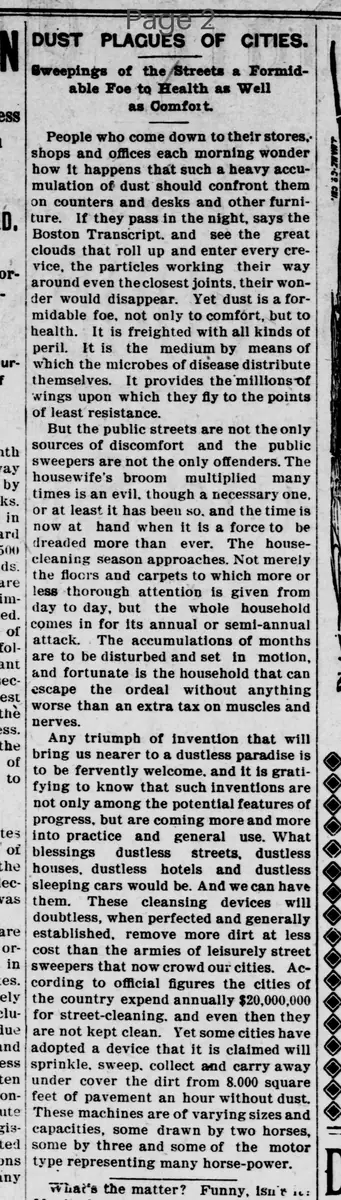
DUST PLAGUES OF CITIES.
Sweepings of the Streets a Formidable Foe to Health as Well as Comfort.
People who come down to their stores, shops and offices each morning wonder how it happens that such a heavy accumulation of dust should confront them on counters and desks and other furniture. If they pass in the night, says the Boston Transcript, and see the great clouds that roll up and enter every crevice, the particles working their way around even the closest joints, their wonder would disappear. Yet dust is a formidable foe, not only to comfort, but to health. It is freighted with all kinds of peril. It is the medium by means of which the microbes of disease distribute themselves. It provides the millions of wings upon which they fly to the points of least resistance.
But the public streets are not the only sources of discomfort and the public sweepers are not the only offenders. The housewife's broom multiplied many times is an evil, though a necessary one, or at least it has been so, and the time is now at hand when it is a force to be dreaded more than ever. The house-cleaning season approaches. Not merely the floors and carpets to which more or less thorough attention is given from day to day, but the whole household comes in for its annual or semi-annual attack. The accumulations of months are to be disturbed and set in motion, and fortunate is the household that can escape the ordeal without anything worse than an extra tax on muscles and nerves.
Any triumph of invention that will bring us nearer to a dustless paradise is to be fervently welcome, and it is gratifying to know that such inventions are not only among the potential features of progress, but are coming more and more into practice and general use. What blessings dustless streets, dustless houses, dustless hotels and dustless sleeping cars would be. And we can have them. These cleansing devices will doubtless, when perfected and generally established, remove more dirt at less cost than the armies of leisurely street sweepers that now crowd our cities. According to official figures the cities of the country expend annually $20,000,000 for street-cleaning, and even then they are not kept clean. Yet some cities have adopted a device that it is claimed will sprinkle, sweep, collect and carry away under cover the dirt from 8,000 square feet of pavement an hour without dust. These machines are of varying sizes and capacities, some drawn by two horses, some by three and some of the motor type representing many horse-power.
Sweepings of the Streets a Formidable Foe to Health as Well as Comfort.
People who come down to their stores, shops and offices each morning wonder how it happens that such a heavy accumulation of dust should confront them on counters and desks and other furniture. If they pass in the night, says the Boston Transcript, and see the great clouds that roll up and enter every crevice, the particles working their way around even the closest joints, their wonder would disappear. Yet dust is a formidable foe, not only to comfort, but to health. It is freighted with all kinds of peril. It is the medium by means of which the microbes of disease distribute themselves. It provides the millions of wings upon which they fly to the points of least resistance.
But the public streets are not the only sources of discomfort and the public sweepers are not the only offenders. The housewife's broom multiplied many times is an evil, though a necessary one, or at least it has been so, and the time is now at hand when it is a force to be dreaded more than ever. The house-cleaning season approaches. Not merely the floors and carpets to which more or less thorough attention is given from day to day, but the whole household comes in for its annual or semi-annual attack. The accumulations of months are to be disturbed and set in motion, and fortunate is the household that can escape the ordeal without anything worse than an extra tax on muscles and nerves.
Any triumph of invention that will bring us nearer to a dustless paradise is to be fervently welcome, and it is gratifying to know that such inventions are not only among the potential features of progress, but are coming more and more into practice and general use. What blessings dustless streets, dustless houses, dustless hotels and dustless sleeping cars would be. And we can have them. These cleansing devices will doubtless, when perfected and generally established, remove more dirt at less cost than the armies of leisurely street sweepers that now crowd our cities. According to official figures the cities of the country expend annually $20,000,000 for street-cleaning, and even then they are not kept clean. Yet some cities have adopted a device that it is claimed will sprinkle, sweep, collect and carry away under cover the dirt from 8,000 square feet of pavement an hour without dust. These machines are of varying sizes and capacities, some drawn by two horses, some by three and some of the motor type representing many horse-power.
What sub-type of article is it?
Curiosity
Medical Curiosity
What themes does it cover?
Misfortune
Triumph
What keywords are associated?
Urban Dust
Health Hazards
Street Cleaning
House Cleaning
Dust Inventions
Microbes
Public Health
Where did it happen?
Cities
Story Details
Location
Cities
Story Details
Dust from streets and house cleaning poses health risks by spreading microbes; inventions for dustless cleaning are emerging to improve urban hygiene and efficiency.