Thank you for visiting SNEWPapers!
Sign up free
Story
August 26, 1882
The Grenada Sentinel
Grenada, Grenada County, Mississippi
What is this article about?
A gardener's experiment pinching pea vines on rich land yielded 25% more peas and extended the harvest period, as detailed in a report from the American Garden.
Clipping
OCR Quality
100%
Excellent
Full Text
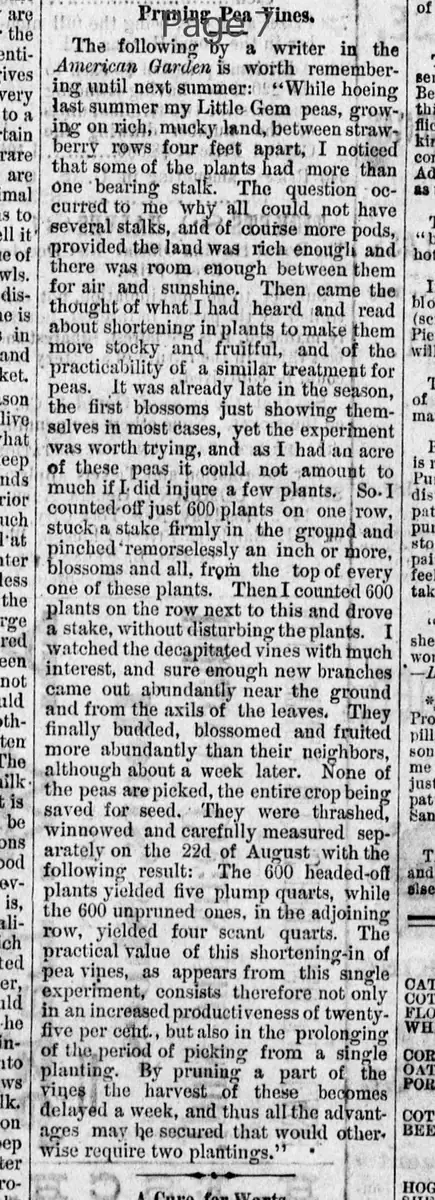
The following by a writer in the American Garden is worth remembering until next summer: "While hoeing last summer my Little Gem peas, growing on rich, mucky land, between strawberry rows four feet apart, I noticed that some of the plants had more than one bearing stalk. The question occurred to me why all could not have several stalks, and of course more pods, provided the land was rich enough and there was room enough between them for air and sunshine. Then came the thought of what I had heard and read about shortening in plants to make them more stocky, and fruitful, and of the practicability of a similar treatment for peas. It was already late in the season, the first blossoms just showing themselves in most cases, yet the experiment was worth trying, and as I had an acre of these peas it could not amount to much if I did injure a few plants. So I counted off just 600 plants on one row, stuck a stake firmly in the ground and pinched remorselessly an inch or more, blossoms and all, from the top of every one of these plants. Then I counted 600 plants on the row next to this and drove a stake, without disturbing the plants. I watched the decapitated vines with much interest, and sure enough new branches came out abundantly near the ground and from the axils of the leaves. They finally budded, blossomed and fruited more abundantly than their neighbors, although about a week later. None of the peas are picked, the entire crop being saved for seed. They were thrashed, winnowed and carefully measured separately on the 22d of August with the following result: The 600 headed-off plants yielded five plump quarts, while the 600 unpruned ones, in the adjoining row, yielded four scant quarts. The practical value of this shortening-in of pea vines, as appears from this single experiment, consists therefore not only in an increased productiveness of twenty-five per cent., but also in the prolonging of the period of picking from a single planting. By pruning a part of the vines the harvest of these becomes delayed a week, and thus all the advantages may be secured that would otherwise require two plantings."
What sub-type of article is it?
Curiosity
Personal Triumph
What themes does it cover?
Triumph
Nature
What keywords are associated?
Pea Pruning
Gardening Experiment
Yield Increase
Plant Shortening
Where did it happen?
Rich, Mucky Land Between Strawberry Rows Four Feet Apart
Story Details
Location
Rich, Mucky Land Between Strawberry Rows Four Feet Apart
Event Date
Last Summer, Measured On The 22d Of August
Story Details
A gardener experimented by pinching the tops of 600 pea plants to encourage more stalks and pods, resulting in a 25% higher yield (five plump quarts vs. four scant quarts) and a delayed harvest by a week compared to 600 unpruned plants.