Thank you for visiting SNEWPapers!
Sign up free
The Virginia Gazette
Richmond, Williamsburg, Richmond County, Virginia
What is this article about?
Vienna dispatch reports the Imperial army under Prince Liechtenstein's victory over combined French, Spanish, and Genoese forces near Placentia on June 16, 1746 (N.S.). The battle involved intense fighting on both wings, resulting in 4000 enemy prisoners, 27 colors, 3 standards, and 5 cannons captured; Imperial losses around 2000 men.
Clipping
OCR Quality
Full Text
VIENNA, June 26, N.S.
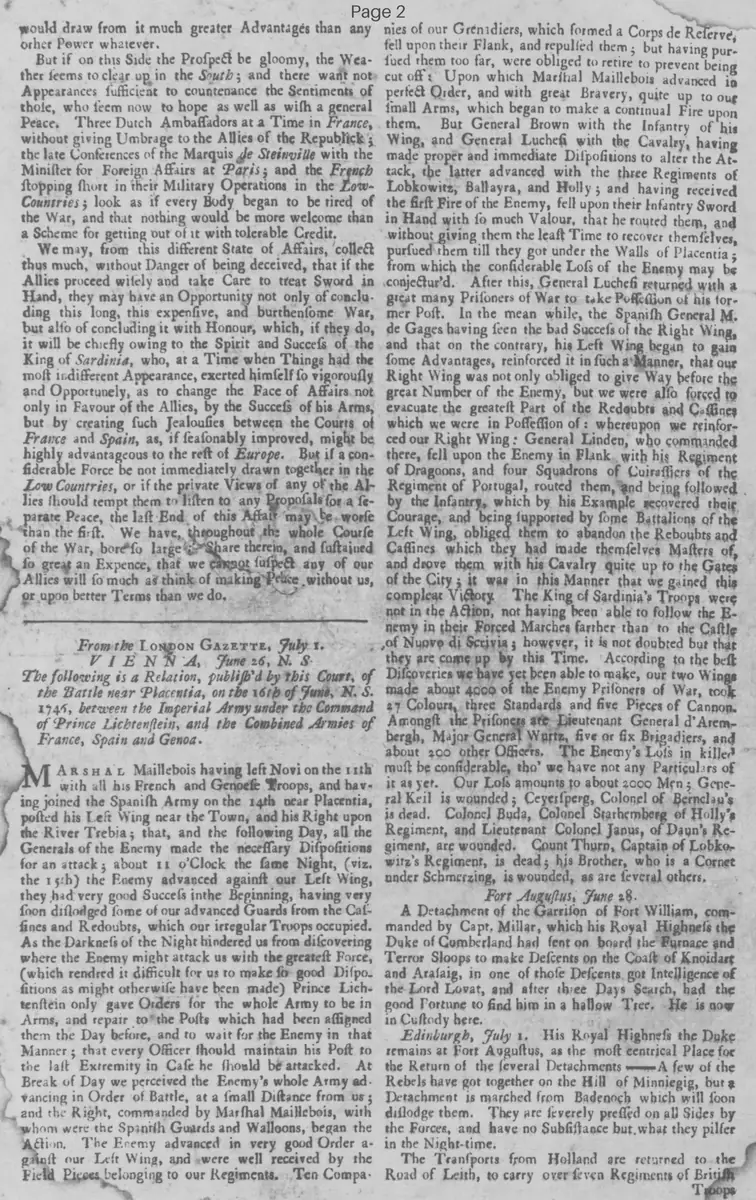
The following is a Relation, publish'd by this Court, of the Battle near Placentia, on the 16th of June, N.S. 1746, between the Imperial Army under the Command of Prince Liechtenstein, and the Combined Armies of France, Spain and Genoa.
MARSHAL Maillebois having left Novi on the 11th with all his French and Genoese Troops, and having joined the Spanish Army on the 14th near Placentia, posted his Left Wing near the Town, and his Right upon the River Trebia; that, and the following Day, all the Generals of the Enemy made the necessary Dispositions for an attack; about II o'Clock the same Night, (viz. the 15th) the Enemy advanced against our Left Wing, they had very good Success in the Beginning, having very soon dislodged some of our advanced Guards from the Cafines and Redoubts, which our irregular Troops occupied. As the Darkness of the Night hindered us from discovering where the Enemy might attack us with the greatest Force, (which rendered it difficult for us to make so good Dispositions as might otherwise have been made) Prince Liechtenstein only gave Orders for the whole Army to be in Arms, and repair to the Posts which had been assigned them the Day before, and to wait for the Enemy in that Manner; that every Officer should maintain his Post to the last Extremity in Case he Should be attacked. At Break of Day we perceived the Enemy's whole Army advancing in Order of Battle, at a small Distance from us; and the Right, commanded by Marshal Maillebois, with whom were the Spanish Guards and Walloons, began the Action. The Enemy advanced in very good Order against our Left Wing, and were well received by the Field Pieces belonging to our Regiments. Ten Companies of our Grenadiers, which formed a Corps de Reserve, fell upon their Flank, and repulsed them; but having pursued them too far, were obliged to retire to prevent being cut off: Upon Which Marshal Maillebois advanced in perfect Order, and with great Bravery, quite up to our small Arms, which began to make a continual Fire upon them. But General Brown with the Infantry of his Wing, and General Luchesi with the Cavalry, having made proper and immediate Dispositions to alter the Attack, the latter advanced with the three Regiments of Lobkowitz, Ballayra, and Holly; and having received the first Fire of the Enemy, fell upon their Infantry Sword in Hand with so much Valour, that he routed them, and without giving them the least Time to recover themselves, pursued them till they got under the Walls of Placentia; from which the considerable Loss of the Enemy may be conjectur'd. After this, General Luchesi returned with a great many Prisoners of War to take Possession of his former Post. In the mean while, the Spanish General M. de Gages having seen the bad Success of the Right Wing, and that on the contrary, his Left Wing began to gain some Advantages, reinforced it in such a Manner, that our Right Wing was not only obliged to give Way before the great Number of the Enemy, but we were also forced to evacuate the greatest Part of the Redoubts and Cafines which we were in Possession of: whereupon we reinforced our Right Wing: General Linden, who commanded there, fell upon the Enemy in Flank with his Regiment of Dragoons, and four Squadrons of Cuirassiers of the Regiment of Portland, routed them, and being followed by the Infantry, which by his Example recovered their Courage, and being supported by some Battalions of the Left Wing, obliged them to abandon the Redoubts and Cafines which they had made themselves Masters of, and drove them with his Cavalry quite up to the Gates of the City; it was in this Manner that we gained this complete Victory. The King of Sardinia's Troops were not in the Action, not having been able to follow the Enemy in their Forced Marches farther than to the Castle of Nuovo di Scrivia; however, it is not doubted but that they are come up by this Time. According to the best Discoveries we have yet been able to make, our two Wings made about 4000 of the Enemy Prisoners of War, took 27 Colours, three Standards and five Pieces of Cannon. Amongst the Prisoners are Lieutenant General d'Aremberg, Major General Wurtz, five or six Brigadiers, and about 200 other Officers, The Enemy's Loss in killed must be considerable, tho' we have not any Particulars of it as yet. Our Loss amounts to about 2000 Men; General Keil is wounded; Ceyerperg, Colonel of Bernclau's is dead. Colonel Buda, Colonel Starhemberg of Holly Regiment, and Lieutenant Colonel Janus, of Daun's Regiment, are wounded. Count Thurn, Captain of Lobkowitz's Regiment, is dead; his Brother, who is a Cornet under Schmerzing, is wounded, as are several others.
What sub-type of article is it?
What keywords are associated?
What entities or persons were involved?
Where did it happen?
Foreign News Details
Primary Location
Placentia
Event Date
16th Of June, N.S. 1746
Key Persons
Outcome
imperial victory; about 4000 enemy prisoners, 27 colours, three standards, five pieces of cannon captured; enemy killed considerable but unspecified; imperial loss about 2000 men; wounded: general keil, colonel buda, colonel starhemberg, lieutenant colonel janus; dead: ceyerperg (colonel of bernclau's), count thurn.
Event Details
Marshal Maillebois joined Spanish forces near Placentia and attacked Imperial left wing at night on June 15. At dawn on June 16, enemy advanced; Imperial grenadiers repulsed them initially. General Luchesi routed enemy right wing with cavalry, pursuing to Placentia walls and capturing prisoners. On Imperial right, enemy gained ground but General Linden counterattacked with dragoons and cuirassiers, retaking positions and driving enemy to city gates. King of Sardinia's troops arrived late.