Thank you for visiting SNEWPapers!
Sign up free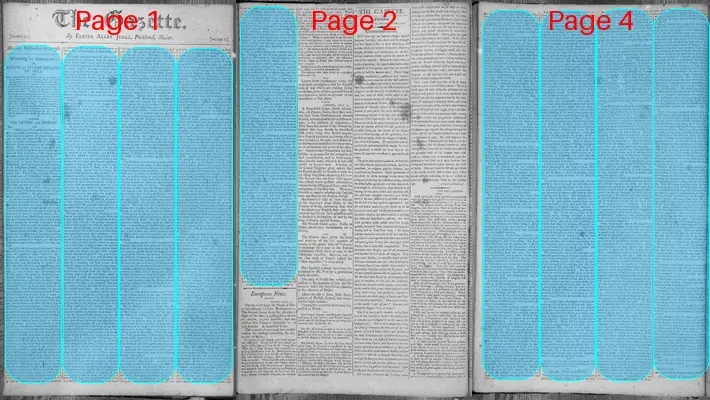
The Gazette
Portland, Cumberland County, Maine
What is this article about?
A detailed eyewitness letter recounts the French Directory's diplomatic and military maneuvers leading to the overthrow of the Swiss cantons' governments in early 1798, the invasion of Berne and Fribourg, establishment of the Helvetic Republic, and the forced annexation of Geneva into France, warning Americans of similar threats.
Merged-components note: This is a single continued article across pages 1, 2, and 4 detailing the fall of the Swiss government, French conduct towards Geneva, and a warning to Americans.
Clippings
1 of 3
OCR Quality
Full Text
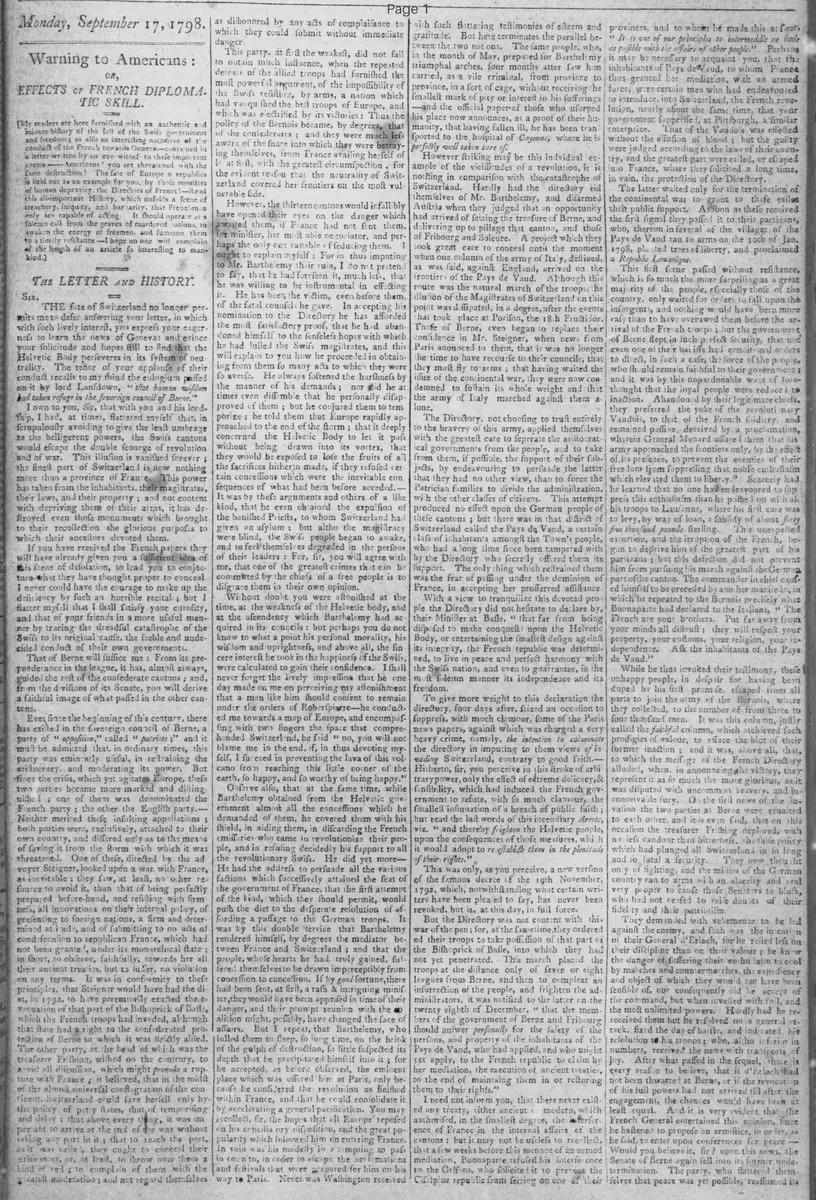
Warning to Americans:
OR,
EFFECTS OF FRENCH DIPLOMATIC SKILL.
(My readers are here furnished with an authentic and minute history of the fall of the Swiss government and freedom; as also an interesting narrative of the conduct of the French towards Geneva—contained in a letter written by an eye witness to these important events—Americans! you are threatened with the same destruction! The fate of European republics is held out as an example for you, by those monsters of human depravity, the Directors of France!—Read this all-important History, which unfolds a scene of treachery, iniquity, and barbarity, that Frenchmen only are capable of acting. It should operate as a solemn call from the graves of murdered nations, to awaken the energy of freemen, and summon them to a timely resistance—I hope no one will complain of the length of an article so interesting to mankind.]
THE LETTER AND HISTORY
SIR,
THE fate of Switzerland no longer permits me to defer answering your letter, in which with such lively interest, you express your eagerness to learn the news of Geneva: and evince your solicitude and hopes still to find that the Helvetic Body perseveres in its system of neutrality. The tenor of your applause of their conduct recalls to my mind the eulogium passed on it by lord Lansdowne, "that human wisdom had taken refuge in the sovereign council of Berne."
I own to you, Sir, that with you and his lordship, I had, at times, flattered myself that, in scrupulously avoiding to give the least umbrage to the belligerent powers, the Swiss cantons would escape the double curse of revolution and of war. This illusion is vanished forever; the finest part of Switzerland is now nothing more than a province of France. This power has taken from the inhabitants, their magistrates, their laws, and their property; and not content with depriving them of their arms, it has destroyed even those monuments which brought to their recollection the glorious purposes to which their ancestors devoted them.
If you have received the French papers they will have already given you a sufficient idea of this scene of desolation, to lead you to conjecture that they have thought proper to conceal. I never could have the courage to make up the deficiency by such an horrible recital; but I flatter myself that I shall satisfy your curiosity, and that of your friends in a more useful manner by tracing the dreadful catastrophe of the Swiss to its original cause, the feeble and undecided conduct of their own governments.
That of Berne will suffice me: From its preponderance in the league, it has, almost always, guided the rest of the confederate cantons; and, from the divisions of its Senate, you will derive a faithful image of what passed in the other cantons.
Ever since the beginning of this century, there has existed in the sovereign council of Berne, a party of "opposition," called "patriots;" and it must be admitted that, in ordinary times, this party was eminently useful, in restraining the aristocracy, and moderating its power. But since the crisis, which yet agitates Europe, these two parties became more marked and distinguished; one of them was denominated the French party; the other the English party.—Neither merited these insulting appellations; both parties were, exclusively, attached to their own country, and differed only as to the means of saving it from the storm with which it was threatened. One of these, directed by the advoyer Steigner, looked upon a war with France, as inevitable: they saw, at least, no other re-source to avoid it, than that of being perfectly prepared before-hand, and resisting with firmness, all innovations on their internal policy, of presenting to foreign nations, a firm and determined attitude, and of submitting to no acts of condescension to republican France, which had not been granted, under its monarchical state: in short, to observe, faithfully, towards her all their ancient treaties, but to suffer, no violation on any terms. It was in conformity to these principles, that Steigner would have had the diet, in 1792, to have peremptorily exacted the evacuation of that part of the Bishoprick of Basil, which the French troops had invaded, although that state had a right to the confederated protection of Berne to which it was strictly allied.
The other party, at the head of which was the treasurer Frishing, wished on the contrary, to avoid all discussion, which might provoke a rupture with France: it believed, that in the midst of the almost universal conflagration of the continent, Switzerland could save herself only by the policy of petty states, that of temporizing and delay: that above every thing, it was important to arrive at the end of the war without taking any part in it; that to reach the port, as it was called, they ought to conceal their grievances, or, at least, to throw over them a kind of veil: to complain of them with the greatest moderation; and not regard themselves as dishonored by any acts of complaisance to which they could submit without immediate danger.
This party, at first the weakest, did not fail to obtain much influence, when the repeated defeats of the allied troops had furnished the most powerful argument, of the impossibility of the Swiss resisting, by arms, a nation which had vanquished the best troops of Europe, and which was electrified by its victories: Thus the policy of the Bernois became, by degrees, that of the confederates; and they were much less aware of the snare into which they were betraying themselves, from France availing herself of it at first, with the greatest circumscription, for the evident reason that the neutrality of Switzerland covered her frontiers on the most vulnerable side.
However, the thirteen cantons would infallibly have opened their eyes on the danger which awaited them, if France had not sent them, for minister, her most able negotiator, and perhaps the only one capable of seducing them. I ought to explain myself: For in thus imputing to Mr. Barthelemy their ruin, I do not pretend to say, that he had foreseen it, much less, that he was willing to be instrumental in effecting it. He has been the victim, even before them, of the fatal counsel he gave. In accepting his nomination to the Directory he has afforded the most satisfactory proof, that he had abandoned himself to the senseless hopes with which he had lulled the Swiss magistrates, and this will explain to you how he proceeded in obtaining from them so many acts to which they were so averse. He always softened the harshness by the manner of his demands; nor did he at times even dissemble that he personally disapproved of them; but he conjured them to temporize; he told them that Europe rapidly approached to the end of the storm; that it deeply concerned the Helvetic Body to let it pass without being drawn into its vortex, that they would be exposed to lose the fruits of all the sacrifices hitherto made, if they refused certain concessions which were the inevitable consequences of what had been before acceded.—It was by these arguments and others of a like kind, that he even obtained the expulsion of the banished Priests, to whom Switzerland had given an asylum; but although the magistracy were blind, the Swiss people began to awake, and to feel themselves degraded in the persons of their leaders: For, sir, you will agree with me, that one of the greatest crimes that can be committed by the chiefs of a free people is to disgrace them in their own opinion.
Without doubt you were astonished at the time, at the weakness of the Helvetic body, and at the ascendency which Barthelemy had acquired in its councils: but perhaps you do not know to what a point his personal morality, his wisdom and uprightness, and above all, the sincere interest he took in the happiness of the Swiss, were calculated to gain their confidence. I shall never forget the lively impression that he once made on me on perceiving my astonishment that a man like him should consent to remain under the orders of Robespierre—he conducted me towards a map of Europe, and encompassing with two fingers the space that comprehended Switzerland, he said "no, you will not blame me in the end, if, in thus devoting myself, I succeed in preventing the lava of this volcano from reaching this little corner of the earth, so happy, and so worthy of being happy."
Observe also, that at the same time, while Barthelemy obtained from the Helvetic government almost all the concessions which he demanded of them, he covered them with his shield, in aiding them, in discarding the French emissaries who came to revolutionize their people, and in refusing decidedly his support to all the revolutionary Swiss. He did yet more—He had the address to persuade all the various factions which successively attained the seat of the government of France, that the first attempt of the kind, which they should permit, would push the diet to the desperate resolution of affording a passage to the German troops. It was by this double service that Barthelemy rendered himself, by degrees the mediator between France and Switzerland: and that the people, whose hearts he had, truly gained, suffered themselves to be drawn imperceptibly from concession to concession. If by good fortune, there had been sent, at first, a rash & intriguing minister, they would have been apprised in time of their danger, and their prompt reunion with the coalition might, possibly, have changed the face of affairs. But I repeat, that Barthelemy, who lulled them to sleep, so long time, on the brink of the gulph of destruction, so little suspected its depth that he precipitated himself into it: for he accepted, as before observed, the eminent place which was offered him at Paris, only because he considered the revolution as finished within France, and that he could consolidate it by accelerating a general pacification. You may recollect, sir, the hopes that all Europe reposed on his conciliatory disposition, and the great popularity which followed him on entering France. In vain was his modesty in attempting to pass incognito, in order to escape the acclamations and festivals that were prepared for him on his way to Paris. Never was Washington received with such flattering testimonies of esteem and gratitude. But here terminates the parallel between the two nations. The same people, who, in the month of May, prepared for Barthelemy triumphal arches, four months after saw him carried, as a vile criminal, from province to province, in a sort of cage, without receiving the smallest mark of pity or interest in his sufferings—and the official paper of those who usurped his place now announces, as a proof of their humanity, that having fallen ill, he has been transported to the hospital of Cayenne, where he is perfectly well taken care of.
However striking may be this individual example of the vicissitudes of a revolution, it is nothing in comparison with the catastrophe of Switzerland. Hardly had the Directory rid themselves of Mr. Barthelemy, and disarmed Austria when they judged that an opportunity had arrived of seizing the treasure of Berne, and delivering up to pillage that canton, and those of Fribourg and Soleure. A project which they took great care to conceal until the moment when one column of the army of Italy, destined, as was said, against England, arrived on the frontiers of the Pays de Vaud. Although this route was the natural march of the troops, the illusion of the Magistrates of Switzerland on this point was dissipated, in a degree, after the events that took place at Porrentruy, the 18th Fructidor. Those of Berne, even began to replace their confidence in Mr. Steigner, when news from Paris announced to them, that it was no longer the time to have recourse to their councils, that they must fly to arms; that having waited the issue of the continental war, they were now condemned to sustain its whole weight and that the army of Italy marched against them alone.
The Directory, not choosing to trust entirely to the bravery of this army, applied themselves with the greatest care to separate the aristocratical governments from the people, and to take from them, if possible, the support of their subjects, by endeavouring to persuade the latter that they had no other view, than to force the Patrician families to divide the administration, with the other classes of citizens. This attempt produced no effect upon the German people of these cantons; but there was in that district of Switzerland called the Pays de Vaud, a certain class of inhabitants amongst the Town's people, who had a long time since been tampered with by the Directory who secretly offered them its support. The only thing which restrained them was the fear of passing under the dominion of France, in accepting her proffered assistance. With a view to tranquilize this devoted people the Directory did not hesitate to declare by, their Minister at Basil, "that far from being disposed to make conquests upon the Helvetic Body, or entertaining the smallest design against its integrity, the French republic was determined, to live in peace and perfect harmony with the Swiss nation, and even to guarantee, in the most solemn manner its independence and its freedom."
To give more weight to this declaration the directory, four days after, seized an occasion to suppress, with much clamour, some of the Paris news papers, against which was charged a very heavy crime, namely, the intention to calumniate the directory in imputing to them views of invading Switzerland, contrary to good faith.—Hitherto, sir, you perceive in this stroke of arbitrary power, only the effect of extreme delicacy, & sensibility, which had induced the French government to refute, with so much clamour, the smallest imputation of a breach of public faith but read the last words of this incendiary Arrete. viz. "and thereby frighten the Helvetic people, upon the consequences of those measures, which it would adopt to re-establish them in the plenitude of their rights."
This was only, as you perceive, a new version of the famous decree of the 19th November, 1792, which, notwithstanding what certain writers have been pleased to say, has never been revoked, but is, at this day, in full force. But the Directory was not content with this war of the pen; for, at the same time, they ordered their troops to take possession of that part of the Bishoprick of Basil, into which they had not yet penetrated. This march placed the troops at the distance only of seven or eight leagues from Berne, and then to complete an insurrection of the people, and frighten the administrators, it was notified to the latter on the twenty eighth of December, "that the members of the government of Berne and Fribourg should answer personally for the safety of the persons, and property of the inhabitants of the Pays de Vaud, who had applied, and who might yet apply, to the French republic to claim by her mediation, the execution of ancient treaties. to the end of maintaining them in or restoring them to their rights."
I need not inform you, that there never existed any treaty, either ancient or modern, which authorised, in the smallest degree, the interference of France in the internal affairs of the cantons: but it may not be useless to recollect, that a few weeks before this menace of an armed mediation, Buonaparte refused his interference to the Grisons, who solicited it to prevent the Cisalpine republic from seizing on one of their provinces, and to whom he made this answer, "It is one of our principles to intermeddle as little as possible with the affairs of other people." Perhaps it may be necessary to acquaint you, that the inhabitants of Pays de Vaud, to whom France thus granted her mediation, with an armed force, were certain men who had endeavoured to introduce, into Switzerland, the French revolution, nearly about the same time, that your government suppressed, at Pittsburgh, a similar enterprize. That of the Vaudois was effected without the effusion of blood; but the guilty were judged according to the laws of their country, and the greatest part were exiled, or escaped into France, where they solicited a long time, in vain, the protection of the Directory.
The latter waited only for the termination of the continental war to grant to these exiles their public support. As soon as these received the first signal they passed it to their partizans, who, thereon in several of the villages of the Pays de Vaud ran to arms on the 10th of Jan. 1798, planted trees of liberty, and proclaimed a Republic Lemanique.
This first scene passed without resistance, which is so much the more surprising as a great majority of the people, especially those of the country, only waited for orders to fall upon the insurgents, and nothing would have been more easy than to have overawed them before the arrival of the French troops; but the government of Berne kept in such perfect security, that not even one of their bailiffs had conditional orders to direct, in such a case, the force of the people, who should remain faithful to their government; and it was by this unpardonable want of forethought that the loyal people were reduced to inaction. Abandoned by their legitimate chiefs, they preferred the yoke of the revolutionary Vaudois, to that of the French soldiery, and remained passive, deceived by a proclamation, wherein General Menard assured them that his army approached the frontiers only, by the effect of its presence, to prevent the enemies of their freedom from suppressing that noble enthusiasm which elevated them to liberty." Scarcely had he learned that no one had endeavoured to oppress this enthusiasm than he passed on with all his troops to Lausanne, where his first care was to levy, by way of loan, a subsidy of about forty five thousand pounds sterling. This unexpected extortion, and the irruption of the French, began to deprive him of the greatest part of his partizans; but this defection did not prevent him from pursuing his march against the German part of the canton. The commander in chief caused himself to be preceded by another manifesto, in which he repeated to the Bernois precisely what Buonaparte had declared to the Italians, "The French are your brothers. Put far away from your minds all distrust; they will respect your property, your customs, your religion, your independence. Ask the inhabitants of the Pays de Vaud."
While he thus invoked their testimony, these unhappy people, in despair for having been duped by his first promise, escaped from all parts to join the army of the Bernois, where they collected, to the number of from three to four thousand men. It was this column, justly called the faithful column, which achieved such prodigies of valour, to efface the blot of their former inaction; and it was, above all, that, to which the message of the French Directory alluded, when, in announcing the victory, they represent it as so much the more glorious, as it was disputed with uncommon bravery, and inconceivable fury. On the first news of the invasion the two parties at Berne were reunited to each other, and it is even said, that on this occasion the treasurer Frishing deplored, with no less candour than bitterness, the false policy which had plunged all Switzerland in so long and so fatal a security. They now thought only of fighting, and the militia of the German country ran to arms with an alacrity and zeal very proper to cause those Senators to blush, who had not ceased to raise doubts of their fidelity and their patriotism.
They demanded with vehemence to be led against the enemy, and such was the intention of their General d'Erlach, for he relied less on their discipline than on their valour; he knew the danger of suffering their enthusiasm to cool by marches and countermarches, the expediency and object of which they would not have been sensible of, nor consequently did he accept of the command, but when invested with full, and the most unlimited powers. Hardly had he received them but he resolved on a general attack, fixed the day of battle, and indicated his resolution to his troops; who, although in inferior numbers, received the news with transports of joy. After what passed in the sequel, there is every reason to believe, that if d'Erlach had not been thwarted at Berne, or if the revocation of his full powers had not arrived till after the engagement, the chances would have been at least equal. And it is very evident that the French General entertained this opinion, since he hastened to propose an armistice, in order, as he said, to enter upon conferences for peace—Would you believe it, sir? upon this news, the Senate of Berne again fell into its former indecision. The party, who flattered themselves that peace was yet possible, resumed its
foreign majority. and revoked the full powers given to D'Erlach.—From this moment all was lost, and the militia believed themselves betrayed, not only by the party. which they accused of being devoted to France, but by many, of their military chiefs, on receiving from them orders for certain retrograde movements, which this new state of things rendered necessary.— The peasants, whose ardent courage was mounted to the highest pitch, on perceiving the enemy, and on learning that the Soleureois had been cut to pieces, believed themselves sold when a retreat was ordered, and, in their first paroxysms of rage, they sacrificed several of their general officers. This is, without doubt, an indelible blot on the character of the Helvetic people, but it ought to fall entirely on those scandalous divisions in the government, which, after having displayed so much wisdom and capacity on ordinary occasions, discovered itself so unequal and pusillanimous in the hour of danger.—It is a great misfortune, that Switzerland did not, on this occasion, think to name a Dictator, or that, in its federal association, it does not, as yours, present the incalculable advantage of an unity in the Executive. You already know the deplorable consequences which remain for me to recite : You know, without doubt, that the French General profited of this moment of universal confusion to make an attack upon all points, in spite of the armistice, and— he justified himself for this breach of faith, in writing to the Directory, " In a position critical, I thought myself justified to repel force by force, and not doubting their intention to attack, there remained only to me to prevent it." In short, sir, you must have seen that according to his own confessions the Swiss militia, disorganized as they were when he made the attack, " sustained with incredible bravery, five successive actions, and scarcely driven from one position but they knew how to avail themselves of another." Perhaps you are uninformed, that in the last of these five engagements, it was the Avoyer Steigner, who brought back the Bernois to the charge, and that this chief of the Senate, in dignant at seeing his corps debating upon the possibility of obtaining peace, when the noise of the cannon was heard, even at the gates of Berne, quitted the Senate, where he presided, to seek death at the head of the troops. However it is not true that he had the good fortune to meet such a fate, as hath been related in some papers; the truth is that he every where braved death; and was on the point of ending his days so gloriously, when four peasants serving him as a shield. forced the aged statesman into a car, and carried him, in spite of his efforts, far from the field of battle. The first thing which the French did, on arriving at Berne, was to confer provisionally, his place upon his rival, the treasurer Frisching— But they did not long delay to depose him, on perceiving, that they had been deceived by those who described him as their partizan. I am far from believing that he ever was one, and I am even convinced that he constantly held their principles in abhorrence. It is too true, however, that a spirit of opposition led him to contravene every vigorous measure which Steigner's party proposed, whether to preserve the dignity of the national character, or to prepare,in any event,for the common defence. And, in short, and above all things that these oppositions, and this sort of intestine division, more than any thing else, contributed to create a belief in the French, that they had a powerful party in Switzerland, who would support them on their arrival. I even doubt, if they would ever have thoughts of entering the country without such a hope as this. Fribourg became the victim of the same violation of the armistice, of which I have before spoken. This city was attacked and taken in the midst of the night, when the inhabitants had abandoned themselves to slumber on the faith of the new conferences. which the French General had demanded. The letter in which he has rendered an account of this exploit is a very instructive paper, especially when compared with all the subsequent manifestos, wherein he boasts of having been received as a benefactor. by the majority of the Swiss Peasantry, who had invoked him to aid them in shaking off
Continued to the fourth page of this paper.
[Continued from second page]
The oppressive voice of their magistrates. This same general has written to the Directory, that the magistracy of Fribourg had acquiesced in delivering up to him the city by capitulation, but were prevented from doing it for several hours, by armed peasants who entered, in arms, domineered over the government, and left no freedom in their deliberation.
It is painful to proceed in relating the rest of this military expedition, which has been one continued scene of destruction, of rapes, and above all of plunder, under the pretext that the neighbouring country around Berne was not included in the capitulation, which related to that place; the richest villages were abandoned to the soldiers, and the officers reserved to themselves the capital, which they despoiled with an avidity that surpassed the extortions of General Menou in Italy. After having taken from the noble families, all that they possessed which was capable of being seized, they taxed them with enormous contributions; and in the just fear that they could not satisfy them, they arrested the principal members of those families, and sent them as hostages to Huningue, and to Strasburg. One would have thought, however, that the French would have been satisfied with the capture of the public treasure, the wealth of which surpassed their hopes, since it has been valued at 600,000l. sterling. This prodigious sum was the fruit of the economy of two centuries, and it would have been more than sufficient to have put the country in a respectable state of defence, if the government of Berne had been willing to open its eyes upon the dangers with which it was menaced. But such was, shall I say its want of foresight, or its parsimony, that it did not even think of preparing surgeons for its little army. And, truly, if it had made use of such a treasure, and divided it among such of the confederacy as were destitute of money, to prepare for the war, it is more than probable the war would have been avoided, as this treasure constituted the principal motive of aggression on the part of France.
The Directory, however, has not failed to declare that the aggressions of the governments of Berne and Fribourg, compelled their troops, coming from Italy, to enter these territories, and that the French army had recourse to arms only because it was attacked.
If, as I suppose, Sir, you have received in America, the debates of the two councils of France, you have seen that La Combe, Saint Michel, in the council of ancients, declared that the executive power had only repelled an unjust aggression, that the national cockade had been publicly insulted in Switzerland, and that so many encroachments had, doubtless, for a long time provoked a declaration of war on the part of France, but for the sacrifices they had continually made to preserve peace.
You will also have seen, that when they came to deposit the Swiss colours at the feet of the directory, their President, Merlin, answered the officers that brought them, that the French people had become, as it were, the providence of the political world.
After such impiety, and what you know of the French character, you will not be astonished that the successor of Barthelemy added to so many outrages, that of sarcasm, in ordering the Swiss, immediately after their defeat, to establish the liberty of the press, that liberty of which his masters openly boast that they have destroyed even the smallest remains.
To this irony, the directory added one not less cruel, an engagement to restore the inestimable Helvetic people to their former dignity. For some time it hesitated on the government it should dictate, wavering on the convenience either of preserving several small independent republics, or consolidating them into one. The latter opinion prevailed, and a formula was sent from Paris, which is nothing else but the copy of the French constitution, and which all the cantons and their allies, were ordered to accept, without the smallest modification. Hitherto several of the little cantons would not hear of any new organization, and showed themselves determined to preserve their own independence, and all their ancient forms.
Before they could have recourse to arms, they wrote to the French general 'that the obligation of self defence could alone induce them to recur to this desperate expedient; that they possessed nothing but their liberty, no other riches but their flocks, and that they were ready to give to the French republic every pledge and every proof of devotion, consistent with their liberty and independence.'
They were answered by an express order to consolidate immediately their independence with that of the new republic, one, indivisible, representative and democratic. But all these high sounding terms did not impose on this simple race of shepherds. As they had not abused their independence, they were unwilling to renounce it, and armed themselves to repel the French general. He has already began his march, and if he has not caused himself to be preceded by a manifesto, it is because he found it too difficult to name even the semblance of a grievance, and too absurd to pretend that it was his wish to overthrow aristocracy by marching against the cantons of Uri, Schwitz, Underwalden, the only cantons which now hold out. I doubt much if the General has the audacity to address to these three cantons the manifesto which he sent to the people of Berne, in which he has said 'In vain do the nobles, the patricians, the oligarchs tell you, that they arm you for the cause of liberty. William Tell rises from his awful tomb. He exclaims to you, My children break your chains, your senators are your jailors, these Frenchmen are your brothers!'
Some persons flatter themselves, that in this struggle, personal courage will regain her rights, because the French will not be able to conduct in these rugged mountains, either their cavalry or their artillery, which have afforded them such great advantages over the army of Berne. But the descendants of William Tell, ought not to count upon their despair; and I will not dissemble to you, that I await the news of the first battle with so much the more anxiety, as the cabinets of the continental powers appear to look for the result of this contest with the same indifference, as for that of the revolt of the Pacha Paswan Oglu against the Porte. I add, not without the most sensible grief, that the greatest part of the people of Europe, seem to behold the expiring sight of Helvetic liberty, with the same stupid stare that the simple inhabitants of a village regard at a public show, the fictitious spectacle of a dwarf combatting a giant.
I nevertheless except from this censure, all classes of the English nation, in whom this aggression has caused such an indignation against the French, and a sentiment of sympathy so general and so strong in favor of the unfortunate Swiss, that had their resistance been prolonged a few days, a subscription, truly national, would have been opened, to have enabled them to sustain so unequal a contest. I doubt not, Sir, that the news of their catastrophe has produced in America similar impressions. I well know that, even before this last dreadful event, your citizens, who at first offered to heaven their incessant prayers that France might take her rank among free nations, have not been able to refrain from beholding as the most abominable tyranny, that which the revolutionists of the day dare to call by the sacred name of Liberty. The only consolation I experience, in the present moment, is in thinking on the three people who resist, with so much horror, the empoisoned doctrines of the French: They are, in truth, the only three free people in the universe;—The little cantons of Switzerland, the people of Great Britain, and those of the United States of America. Here I delight to repose myself on the idea! Homage and glory to real liberty! It behoves all those who are her true votaries, to tear the mask from those base imposters who have dared to seize on her standards, to blaspheme her name, and who would have made her odious, if ever true liberty could have been rendered so.
I believe I forgot to mention to you, that, before the attack of the Pays de Vaud, Mengaud, the new French ambassador, had exerted his utmost efforts to divide the members of the Diet, and to break the bond of the Helvetic union. It succeeded only in regard to Basle, & there merely so far as to cause an insurrection of a part of the people, who seized on the arsenal on the 18th February, at the very moment when it was important to march to the relief of Berne, Fribourg, and Soleure. The revolutionists of Basle, who, at the same time possessed themselves of the government, recalled their representatives from the Diet, and persuaded themselves that, by so signal a service, they had insured their claim to the everlasting gratitude of France. But I leave you to judge of their surprise, when, having reclaimed a certain quantity of brass that they possessed in the arsenal of Berne, and which they presumed the French had taken by mistake, Mengaud answered them on the 12th March, 'that he begged leave to congratulate them upon the attention which they paid to every thing that related to their own interest, without feeling the least anxiety about the cares and solicitudes of the French republic, and without considering that his troops have more need than they of the articles reclaimed for the conquest of freedom, and the maintenance of the Helvetic republic.'
This was not all: for a few days after, this same Mengaud brought forward another affair that had been long since settled: relating to the citizens of Bale, against whom France pretended she had reasons of complaint, and who had suffered a verdict, with which Mr. Barthelemy had declared himself satisfied. His successor affected to consider this verdict as an act of derision, demanded a new hearing of the cause, and added, that he could not conceal, that he should consider as their accomplices every person who should dare to raise a voice in their favour.
It was to this message that the new national assembly of Basle answered, by laconically demanding if they were to understand by these words, the persons of the witnesses and of the lawyers.
It is evident that a sentiment of indignation and rage, forced from the Baslois this reply—and I should not be astonished if the remorse which they have experienced from seeing their confederation betrayed, should carry them, very soon, to display the first signal of repentance and vengeance. Sooner or later the insurrection must burst out. Never will France be able to restrain the general despair of the Swiss, but by a numerous army. They are too much exhausted to pay such an army, and the country cannot furnish its subsistence; whenever this army becomes enfeebled, or removes to a distance, the Swiss will know how to regain their independence. Altho they are, for the greatest part, vanquished, divided, plundered, and disarmed, it is out of the power of France to subjugate them, and if she does not succeed in destroying their morals and national character, liberty will again spring from her ashes.
Here ends all that relates to Switzerland. The remainder—is another picture of French perfidy, in which Geneva is a second time the victim.
ALAS, POOR GENEVA!
However long this letter may appear, I cannot prevail on myself to finish it without speaking of the deplorable fate of Geneva, in which interest you will interest yourself, in spite of the crimes committed in 1794. It is very true those were more the crimes of France than of the people of Geneva, who disavowed them, as far as depended upon them, by revoking all the revolutionary judgments, by discarding from public employments those who had concurred in them, and by re-establishing a sort of calm, during the whole interval which was afforded by the interruption of the disorganizing projects of the French directory.
In Feb. last, when the troops of Gen. Menard entered the Pays de Vaud, & advanced against Berne, they had no immediate interest in seizing on Geneva, much less had they any pretext since it was completely municipalized, according to the orders it had received. The Genevans forgot then, their past calamities, to weep over those which threatened the rest of Switzerland. The only personal fear which they could then entertain was that of seeing themselves incorporated with the great republic, who might be desirous of some strong hold to keep Switzerland in check. But however apparent the danger was, they consoled themselves, on receiving the proclamation of Gen. Brune, dated 10th March, wherein he rejects as a signal calumny, the supposition of a project to conquer any part of Switzerland. 'No,' says the general, 'the French republic wishes to appropriate to herself nothing which belongs to the Helvetic confederacy.'
A denial so formal calmed the most suspicious Genevans, and they mutually reproached themselves for having given way to such unjust suspicions of the views of the directory toward them, when Deportes, the French resident at Geneva, desired a confidential interview with those citizens who stood highest in the public opinion, to whose consideration he submitted the signal advantages they would derive from being incorporated with the Great Nation. Observe the same turn of phrase is preserved, which the agents of the directory adopted three months before with the American ministers, that France did not make the demand, but thought it would be more delicate that the offer should come from them. Deportes added, that if they had the wisdom to enter into his views, and to anticipate his wishes, in expressing it as their own voluntary and spontaneous desire, he was authorized to grant to them the most advantageous conditions—among others, exemption from all military requisitions during the present war, the preservation of their worship, of their academy, of their hospitals, and of their property, individual and national, &c.
The citizens to whom he addressed himself, might indeed have demanded upon what ground the French republic was likely to have a more sacred regard for this second treaty than for the promises which she had formerly made, never to make any attempts on their political independence. Promises to which she had given the greatest solemnity and publicity by suspending the standard of Geneva by the side of that of the United States of America. But they contented themselves with requiring from him an explanation of the nature of those dangers to which the refusal would expose them. 'I will not dissemble,' replied he, 'that Geneva would be treated as a state against which France has heavy causes of complaint.'
Their consternation was at the highest extreme: but the danger of the moment united citizens of all parties; not one voice was heard to comply with the desire of France; and the assembly of the people appointed a commission, composed of all the magistrates indiscriminately, to deliberate on measures for saving the republic; unanimous in the resolution of defending the independence of their country, and above all, never to make the sacrifice voluntarily.—These commissioners resolved to accede to all the others, excepting this one; such was the tenor of a note, in which they answered, to the Resident of France, towards the end of March, 'the disposition of the people of Geneva to enter into every arrangement which might be agreeable to the Great Nation, with one single reserve, a reserve of which they alone could properly appreciate the value, that of their political independence.' The Resident, enraged at this note, which was in effect, a solemn protest, redoubled the measures of rigour for the blockade of Geneva, which, since the occupation of Savoy, is surrounded on every side by the French territory. He went farther: he informed the inhabitants that if they did not choose to negotiate with good grace with him, they might treat with the victorious army then at their gates. As they had declared to him beforehand that they would not have recourse to any physical resistance against open force, but that they would prefer the peril of such an attempt to the disgrace of erasing themselves from the number of Sovereign and Independent States, this menace neither intimidated nor disunited them. It is truly remarkable, that at this period, when it was not to be supposed that the resentments arising from their political dissensions were quite extinguished, and under the distress of a blockade, which ruined the lower class of people, by raising the price of provisions, the fear of becoming Frenchmen, and the ardour to remain Genevans, were such, that not a voice was raised, not a whisper heard, to suggest a wish of union with France.
For some few days the Genevans had a gleam of hope. Letters were received from Paris, which stated, that the conduct of the Directory was universally censured (even by the Jacobin party) that every one there blamed this scandalous abuse of power against the first state in Europe, which had acknowledged the French Republic, the first with whom it had made a Treaty of Peace, the first who revolutionized itself to please France. They added, that the last remnants of shame would restrain the Directory, that all the members did not agree on the expediency of this attempt, and that Geneva would be yet saved, if she could succeed without a rupture, to reach the end of the Presidency of Merlin.
Was it Merlin who suggested this indirect mode of treating with Geneva, for the same purpose as with the captors of the American vessels? Of this I am ignorant, but he ought to have known that the Genevans were completely ruined since the bankruptcy of the Great Nation under the faith of which they had placed their fortunes in the public funds of France. Their nominal independence, if one may so call it, was the only thing she had left them, and even if there had been in a state to purchase its preservation it was too evident that the first pecuniary sacrifice made on this account would have been the preface to the payment of a tribute, which it would be necessary to repeat as long as there were avaricious men at the head of the Directory, or the French ministry. Be this as it may the resident Deportes, began to assume more and more a threatening tone; altho only one month had passed since the negociation had commenced, he complained with their amusing him with delays, and of their daring to treat with him, a la Malmesbury. His complaints produced no more effect than the efforts by which he endeavored to divide the parties, and rekindle certain passions not quite extinct, the people remained unshaken in their zeal; they highly approved the resistance of their commissioners, and renewed their powers on Sunday, 15th April.
While they were peaceably assembled in the great Church, and proceeding according to the mode prescribed for the completion of the above business, three columns of French troops presented themselves at the gates, as if intending to pass the Rhone, which they had frequently done on other occasions. This time instead of passing through the city, they established themselves in it, seized upon the military posts, and placed private sentinels in every street, to cut off all communication. It was not till six o'clock in the evening that they permitted, or rather that they ordered, the commissioners to assemble. This body no longer hesitated to decree that it was time to treat for the reunion of Geneva with France, and the Resident wrote the next day to Paris, that Geneva was in the height of joy and happiness, and that the Genevan branch was worthy to figure on the French faces.
There is one anecdote which is worthy of being preserved, and ought to serve as a lesson to the jacobins of all Countries. The first act of authority of the French Generals, on entering Geneva, was immediately to repair to two clubs of Genevan jacobins, and to dissolve their societies. You will comprehend the cause, Sir, when I mention, that these Revolutionists, who had not ceased for six years to exult in the principles the victories, and the magnanimity of the great Nation, shewed themselves to be the most desperate, in their resistance, when they saw that their own Country was doomed to be the victim of these principles, and as the jacobins possess every where, an eminent degree of energy, they would have been disposed to redeem their past delusions and their crimes, by flying to arms—and sacrificing themselves in a resistance which could have been of no avail. The Resident of France, apprehensive of the consequences of their despair, offered to the party oppressed in 1794 to avenge them of the innocent blood which had been shed at that epoch. But they rejected this offer on recollecting that no blood had been shed but by the express order of the Residency Sonnair, the predecessor of him, who now proposed to them to demand an account of it.
Whatever may be the cause, the members of these jacobins clubs, are hitherto the only Genevans who have experienced the least personal vexation on the part of the French army. Their consternation is that of rage, while that of the other citizens is gloomy, concentrated and silent.
I have just received the treaty of reunion, extorted at the point of the French bayonet; and which the Councils of Paris will doubtless ratify at this moment, as an act perfectly free; the following is the first article:
'The French republic accepts the wish of the citizens of the republic of Geneva, for their union with the French people.'
'The French government considering that the undernamed, I. Mallet Du Pan, I. D. J vernol and I. A. Duroveray, have publicly written and intrigued against the French republic, declares that they never can be admitted to the honour of becoming French citizens.'
I need not tell you, Sir, how much I glory in seeing my name distinguished by this brilliant reprobation in the death warrant of my unhappy country.
I am informed, that the second part of this article delayed, for several days, the conclusion of the Treaty; and, that it was not without difficulty that my fellow citizens obtained that it should be inserted not in their name but in that of France, and as one of her wishes. Alas! They have, however, but too much reason to reproach me for having negotiated and signed the Treaty in 1792, which disarmed Geneva and Switzerland, and which so promptly violated the employers of Gen. Montesquieu. However honorable this Treaty was in itself. I shall never pardon myself for having trusted a single moment to the punic faith of the French Revolutionists.
I am Sir, with respect, your very obedient and very humble servant,
I. D. JVERNOIS
May 29, 1798.
Printed by E. A. Ysnks, Pantford.
What sub-type of article is it?
What keywords are associated?
What entities or persons were involved?
Where did it happen?
Foreign News Details
Primary Location
Switzerland
Event Date
January To May 1798
Key Persons
Outcome
french forces invaded swiss cantons, leading to battles with swiss militia sustaining heavy losses; capture of berne's treasure (600,000l. sterling); plundering, rapes, and arrests; establishment of helvetic republic modeled on french constitution; forced annexation of geneva; some cantons like uri, schwitz, underwalden resist.
Event Details
An eyewitness letter details internal divisions in Swiss governments, particularly Berne, allowing French diplomatic manipulation via Barthelemy to extract concessions. In 1798, French army from Italy invaded Pays de Vaud, sparking uprising; Swiss resistance failed due to indecision and revocation of General d'Erlach's powers, leading to defeats, armistice violations, and occupation of Berne and Fribourg with widespread plunder. Directory imposed Helvetic Republic. In Geneva, despite initial resistance and blockade, French troops entered on April 15, forcing reunion treaty.