Thank you for visiting SNEWPapers!
Sign up free
Editorial
August 7, 1858
Dollar Weekly Mirror
Manchester, Hillsboro County, Hillsborough County, New Hampshire
What is this article about?
Editorial quoting Theodore Parker on undervaluing physical health in New England, contrasting urban vs. rural lifespans, critiquing mind-focused education, and advocating strong bodies for men and women, citing examples like Dr. James Jackson and Mr. Quincy.
Clipping
OCR Quality
98%
Excellent
Full Text
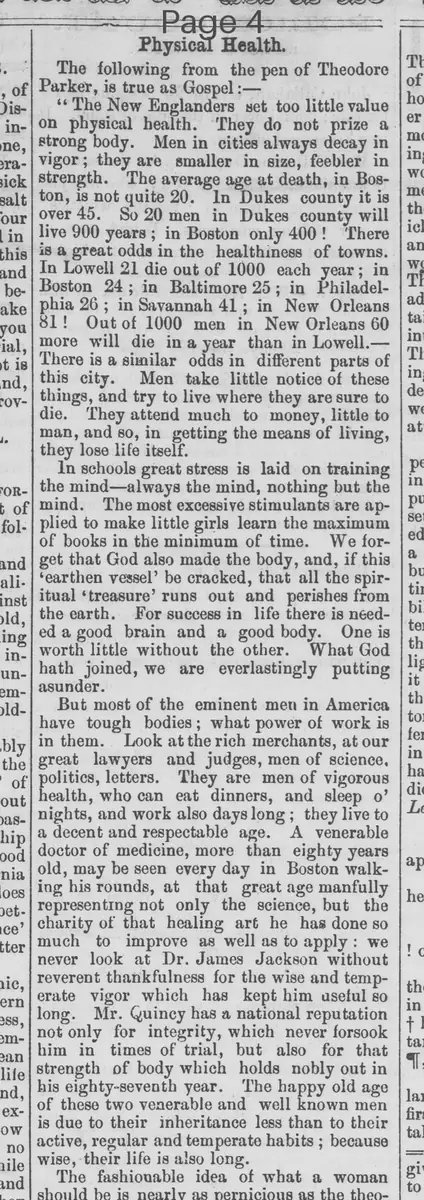
Physical Health.
The following from the pen of Theodore Parker, is true as Gospel:-
"The New Englanders set too little value on physical health. They do not prize a strong body. Men in cities always decay in vigor; they are smaller in size, feebler in strength. The average age at death, in Boston, is not quite 20. In Dukes county it is over 45. So 20 men in Dukes county will live 900 years; in Boston only 400! There is a great odds in the healthiness of towns. In Lowell 21 die out of 1000 each year; in Boston 24; in Baltimore 25; in Philadelphia 26: in Savannah 41: in New Orleans 81! Out of 1000 men in New Orleans 60 more will die in a year than in Lowell.—
There is a similar odds in different parts of this city. Men take little notice of these things, and try to live where they are sure to die. They attend much to money, little to man, and so, in getting the means of living, they lose life itself.
In schools great stress is laid on training the mind—always the mind, nothing but the mind. The most excessive stimulants are applied to make little girls learn the maximum of books in the minimum of time. We forget that God also made the body, and, if this 'earthen vessel' be cracked, that all the spiritual 'treasure' runs out and perishes from the earth. For success in life there is needed a good brain and a good body. One is worth little without the other. What God hath joined, we are everlastingly putting asunder.
But most of the eminent men in America have tough bodies; what power of work is in them. Look at the rich merchants, at our great lawyers and judges, men of science, politics, letters. They are men of vigorous health, who can eat dinners, and sleep o' nights, and work also days long; they live to a decent and respectable age. A venerable doctor of medicine, more than eighty years old, may be seen every day in Boston walking his rounds, at that great age manfully representing not only the science, but the charity of that healing art he has done so much to improve as well as to apply: we never look at Dr. James Jackson without reverent thankfulness for the wise and temperate vigor which has kept him useful so long. Mr. Quincy has a national reputation not only for integrity, which never forsook him in times of trial, but also for that strength of body which holds nobly out in his eighty-seventh year. The happy old age of these two venerable and well known men is due to their inheritance less than to their active, regular and temperate habits; because wise, their life is also long.
The fashionable idea of what a woman should be is nearly as pernicious as the theological conception of what God is—almost as unnatural. She must be as feeble as a ghost. Hardly can she bear the burden of her ill-supported clothes. Steady and continuous toil is impossible to such a doll. She glories in her shame, and is as proud of weakness as Hercules and Samson are supposed to have been of their legs and great burley shoulders. But we doubt if it be natural that a 'cultivated woman,' should be a cross betwixt a ghost and a London doll. Charlemagne's daughter, on her shoulder, carrying home her lover through the treacherous and newly fallen snow, is a little nearer the type of the animal woman. 'In the sweat of thy face shalt thou eat bread,' though reported as a curse for man alone, is a blessing which the Infinite pronounces also on woman; the second benediction recorded in Genesis."
The following from the pen of Theodore Parker, is true as Gospel:-
"The New Englanders set too little value on physical health. They do not prize a strong body. Men in cities always decay in vigor; they are smaller in size, feebler in strength. The average age at death, in Boston, is not quite 20. In Dukes county it is over 45. So 20 men in Dukes county will live 900 years; in Boston only 400! There is a great odds in the healthiness of towns. In Lowell 21 die out of 1000 each year; in Boston 24; in Baltimore 25; in Philadelphia 26: in Savannah 41: in New Orleans 81! Out of 1000 men in New Orleans 60 more will die in a year than in Lowell.—
There is a similar odds in different parts of this city. Men take little notice of these things, and try to live where they are sure to die. They attend much to money, little to man, and so, in getting the means of living, they lose life itself.
In schools great stress is laid on training the mind—always the mind, nothing but the mind. The most excessive stimulants are applied to make little girls learn the maximum of books in the minimum of time. We forget that God also made the body, and, if this 'earthen vessel' be cracked, that all the spiritual 'treasure' runs out and perishes from the earth. For success in life there is needed a good brain and a good body. One is worth little without the other. What God hath joined, we are everlastingly putting asunder.
But most of the eminent men in America have tough bodies; what power of work is in them. Look at the rich merchants, at our great lawyers and judges, men of science, politics, letters. They are men of vigorous health, who can eat dinners, and sleep o' nights, and work also days long; they live to a decent and respectable age. A venerable doctor of medicine, more than eighty years old, may be seen every day in Boston walking his rounds, at that great age manfully representing not only the science, but the charity of that healing art he has done so much to improve as well as to apply: we never look at Dr. James Jackson without reverent thankfulness for the wise and temperate vigor which has kept him useful so long. Mr. Quincy has a national reputation not only for integrity, which never forsook him in times of trial, but also for that strength of body which holds nobly out in his eighty-seventh year. The happy old age of these two venerable and well known men is due to their inheritance less than to their active, regular and temperate habits; because wise, their life is also long.
The fashionable idea of what a woman should be is nearly as pernicious as the theological conception of what God is—almost as unnatural. She must be as feeble as a ghost. Hardly can she bear the burden of her ill-supported clothes. Steady and continuous toil is impossible to such a doll. She glories in her shame, and is as proud of weakness as Hercules and Samson are supposed to have been of their legs and great burley shoulders. But we doubt if it be natural that a 'cultivated woman,' should be a cross betwixt a ghost and a London doll. Charlemagne's daughter, on her shoulder, carrying home her lover through the treacherous and newly fallen snow, is a little nearer the type of the animal woman. 'In the sweat of thy face shalt thou eat bread,' though reported as a curse for man alone, is a blessing which the Infinite pronounces also on woman; the second benediction recorded in Genesis."
What sub-type of article is it?
Education
Social Reform
Moral Or Religious
What keywords are associated?
Physical Health
Education Reform
Urban Decay
Women's Strength
Temperate Habits
Biblical Benediction
What entities or persons were involved?
Theodore Parker
Dr. James Jackson
Mr. Quincy
New Englanders
Editorial Details
Primary Topic
Valuing Physical Health In Education And Society
Stance / Tone
Advocacy For Physical Vigor And Temperate Habits
Key Figures
Theodore Parker
Dr. James Jackson
Mr. Quincy
New Englanders
Key Arguments
New Englanders Undervalue Physical Health
Urban Life Leads To Shorter Lifespans Compared To Rural Areas
Education Overemphasizes Mental Training At Expense Of Body
Eminent Men Succeed Due To Strong Bodies And Temperate Habits
Fashionable Ideals Make Women Unnaturally Feeble
Physical Labor Is A Blessing For Women As Well As Men