Thank you for visiting SNEWPapers!
Sign up free
American Republican And Baltimore Daily Clipper
Baltimore, Maryland
What is this article about?
The National Sabbath Convention in Baltimore united leaders from diverse religious and political backgrounds, including John Quincy Adams, to advocate for universal Sabbath observance as essential for virtue, salvation, and preserving free institutions. The event fostered harmony and moral influence across the nation.
Clipping
OCR Quality
Full Text
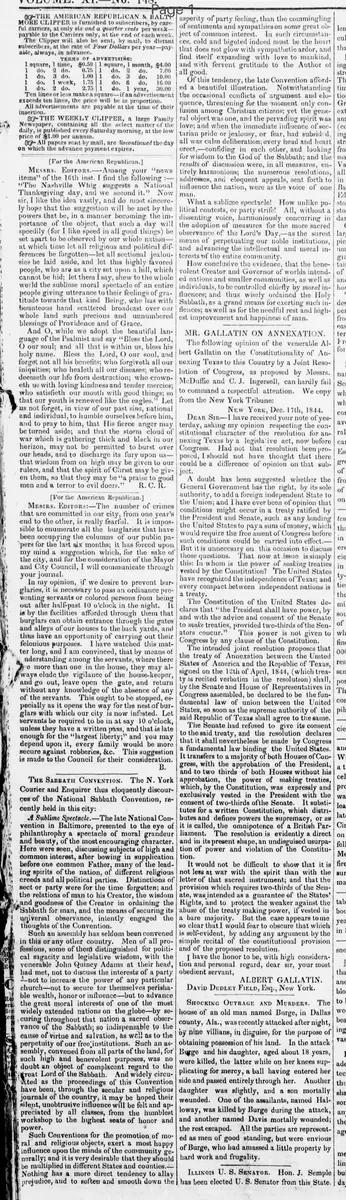
A Sublime Spectacle.—The late National Convention in Baltimore, presented to the eye of philanthropy a spectacle of moral grandeur and beauty, of the most encouraging character. Here were seen, discussing subjects of high and common interest, after bowing in supplication before one common Father, many of the leading spirits of the nation, of different religious creeds and all political parties. Distinctions of sect or party were for the time forgotten; and the relations of man to his Creator, the wisdom and goodness of the Creator in ordaining the Sabbath for man, and the means of securing its universal observance, intently engaged the thoughts of the Convention.
Such an assembly has seldom been convened in this or any other country. Men of all professions, some of them distinguished for political sagacity and legislative wisdom, with the venerable John Quincy Adams at their head, had met, not to discuss the interests of a party—not to increase the power of any particular church—not to secure for themselves perishable wealth, honor or influence—but to advance the great moral interests of one of the most widely extended nations on the globe—by securing throughout that nation a sacred observance of the Sabbath: so indispensable to the cause of virtue and salvation, as well as to the perpetuity of our free institutions. Such an assembly, convened from all parts of the land, for such high and benevolent purposes, was no doubt an object of complacent regard to the great Lord of the Sabbath. And widely circulated as the proceedings of this Convention have been, through the secular and religious journals of the country, it may be hoped their silent, unobtrusive influence will be felt and appreciated by all classes, from the humblest workshop to the highest seats of honor and power.
Such Conventions for the promotion of moral and religious objects, exert a most happy influence upon the minds of the community generally; and it is very desirable that they should be multiplied in different States and counties. Nothing has a more direct tendency to allay prejudice, and to soften and smooth down the asperity of party feeling, than the commingling of sentiments and sympathies on some great object of common interest. In such circumstances, cold and bigoted indeed must be the heart that does not glow with sympathetic ardor, and find itself expanding with love to mankind, and with fervent gratitude to the Author of all good.
Of this tendency, the late Convention afforded a beautiful illustration. Notwithstanding the occasional conflicts of argument and eloquence, threatening for the moment only confusion among Christian citizens; yet the general object was one, and the pervading spirit was love; and when the immediate influence of sectarian pride or jealousy, or fear, had subsided, all was calm deliberation; every head and heart erect,—confiding in each other, and looking for wisdom to the God of the Sabbath; and the results of discussion were, in all measures, entirely harmonious; the numerous resolutions, addresses, and eloquent appeals, sent forth to influence the nation, were as the voice of one man.
What a sublime spectacle! How unlike political contests, or party strife! All, without a dissenting voice, harmoniously concurring in the adoption of measures for the more sacred observance of the Lord's Day,—as the surest means of perpetuating our noble institutions, and advancing the intellectual and moral interests of the entire community.
How conclusive the evidence, that the benevolent Creator and Governor of worlds intended nations and smaller communities, as well as individuals, to be controlled chiefly by moral influences; and thus wisely ordained the Holy Sabbath, as a grand means for exerting such influences; as well as for the needful rest and highest improvement and happiness of man.
What sub-type of article is it?
What themes does it cover?
What keywords are associated?
What entities or persons were involved?
Where did it happen?
Story Details
Key Persons
Location
Baltimore
Event Date
Recently
Story Details
Leaders from various religious creeds and political parties gathered in Baltimore for the National Sabbath Convention, led by John Quincy Adams, to discuss and promote the universal observance of the Sabbath for moral, virtuous, and institutional benefits, resulting in harmonious resolutions and appeals.