Thank you for visiting SNEWPapers!
Sign up free
Editorial
April 11, 1867
The Daily Phoenix
Columbia, Richland County, South Carolina
What is this article about?
Editorial from April 11, 1867, analyzes Supreme Court motions by Mississippi and Georgia against the military Reconstruction Act, predicts court will decline jurisdiction, cites Northern press views, warns of political risks from unconstitutionality ruling, and urges Southern compliance with laws.
Clipping
OCR Quality
98%
Excellent
Full Text
COLUMBIA.
Thursday Morning, April 11, 1867.
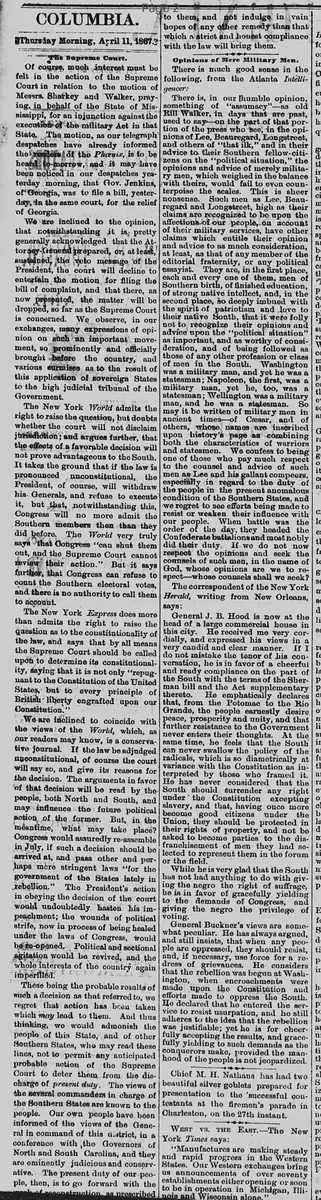
The Supreme Court.
Of course, much interest must be felt in the action of the Supreme Court in relation to the motion of Messrs. Shafkey and Walker, praying, in behalf of the State of Mississippi, for an injunction against the execution of the military Act in that State. The motion, as our telegraph despatches have already informed the readers of the Phoenix, is to be heard to-morrow, and it may have been noticed in our despatches yesterday morning, that Gov. Jenkins, of Georgia, was to file a bill, yesterday in the same court, for the relief of Georgia.
We are inclined to the opinion, that notwithstanding it is pretty generally acknowledged that the Attorney-General prepared, or, at least, sustained, the veto message of the President, the court will decline to entertain the motion for filing the bill of complaint, and that there, as now presented, the matter will be dropped, so far as the Supreme Court is concerned. We observe, in our exchanges, many expressions of opinion on such an important movement, so prominently and officially brought before the country, and various surmises as to the result of this application of sovereign States to the high judicial tribunal of the Government.
The New York World admits the right to raise the question, but doubts whether the court will not disclaim jurisdiction; and argues further, that the effects of a favorable decision will not prove advantageous to the South. It takes the ground that if the law is pronounced unconstitutional, the President, of course, will withdraw his Generals, and refuse to execute it, but that, notwithstanding this, Congress will no more admit the Southern members than they did before. The World very truly says that Congress "can shut them out, and the Supreme Court cannot review their action." But it says further, that Congress can refuse to count the Southern electoral votes, and there is no authority to call them to account.
The New York Express does more than admits the right to raise the question as to the constitutionality of the law, and says that by all means the Supreme Court should be called upon to determine its constitutionality, saying that it is not only "repugnant to the Constitution of the United States, but to every principle of British liberty engrafted upon our Constitution."
We are inclined to coincide with the views of the World, which, as our readers may know, is a conservative journal. If the law be adjudged unconstitutional, of course the court will say so, and give its reasons for the decision. The arguments in favor of that decision will be read by the people, both North and South, and may influence the future political action of the former. But, in the meantime, what may take place? Congress would assuredly re-assemble in July, if such a decision should be arrived at, and pass other and perhaps more stringent laws "for the government of the States lately in rebellion." The President's action in obeying the decision of the court would undoubtedly hasten his impeachment; the wounds of political strife, now in process of being healed under the laws of Congress, would be re-opened. Political and sectional agitation would be revived, and the whole interests of the country again imperilled.
These being the probable results of such a decision as that referred to, we regret that action has been taken which may lead to them. And thus thinking, we would admonish the people of this State, and of other Southern States, who may read these lines, not to permit any anticipated probable action of the Supreme Court to deter them from the discharge of present duty. The views of the several commanders in charge of the Southern States are known to the people. Our own people have been informed of the views of the General in command of this district, in a conference with the Governors of North and South Carolina, and they are eminently judicious and conservative. The present duty of our people, then, is to go forward with the work prescribed to them, and not indulge in vain hopes of any other remedy than that which a strict and honest compliance with the law will bring them.
Thursday Morning, April 11, 1867.
The Supreme Court.
Of course, much interest must be felt in the action of the Supreme Court in relation to the motion of Messrs. Shafkey and Walker, praying, in behalf of the State of Mississippi, for an injunction against the execution of the military Act in that State. The motion, as our telegraph despatches have already informed the readers of the Phoenix, is to be heard to-morrow, and it may have been noticed in our despatches yesterday morning, that Gov. Jenkins, of Georgia, was to file a bill, yesterday in the same court, for the relief of Georgia.
We are inclined to the opinion, that notwithstanding it is pretty generally acknowledged that the Attorney-General prepared, or, at least, sustained, the veto message of the President, the court will decline to entertain the motion for filing the bill of complaint, and that there, as now presented, the matter will be dropped, so far as the Supreme Court is concerned. We observe, in our exchanges, many expressions of opinion on such an important movement, so prominently and officially brought before the country, and various surmises as to the result of this application of sovereign States to the high judicial tribunal of the Government.
The New York World admits the right to raise the question, but doubts whether the court will not disclaim jurisdiction; and argues further, that the effects of a favorable decision will not prove advantageous to the South. It takes the ground that if the law is pronounced unconstitutional, the President, of course, will withdraw his Generals, and refuse to execute it, but that, notwithstanding this, Congress will no more admit the Southern members than they did before. The World very truly says that Congress "can shut them out, and the Supreme Court cannot review their action." But it says further, that Congress can refuse to count the Southern electoral votes, and there is no authority to call them to account.
The New York Express does more than admits the right to raise the question as to the constitutionality of the law, and says that by all means the Supreme Court should be called upon to determine its constitutionality, saying that it is not only "repugnant to the Constitution of the United States, but to every principle of British liberty engrafted upon our Constitution."
We are inclined to coincide with the views of the World, which, as our readers may know, is a conservative journal. If the law be adjudged unconstitutional, of course the court will say so, and give its reasons for the decision. The arguments in favor of that decision will be read by the people, both North and South, and may influence the future political action of the former. But, in the meantime, what may take place? Congress would assuredly re-assemble in July, if such a decision should be arrived at, and pass other and perhaps more stringent laws "for the government of the States lately in rebellion." The President's action in obeying the decision of the court would undoubtedly hasten his impeachment; the wounds of political strife, now in process of being healed under the laws of Congress, would be re-opened. Political and sectional agitation would be revived, and the whole interests of the country again imperilled.
These being the probable results of such a decision as that referred to, we regret that action has been taken which may lead to them. And thus thinking, we would admonish the people of this State, and of other Southern States, who may read these lines, not to permit any anticipated probable action of the Supreme Court to deter them from the discharge of present duty. The views of the several commanders in charge of the Southern States are known to the people. Our own people have been informed of the views of the General in command of this district, in a conference with the Governors of North and South Carolina, and they are eminently judicious and conservative. The present duty of our people, then, is to go forward with the work prescribed to them, and not indulge in vain hopes of any other remedy than that which a strict and honest compliance with the law will bring them.
What sub-type of article is it?
Constitutional
Partisan Politics
What keywords are associated?
Supreme Court
Reconstruction Act
Mississippi Injunction
Georgia Bill
Constitutional Challenge
Southern Compliance
Political Risks
What entities or persons were involved?
Supreme Court
Messrs. Shafkey And Walker
State Of Mississippi
Gov. Jenkins Of Georgia
Attorney General
President
Congress
New York World
New York Express
Editorial Details
Primary Topic
Supreme Court Jurisdiction Over Military Reconstruction Act
Stance / Tone
Conservative Caution Against Court Challenge, Urging Legal Compliance
Key Figures
Supreme Court
Messrs. Shafkey And Walker
State Of Mississippi
Gov. Jenkins Of Georgia
Attorney General
President
Congress
New York World
New York Express
Key Arguments
Court Likely To Decline Jurisdiction On Mississippi's Injunction Motion
Unconstitutionality Ruling Would Not Benefit South As Congress Can Still Exclude Southern Members
Such A Decision Risks Impeachment, Renewed Agitation, And Harsher Laws
Southern States Should Comply With Military Commanders' Judicious Directives