Thank you for visiting SNEWPapers!
Sign up free
The Spirit Of The Age
Woodstock, Windsor County, Vermont
What is this article about?
In 'The Wrecker's Daughter,' Edward Irving, a young Virginian shipwreck survivor, is rescued by wrecker John Brown and cared for by his family, especially daughter Ellen. Amid recovery, Irving and Ellen develop a deep romantic bond through shared studies. Jealous Spaniard Antonio schemes against Irving. After Irving's temporary departure to gain family approval, he returns to pledge his love to Ellen under the moonlight, unaware of Antonio's vengeful watch.
Merged-components note: Continuation of the serialized literary story 'The Wrecker's Daughter' across pages.
Clippings
1 of 2
OCR Quality
Full Text
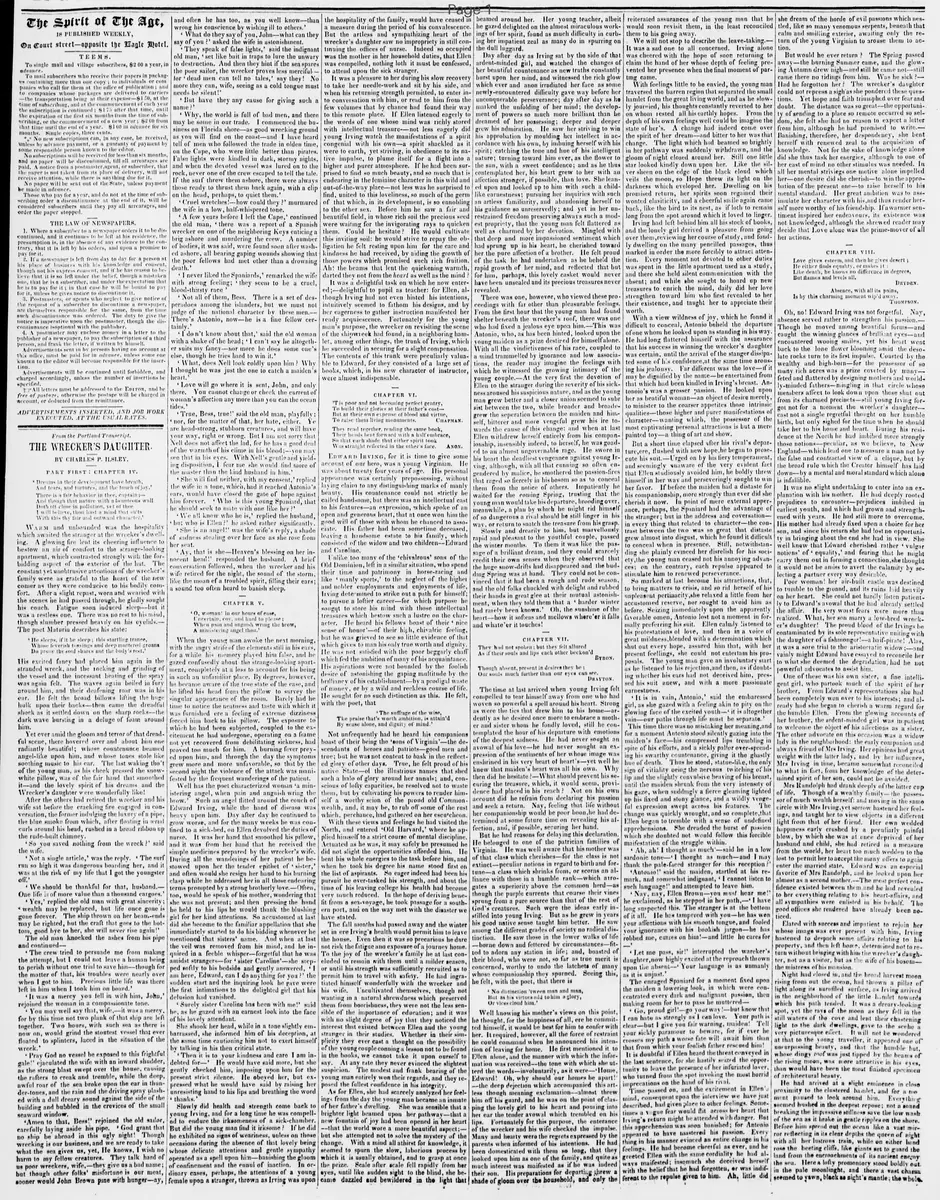
THE WRECKER'S DAUGHTER
BY CHARLES P. ILSLEY.
PART FIRST: CHAPTER IV.
Dreams in their development have breath,
And tears, and tortures, and the touch of joy.
There is a fair behavior in thee, captain—
And though that nature with a beauteous wall
Doth oft close in pollution, yet of thee
I will believe, thou hast a mind that suits
With this thy fair and outward character.
Warm and unbounded was the hospitality
which awaited the stranger at the wrecker's dwelling. A glowing fire lent its cheering influence to
bestow an air of comfort to the strange-looking
apartment, which contrasted strongly with the forbidding aspect of the exterior of the hut. The
constant yet unobtrusive attentions of the wrecker's
family were as grateful to the heart of the new
comer as they were conducive to his bodily comfort. After a slight repast, worn and wearied with
the scenes he had passed through, he gladly sought
his couch. Fatigue soon induced sleep—but it
was a restless one. There was no rest to his mind,
though slumber pressed heavily on his eyelids.—
The poet Maturin describes his state:
He sleeps. if it be sleep; this startling trance.
Whose feverish tossings and deep muttered groans
Do prove the soul shares not the body's rest.
His excited fancy had placed him again in the
stranded wreck, and the rocking and grinding of
the vessel and the incessant beating of the spray
was again felt. The waves again boiled in fury
around him, and their deafening roar was in his
ear. He felt the broad billows lifting the huge
hulk upon their backs—then came the dreadful
shock as it settled down on the sharp rocks—the
dark wave bursting in a deluge of foam around
him.
Yet ever amid the gloom and terror of that dreadful scene, there hovered over and about him one
radiantly beautiful; whose countenance beamed
angel-like upon him, and whose tones stole like
soothing music to his ear. The last waking thought
of the young man, as his cheek pressed the snow-
white pillow, was of the fair hand that smoothed
it—and the lovely spirit of his dreams and the
Wrecker's daughter were wonderfully like!
After the others had retired the wrecker and his
wife sat before the crackling fire engaged in conversation, the former indulging the luxury of a pipe.
the blue smoke from which, after floating in aerial
curls around his head, rushed in a broad ribbon up
the rude-built chimney.
'So you saved nothing from the wreck?' said
the wife.
'Not a single article,' was the reply. The surf
run so high it was dangerous boarding her, and it
was at the risk of my life that I got the youngster
off.'
We should be thankful for that, husband.—
One life is of more value than a thousand cargoes.'
'Yes,' replied the old man with great sincerity;
wealth may be replaced, but life once gone is
gone forever. The ship thrown on her beam-ends
may be righted, but the craft that goes to the bottom, good bye to her, she will never rise again!'
The old man knocked the ashes from his pipe
and continued—
The crew tried to persuade me from making
the attempt, but I could not leave a human being
to perish without one trial to save him—though for
the matter of that, his troubles were nearly over
when I got to him. Precious little life was there
left in him when I took him on board.'
'It was a mercy you fell in with him, John,'
rejoined the woman in a compassionate tone.
You may well say that, wife,—it was a mercy,
for by this time not two plank of that ship are left
together. Two hours, with such sea as there is
now on, would grind the stoutest vessel that ever
floated to splinters, placed in the situation of the
wreck.
Pray God no vessel be exposed to this frightful
gale!' ejaculated the wife with an inward shudder,
as the strong blast swept over the house, causing
the rafters to creak and tremble, while the deep,
awful roar of the sea broke upon the ear in thunder-tones, and the rain and the driving spray plashed
with a dull dreary sound against the side of the
building and bubbled in the crevices of the small
seaward window.
'Amen to that, Bess!' rejoined the old sailor.
carefully laying aside his pipe. God grant that
no ship be abroad in this ugly night! Though
wrecking is our business, and we are ready to take
what the sea gives us, yet, He knows, I wish no
harm to my fellow creatures. They talk hard of
us poor wreckers, wife,—they give us a bad name;
but though other folks' misfortune is our meat,
sooner would John Brown pine with hunger—ay,
and often he has too, as you well know—than
wrong his conscience by wishing ill to others.
What do they say of you, John—what can they
say of you?' asked the wife in astonishment.
They speak of false lights,' said the indignant
old man, 'set like bait in traps to lure the unwary
to destruction. And then they hint if the sea spares
the poor sailor, the wrecker proves less merciful.—
for 'dead men can tell no tales,' say they! No
more they can, wife, seeing as a cold tongue must
needs be silent!'
But have they any cause for giving such a
name?'
Why, the world is full of bad men, and there
may be some in our trade. I commenced the business on Florida shore—as good wrecking ground
as you will find on the coast—and I have heard
tell of men who followed the trade in olden time,
on the Cape, who were little better than pirates.
False lights were kindled in dark, stormy nights,
and when the devoted vessel was lured on to the
rock, never one of the crew escaped to tell the tale.
If the surf threw them ashore, there were always
those ready to thrust them back again, with a clip
on the head, perhaps, to quiet them.
'Cruel wretches!—how could they?' murmured
the wife in a low, half-whispered tone.
'A few years before I left the Cape,' continued
the old man, 'there was a report of a Spanish
wrecker on one of the neighboring Keys enticing a
brig ashore and murdering the crew. A number
of bodies, it was said, were found soon after washed ashore, all bearing gaping wounds showing that
the poor fellows had met other than a drowning
death.'
'I never liked the Spaniards,' remarked the wife
with strong feeling; 'they seem to be a cruel,
blood-thirsty race'
Not all of them, Bess. There is a set of desperadoes among the islanders, but we must not
judge of the national character by these men.—
There's Antonio, now—he is a fine fellow certainly.'
'I don't know about that,' said the old woman
with a shake of the head; 'I can't say he altogether suits my fancy—nor more he does some one's
else, though he tries hard to win it.'
What, does Nell look coldly upon him? Why
I thought he was just the one to catch a maiden's
heart.
'Love will go where it is sent, John, and only
there. You cannot change or check the current of
woman's affection any more than you can the ocean
tides.'
True, Bess, true!' said the old man, playfully;
nor, for the matter of that, her hate, either. Ye
are head-strong, stubborn creatures, and will have
your way, right or wrong. But I am not sorry that
Nell does not affect the lad, for he has a good deal
of the warmth of his clime in his blood;—you may
see that in his eyes. With Nell's gentle and yielding disposition, I fear me she would find more of
the master than the kind husband in him.
She will find neither, with my consent,' replied
the wife in a tone, which, had it reached Antonio's
ears, would have closed the gate of hope against
him forever. Who is this young Spaniard, that
he should seek to mate with one like her?'
'We all know who he is.' replied the husband.
'but who is Ellen?' he asked rather significantly.
She is an angel!' was the wife's reply, a shade
of sadness stealing over her face as she rose from
her seat.
'Ay, that is she—Heaven's blessing on her innocent head!' responded the husband. A brief
conversation followed, when the wrecker and his
wife retired for the night, the sound of the storm,
like the moan of a troubled spirit, filling their ears;
a sound too often heard to banish sleep.
CHAPTER V.
'O, woman! in our hours of ease.
Uncertain, coy, and hard to please:
When pain and anguish wring the brow,
A ministering angel thou.'
When the young man awoke the next morning,
with the angry strife of the elements still in his ears.
for a while his memory played him false, and he
gazed confusedly about the strange-looking apartment, completely at a loss to account for his being
in such an unfamiliar place. By degrees, however.
he became aware of the true state of the case, and
he lifted his head from the pillow to survey the
singular appearance of the room. Barely had he
time to notice the neatness and taste with which it
was furnished ere a feeling of extreme dizziness
forced him back to his pillow. The exposure to
which he had been subjected, coupled to the excitement he had undergone, operating on a frame
not yet recovered from debilitating sickness, had
proved too much for him. A burning fever preyed upon him, and through the day the symptoms
grew more and more unfavorable, so that by the
second night the violence of the attack was manifested by the frequent wanderings of the patient.
Well has the poet characterized woman 'a ministering angel, when pain and anguish wring the
brow.' Such an angel flitted around the couch of
Edward Irving, while the hand of disease was
heavy upon him. Day after day he continued to
grow worse, and for the many weeks he was confined to a sick-bed, on Ellen devolved the duties of
nurse. It was her hand that smoothed his pillow,
and it was from her hand that he received the
simple medicines prepared by the wrecker's wife.
During all the wanderings of her patient he bestowed upon her the tender epithet of 'sister,'
and often would she resign her hand to his burning clasp while he addressed her in all those endearing terms prompted by a strong brotherly love.—Often, too, would he speak of his mother, wondering that she was not present; and then pressing the hand he held to his lips he would thank the blushing girl for her kind attentions. So accustomed at last did she become to the familiar appellation that she immediately started to do his bidding whenever he mentioned that sister's name. And when at last the veil was removed from his mind, and he inquired in a feeble whisper—forgetful that he was amidst strangers—for 'sister Caroline'—she stepped softly to his bedside and gently answered, 'I am here, Edward, can I do anything for you?' the sudden start and the inquiring look he gave were the first intimations to the delighted girl that his delusion had vanished.
'Surely sister Caroline has been with me!' said
he, as he gazed with an earnest look into the face
of his lovely attendant.
She shook her head, while in a tone slightly embarrassed, she informed him of his deception, at the same time cautioning him not to exert himself by talking in his then critical state.
Then it is to your kindness and care I am indebted for—' He would have said more, but she gently checked him, imposing upon him for the present strict silence. He obeyed her, but expressed what he would have said by raising her unresisting hand to his lips and breathing the word thanks.
Slowly did health and strength come back to young Irving, and for a long time he was compelled to endure the irksomeness of a sick-chamber. But did the young man find it irksome? If he did he exhibited no signs of weariness, unless on those occasions during the absence of that lovely being whose delicate attentions and gentle sympathy operated as a spell upon him—banishing the gloom of confinement and the ennui of inaction. In ordinary cases, perhaps, the attentions of a young female upon a stranger, thrown as Irving was upon the hospitality of the family, would have ceased in a measure during the period of his convalescence. But the artless and sympathizing heart of the wrecker's daughter saw no impropriety in still continuing the offices of nurse. Indeed so occupied was the mother in her household duties, that Ellen was compelled, nothing loth it must be confessed to attend upon the sick stranger.
It was a pleasure to her during his slow recovery to take her needle-work and sit by his side, and when his returning strength permitted, to enter into conversation with him, or read to him from the few volumes that by chance had found their way to this remote place. If Ellen listened eagerly to the words of one whose mind was richly stored with intellectual treasure—not less eagerly did young Irving watch the manifestations of a spirit congenial with his own—a spirit shackled as it were to earth, yet striving, in obedience to its native impulse, to plume itself for a flight into a higher and purer atmosphere. If he had been surprised to find so much beauty, and so much that is endearing in the feminine character in this wild and out-of-the-way place—not less was he surprised to find, united to this loveliness, so much of the germ of that which, in its development, is so ennobling to the other sex. Before him he saw a fair and beautiful field, in whose rich soil the precious seed were waiting for the invigorating rays to quicken them. Could he hesitate? He would cultivate this inviting soil: he would strive to repay the obligation he felt resting upon him for the care and kindness he had received, by aiding the growth of those powers which promised such rich fruition.
Ah! the beams that lent the quickening warmth, darted they not from the heart as well as the mind?
It was a delightful task on which he now entered;—delightful to pupil as teacher: for Ellen, although Irving had not even hinted his intentions, intuitively seemed to fathom his designs, and by her eagerness to gather instruction manifested her ready acquiescence. Fortunately for the young man's purpose, the wrecker on revisiting the scene of the shipwreck had found, in a neighboring hamlet, among other things, the trunk of Irving, which he succeeded in securing for a slight compensation. The contents of this trunk were peculiarly valuable to Edward, for they consisted of a large set of books, which, in his new character of instructor, were almost indispensable.
CHAPTER VI.
"T is poor and not becoming perfect gentry,
To build their glories at their father's cost—
But at their own expense of blood and virtue,
To raise them living monuments.
CHAPMAN.
They read together, reading the same book,
Their heads bent forward with a half embrace,
So that each shade that either spirit took
Was straight reflected in the other's face.
ANON.
Edward Irving, for it is time to give some account of our hero, was a young Virginian. He was about twenty four years of age. His personal appearance was certainly prepossessing, without laying claim to any distinguishing marks of manly beauty. His countenance could not strictly be called handsome, but there was an intellectual cast to his features—an expression, which spoke of an open and generous heart, that at once won him the good will of those with whom he chanced to associate. His father had been sometime deceased, leaving a handsome estate to his family, which consisted of the widow and two children—Edward and Caroline.
Unlike too many of the 'chivalrous' sons of the Old Dominion, left in a similar situation, who spend their time and patrimony in horse-racing and like 'manly sports,' to the neglect of the higher and nobler employments and enjoyments of life, Irving determined to strike out a path for himself to pursue a loftier career—for which purpose he sought to store his mind with those intellectual treasures which bestow such a lustre on the character. He heard his fellows boast of their 'nice sense of honor'—of their high, chivalric feeling, but he was grieved to see so little evidence of that which gives to man his only true worth and dignity. He was not satisfied with the poor beggarly chaff which fed the ambition of many of his acquaintance. His aspirations were not bounded by the foolish desire of astonishing the gaping multitude by the brilliancy of his establishment—by a prodigal waste of money, or by a wild and reckless course of life. He sought for no such distinction as this. He felt with the poet, that
'The suffrage of the wise
The praise that's worth ambition, is attained
By sense alone, and dignity of mind.'
Not unfrequently had he heard his companions boast of their being the 'sons of Virginia'—the descendants of heroes and patriots—good men and true; but he was not content to bask in the reflected glory of other days. True, he felt proud of his native State—of the illustrious names that shed such a halo of glory around her annals; and, conscious of lofty capacities, he resolved not to waste them, but by cultivating his powers to render himself a worthy scion of the proud old Commonwealth, and, it may be, to rub off some of the rust which, perchance, had gathered on her escutcheon.
With these views and feelings he had visited the North, and entered 'Old Harvard,' where he applied himself to a strict course of mental discipline. Actuated as he was, it may safely be presumed he did not slight the opportunities afforded him. He bent his whole energies to the task before him, and when he took his degree his name stood first on the list of aspirants. So eager indeed had been his pursuit he over-tasked his strength, and about the time of his leaving college his health had become very much reduced. In the hope of deriving benefit from a sea-voyage, he took passage for a southern port, and on the way met with the disaster we have stated.
The fall months had passed away and the winter set in ere Irving's health would permit him to leave the house. Even then it was so precarious he dare not risk the fatigue and exposure of a journey home. To the joy of the wrecker's family he at last concluded to remain with them until a milder season, or until his strength was sufficiently recruited as to permit him to travel with safety. He had ingratiated himself wonderfully with the wrecker and his wife. Uncultivated themselves, though not wanting in a natural shrewdness which preserved them from boorishness, they were not the less sensible of the importance of education: and it was with no slight degree of joy that they noticed the interest that existed between Ellen and the young stranger in their studies. Whether in their simplicity they ever cast a thought on the possibility of the young couple conning a lesson not to be found in the books, we cannot take it upon ourself to say. At any rate they never evinced the slightest suspicion. The modest and frank bearing of the young man entirely won their regards, and they reposed the fullest confidence in his integrity.
As for Ellen, she had scarcely analyzed her feelings from the day the young man became an inmate of her father's dwelling. She was sensible that a brighter light beamed upon her pathway—that a new fountain of joy had been opened in her heart—that the world wore a more beautiful aspect;—but she attempted not to solve the mystery of the change. With a mind all athirst for knowledge, it seemed to spurn the slow, laborious process by which it is usually obtained, and to grasp at once the prize. Scale after scale fell rapidly from her eyes, until like sudden sight to the blind, she became dazzled and bewildered in the light that beamed around her. Her young teacher, albeit he gazed delighted on the almost miraculous workings of her spirit, found as much difficulty in curbing her impatient zeal as many do in spurring on the dull laggard.
Day after day as Irving sat by the side of that ardent-minded girl, and watched the changes of her beautiful countenance as new truths constantly burst upon her mind, and witnessed the rich glow which ever and anon irradiated her face as some newly-encountered difficulty gave way before her unconquerable perseverance; day after day as he marked the unfolding of her mind; the development of powers so much more brilliant than he dreamed of her possessing; deeper and deeper grew his admiration. He saw her striving to win his approbation by moulding her intellect in accordance with his own, by imbuing herself with his spirit; catching the tone and hue of his intelligent nature; turning toward him ever, as the flower to the sun, with a sweet confidence; and as he thus contemplated her, his heart grew to her with an affection stronger, if possible, than love. She leaned upon and looked up to him with such a child-like earnestness; pursuing her inquiries with such an artless familiarity, and abandoning herself to his guidance so unreservedly; and yet in her unrestrained freedom preserving always such a modest propriety, that the young man felt flattered as well as charmed by her devotion. Mingled with that deep and more impassioned sentiment which had sprung up in his heart, he cherished toward her the pure affection of a brother. He felt proud of the task he had undertaken as he beheld the rapid growth of her mind, and reflected that but for him, perhaps, this lovely casket would never have been unscaled and its precious treasures never revealed.
There was one, however, who viewed these proceedings with far other than pleasurable feelings. From the first hour that the young man had found shelter beneath the wrecker's roof, there was one who had fixed a jealous eye upon him.—This was Antonio, who, as has been hinted, looked upon the young maiden as a prize destined for himself alone. With all the vindictiveness of his race, coupled to a mind trammelled by ignorance and low associations, the reader may imagine the feelings with which he witnessed the growing intimacy of the young couple.—At the very first the devotion of Ellen to the stranger during the severity of his sickness aroused his suspicious nature, and as the young man grew better and a closer union seemed to subsist between the two, while broader and broader grew the separation between the maiden and himself, bitterer and more vengeful grew his ire towards the cause of this change: and when at last Ellen withdrew herself entirely from his companionship, insensibly indeed, to herself, he was goaded to an almost ungovernable rage. He swore in his heart the deadliest vengeance against young Irving, although, with all that cunning so often engendered by malice, he smothered the passion-fires that raged so fiercely in his bosom so as to conceal them from the notice of others. Impatiently he waited for the coming Spring, trusting that the young man would take his departure, brooding over, meanwhile, a plan by which he might rid himself of so dangerous a rival should he still linger in his way, or return to snatch the treasure from his grasp.
Slowly and drearily to him, but marvellously rapid and pleasant to the youthful couple, passed the winter months. To them it was like the passage of a brilliant dream, and they could scarcely credit their own senses when they observed that the huge snow-drifts had disappeared and the budding Spring was at hand. They could not be convinced that it had been a rough and rude season, and the old folks chuckled with delight and rubbed their hands in great glee at their mutual astonishment, when they told them that a harder winter had rarely been known. Oh, the sunshine of the heart—how it softens and mellows where'er it falls and whate'er it touches!
CHAPTER VII.
They had not spoken; but they felt allured
As if their souls and lips each other beckon'd
BYRON.
Though absent, present in desires they be:
Our souls much further than our eyes can see.
DRAYTON.
The time at last arrived when young Irving felt compelled to tear himself away from one who had woven so powerful a spell around his heart. Strong as were the ties that drew him to his home—ardently as he desired once more to embrace a mother and sister whom he fondly loved, still he contemplated the hour of his departure with emotions of the deepest sadness. He had never sought an avowal of his love—he had never sought an expression of the sentiments of her whose image was enshrined in his very heart of heart's—yet well he knew that maiden's heart was all his own. Why then did he hesitate?—What should prevent his securing the treasure, which, it would seem, providence had placed in his reach? Not on his own account did he refrain from declaring his passion and seek a return. Nay, feeling that life without her companionship would be poor boon, he had determined at some future time on revealing his affection, and, if possible, securing her hand.
But he had reasons for delaying this declaration. He belonged to one of the patrician families of Virginia. He was well aware that his mother was of that class which cherishes—for the class is not extinct—peculiar notions in regard to birth and fortune—a class which shrinks from, or scorns an alliance with those in a humble rank—which arrogates a superiority above the common herd—as though the purple currents that course their veins sprung from a purer source than that of the rest of God's creatures. Such were the ideas early instilled into young Irving. But as he grew in years his good native sense taught him better. He saw among the different grades of society no radical distinction. He saw those in the lower walks of life—borne down and fettered by circumstances—fitted to adorn any station in life; and, boasted of their blood, who were not, so far as true merit is concerned, worthy to undo the latchets of many whose companionship they spurned. Seeing this, he felt, with the poet, that there is
' No distinction 'tween man and man,
But as his virtues add to him a glory,
Or vices cloud him.'
Well knowing his mother's views on this point, he thought, for the happiness of all, ere he committed himself, it would be best for him to confer with her. It required, however, all the force of restraint he could command when he announced his intention of leaving for home. He first mentioned it to Ellen alone, and the manner with which the information was received—the tone with which she uttered the words—involuntarily, as it were—'Home, Edward! Oh, why should our homes be apart!'—the deep dejection which accompanied this artless though meaning exclamation—almost threw him off his guard, and he was on the point of clasping the lovely girl to his heart and pouring into her ear the tender avowal which trembled on his lips. Fortunately for this purpose, the entrance of the wrecker and his wife checked the impulse. Many and hearty were the regrets expressed by the parents when informed of his intentions. He had been domesticated with them so long, that they looked upon him as one of the family, and quite as much interest was manifested as if he was indeed their son. His preparations for departing threw a shade of gloom over the household, and only the reiterated assurances of the young man that he would soon revisit them, in the least reconciled them to his going away.
We will not stop to describe the leave-taking.— It was a sad one to all concerned. Irving alone was cheered with the hope of soon returning to claim the hand of her whose depth of feeling prevented her presence when the final moment of parting came.
With feelings little to be envied, the young man traversed the barren region that separated the small hamlet from the great living world, and as he slowly journeyed, his thoughts constantly reverted to her on whom rested all his earthly hopes. From the depth of his own feelings well could he imagine the state of hers. A change had indeed come over the spirit of her dream—and bitter to her was that change. The light which had beamed so brightly in her pathway was suddenly withdrawn, and the gloom of night closed around her. Still one little star looked kindly down upon her. Like the silver sheen on the edge of the black cloud which veils the moon, so Hope threw its light on the darkness which enveloped her. Dwelling on his promised return, her spirits soon regained their wonted elasticity, and a cheerful smile again came back, like the bird to its nest, as if loth to remain long from the spot around which it loved to linger.
Irving had left behind him all his stock of books, and the lonely girl derived a pleasure from going over them, reviewing her course of study, and fondly dwelling on the many pencilled passages, thus marked in order the more forcibly to attract attention. Every moment not devoted to other duties was spent in the little apartment used as a study, and there she held silent communication with the absent; and while she sought to hoard up new treasures to enrich the mind, daily did her love strengthen toward him who first revealed to her their existence, and taught her to appreciate their worth.
With a wildness of joy, which he found it difficult to conceal, Antonio beheld the departure of one whom he looked upon as standing in his way. He had long flattered himself with the assurance that his success in winning the wrecker's daughter was certain, until the arrival of the stranger dissipated some of his confidence, at the same time arousing his jealousy. Far different was the love—if it may be dignified by the name—he entertained from that which had been kindled in Irving's breast. Antonio's was a grosser passion. He looked upon her as beautiful woman—an object of desire merely, to minister to the coarser appetites those intrinsic qualities—those higher and purer manifestations of character—wanting which, the possessor of the most captivating personal attractions is but a mere painted toy—a thing of art and show.
But a short time elapsed after his rival's departure, ere, flushed with new hope, he began to prosecute his suit.—Urged on by his fiery temperament, and seemingly unaware of the very evident fact that Ellen studiously avoided him, he boldly threw himself in her way and perseveringly sought to win her favor. If before the maiden had a distaste for his companionship, more strongly than ever did she cherish it now. In point of mere external appearance, perhaps, the Spaniard had the advantage of the stranger; but in the address and conversation—in every thing that related to character—the contrast between the two was so great that distaste grew almost into disgust, which he found it difficult to conceal when in presence. Still, notwithstanding she plainly evinced her disrelish for his society, the young man ceased not his annoying advances; on the contrary, each repulse appeared to stimulate him to renewed perseverance.
So marked at last become his attentions, that, to bring matters to crisis, and so rid herself of his unpleasant pertinacity, she relaxed a little from her accustomed reserve, nor sought to avoid him as before. Seizing immediately upon the apparently favorable omen, Antonio lost not a moment in formally preferring his suit. Ellen calmly listened to his protestations of love, and then in a voice of great mildness, blended with a determination which shut out every hope, assured him that, with her present feelings, she could not entertain his proposals. The young man gave an involuntary start as he listened to his rejection, and then, as if doubting whether his ears had not deceived him, pressed his suit anew, and with a more passionate earnestness.
'It is in vain, Antonio,' said the embarrassed girl, as she gazed with a feeling akin to pity on the glowing face of the excited youth—' it is altogether vain—our paths through life must be separate.'
This time there was no mistaking her meaning, and for a moment Antonio stood silently gazing into the maiden's face—his compressed lips trembling in spite of his efforts, and a sickly pallor over-spreading his swarthy countenance, giving it the ghastly hue of death. Thus he stood, statue-like, the only sign of vitality being the nervous twitching of his lip and the slightly convulsive heaving of his breast, until the maiden shrunk from the very intensity of his gaze, when suddenly a fierce gleaming lighted up his fixed and stony glance, and a wildly vengeful expression swept across his features. The change was quickly wrought, and so complete, that Ellen began to tremble with a sense of undefined apprehensions. She dreaded the burst of passion which she doubted not would follow this forcible manifestation of the struggle within.
Ah, ah! I thought as much'—said he in a low sardonic tone—'I thought as much—and I may thank the pale-faced stranger for this reception?'
'Antonio!' said the maiden, startled at his remark, and somewhat indignant, ' I cannot listen to such language!' and attempted to leave him.
Nay, nay, Ellen Brown—you must hear me!'
he exclaimed, as he stepped in her path,—' I have long suspected this. The stranger is at the bottom of it all. He has tampered with you—he has won your affections with his smooth tongue, and fooled your ignorance with his bookish jargon—he has robbed me, curses on him!—and little he cares for
'Let me pass, sir!' interrupted the wrecker's daughter, now highly excited at the reproach thrown upon the absent—'Your language is as unmanly as it is unjust.'
The enraged Spaniard for a moment fixed upon the maiden a lowering look, in which were concentrated every dark and malignant passion, then making room for her to pass he muttered—
Go, proud girl!—go your way!—but know that I can hate as strongly as I can love. Your path is clear—but I give you fair warning, maiden!' Tell your sickly paramour to beware, for if ever he crosses my path a worse fate will await him than that from which your foolish father rescued him!'
It is doubtful if Ellen heard the threat conveyed in the last sentence, for she hastily seized the opportunity to leave the presence of her infuriated lover, who turned from the spot invoking the most horrid imprecations on the head of his rival.
Time passed on, and the excitement in Ellen's mind, consequent upon the interview we have just described, had given place to other feelings. Sometimes a vague fear would flit across her heart that Irving's return might be attended with danger. But this apprehension was soon banished; for Antonio appeared to have mastered his passion. Everything in his manner evinced an entire change in his feelings. He had become cheerful as ever, and he greeted Ellen with the same cordiality he had always manifested; insomuch she deceived herself with the belief that he had forgotten, or was indifferent to the repulse given to him. Ah, little did she dream of the horde of evil passions which nestled, like so many venomous serpents, beneath that calm and smiling exterior, awaiting only the return of the young Virginian to arouse them to action.
But would he ever return? The Spring passed away—the burning Summer came, and the glowing Autumn drew nigh—and still he came not—still came there no tidings from him. Was he sick?— Had he forgotten her? The wrecker's daughter could not repress a sigh as she pondered these questions. Yet hope and faith triumphed over fear and doubt. The distance was so great—the opportunity of sending to a place so remote occurred so seldom, she felt she had no reason to expect a letter from him, although he had promised to write.— Banishing, therefore, her despondency, she bent herself with renewed zeal to the acquisition of knowledge. Not for the sake of knowledge alone did she thus task her energies, although to one of her cast of mind no other stimulus was needed. In all her mental strivings one motive alone impelled her—one desire did she cherish—to win the approbation of the absent one—to raise herself to his mental standard. Her great ambition was to assimilate her character with his, and thus render herself more worthy of his friendship. If a warmer sentiment inspired her endeavors, its existence was not acknowledged, although the shrewd reader may decide that Love alone was the prime-mover of all her actions.
CHAPTER VIII.
Love gives esteem, and then he gives desert;
He either finds equality, or makes it:
Like death, he knows no difference in degrees,
But flames and levels all.
DRYDEN.
Absence, with all its pains,
Is by this charming moment wip'd away.
THOMPSON.
Oh, no! Edward Irving was not forgetful. Nay, absence served rather to strengthen his passion.— Though he moved among beautiful forms—and caught the winning glances of brilliant eyes—and encountered wooing smiles, yet his heart went back to the lone flower blooming amid the desolate rocks turn to its first impulse. Courted by the wealthy and high-born—for the possessor of so many rich acres was a prize coveted by many—feted and flattered by designing mothers and worldly-minded fathers—mingling in that circle whose members affect to look down upon those shut out from its charmed precincts—still young Irving forgot not for a moment the wrecker's daughter— cast not a single regretful thought on her humble birth, but only sighed for the time when he should take her to his home and heart. During his residence at the North he had imbibed more strongly those notions—peculiar, as we believe, to New England—which lead one to measure a man not by the false and contracted view of a clique, but by the broad rule which the Creator himself has laid down—by a mental and moral standard which alone is infallible.
It was no slight undertaking to enter into an explanation with his mother. He had deeply rooted prejudices to encounter—prejudices imbibed in earliest youth, and which had grown and strengthened with years. He had still more to overcome. His mother had already fixed upon a choice for her son, and since his return she had lost no opportunity in bringing about the end she had in view. She well knew that Edward cherished rather 'vulgar notions' of 'equality,' and fearing that he might carry them out in forming a connection, she thought it would not be amiss to avert the calamity by selecting a partner every way desirable.
Poor woman! her air-built castle was destined to tumble to the ground, and its ruins laid heavily on her heart. She could not hardly listen patiently to Edward's avowal that he had already 'settled the affair.' His worst fears were more than realized. What, her son marry a low-bred wrecker's daughter! The proud blood of the Irvings be contaminated by its sole representative uniting with the daughter of a fishmonger!—a half-pirate! Alas, it was a sore trial to the aristocratic widow;—and vainly might Edward have essayed to reconcile her to what she deemed the degradation, had he not powerful advocates to assist him.
One of these was his own sister, a fine intelligent girl, who partook much of the spirit of her brother. From Edward's representations she had been completely won over to his interests; and already had she began to cherish a warm regard for the humble Ellen. From the glowing accounts of her brother, the ardent-minded girl was impatient to welcome the object of his affections as a sister.
The other advocate on this occasion was a widow lady in the neighborhood: the early companion and always friend of Mrs Irving. Her opinions had great weight with the latter lady, and by her influence, Mrs Irving in time, became somewhat reconciled to what in fact, from her knowledge of the determined spirit of her son, could not be avoided.
Mrs Randolph had drank deeply of the bitter cup of life. Though of a wealthy family—the possessor of much wealth herself: and moving in the same circle with Mrs Irving, yet sorrow hastened her feelings, and taught her to view objects in a different light from that of her friend. Her own wedded happiness early crushed by a peculiarly painful blow, by which she was at once deprived of her husband and child, she had retired in a measure from the world, her heart too much wedded to the lost to permit her to accept the many offers to again enter the married state. Edward was an especial favorite of Mrs Randolph, and he looked upon her almost as a second mother.—The most perfect confidence existed between them, and he had revealed to her everything relating to his heart-affairs, and all sympathies were enlisted in his behalf. The good offices she rendered have already been noticed.
Elated with success and impatient to rejoin her whose image was ever present with him, Irving hastened to despatch some affairs relating to his property, and then left home, determined not to return without bringing with him the wrecker's daughter, not as a visitor, but as the wife of his bosom— the mistress of his mansion.
Night had closed in, and the broad harvest moon rising from out the ocean, had thrown a pillar of light along its profiled surface, as Irving arrived in the neighborhood of the little hamlet towards which his path tended. It was a dreary-looking spot, yet the rays of the moon as they fell in the still waters of the cove and lent their chastening light to the dark dwellings, gave to the scene a very picturesque effect. It will not be wondered at that to the young traveller, it appeared one of unsurpassing beauty, and that the humble hut, whose dingy roof was just tipped by the beams of the rising moon, was more attractive in his eyes, than would have been the most finished specimen of architectural beauty.
He had arrived at a slight eminence in close proximity to the clustered hamlet, and for a moment paused to look around him. Everything seemed hushed in the deepest repose; not a sound breaking the impressive stillness save the low wash of the sea as it broke in gentle ripples on the shore. Before him spread out the ocean like a vast mirror reflecting in its clear depths the queen of night with all her lustrous train, while on either hand rose the beetling cliffs, like giants set to guard the land from the encroachments of its ancient enemy the sea. Here a lofty promontory stood boldly out in the pale moonlight, and there a vast chasm seemed to yawn, black as night's mantle; the whole
forming a chequered and singularly grotesque scene—affording striking effects of light and shade. We know not how long the young man might have been absorbed with the view, had not his eye caught sight of an object which induced him to hurry from the spot, the beating of his heart keeping time to the rapidity of his movements.
Standing on one of those promontories which spring from the sea-fully revealed in the broad moon-beam-the quick eye of the young man detected the outlines of a female form. It needed not a second glance to inform him who it was. Striking out from the path he was following, the young man hastened in the direction of the maiden.
So completely abstracted were the senses of the wrecker's daughter as she stood gazing upon the scene before her, she was not aware of the young man's approach, until standing nearly by her side, he whispered her name. The first impulse of the startled girl, as she turned and beheld immediately before her the very being who at that moment solely occupied her thoughts, was to throw herself into the arms that were extended to welcome her. It was an involuntary act, and when she hastily extricated herself from the passionate embrace-
How beautiful she looked!—her conscious heart Glow'd in her cheeks, and yet she felt no wrong.
We will not attempt to portray the feelings that agitated her bosom at this unexpected meeting The poet we have just quoted best describes them, perhaps, in the following passage:
'Joy trickled in her tears, joy filled the sob That rocked her heart till almost heard to throb; And paradise was breathing in the sigh Of nature's child in nature's ecstasy.'
The time, the place, the little circumstance attending the first moment of meeting-all were favorable to the object the young man had in view. Can there be a doubt that he improved the propitious opportunity? or a doubt of the result of that unpremeditated interview? By the light of the moon' as the old ballad runs, they exchanged their vows; 'by the light of the moon' the young man sealed his pledge on the rosy lips of his betrothed; and 'by the light of the moon,' at a late hour, they walked home, two as happy hearts as that planet, or any other, ever smiled upon.
There was one being lurking in the neighborhood, who, from his hiding-place, had witnessed the rapturous meeting and listened to the murmured interchange of feeling, and who went home that night, dogging their footsteps, with a heart overflowing with all the bitterness of malignant hatred and racked with the most vengeful jealousy. The sleeping serpents were aroused, waiting to dart forth their poisonous fangs!
[To be continued.]
What sub-type of article is it?
What themes does it cover?
What keywords are associated?
What entities or persons were involved?
Literary Details
Title
The Wrecker's Daughter
Author
By Charles P. Ilsley.
Subject
Shipwreck Survivor Falls In Love With Wrecker's Daughter Amid Class And Jealousy Tensions
Form / Style
Romantic Narrative Prose In Serialized Chapters
Key Lines