Thank you for visiting SNEWPapers!
Sign up free
The National Intelligencer And Washington Advertiser
Washington, District Of Columbia
What is this article about?
Report on developments in the Creek Country, including Native Americans' attempts at gun making, hatting, dairy production, declining fur trade, emerging cattle trade, and efforts to introduce education despite cultural resistances and family control issues.
Merged-components note: These two components form a continuous article 'Sketch of the State of the Creek Country' discussing Indian trade, education, and development, marked as continued.
Clipping
OCR Quality
Full Text
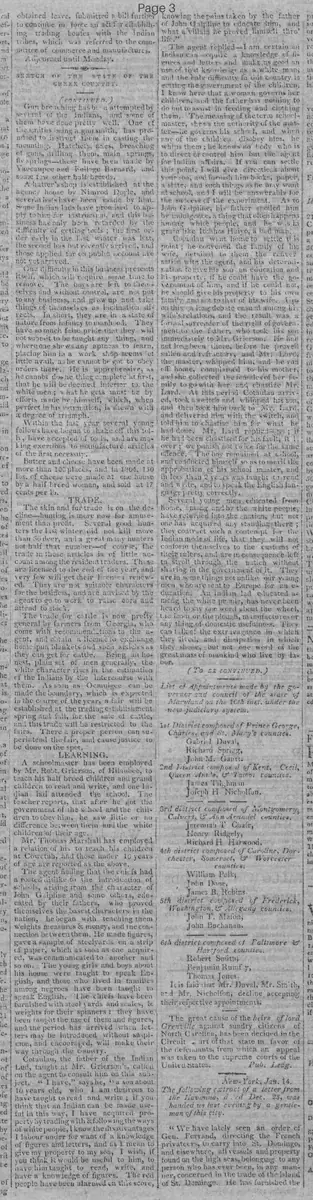
CREEK COUNTRY.
(CONTINUED.)
Gun barrel making has been attempted by several of the Indians, and some of them have done pretty well. One of the smiths being a gun smith, has promised to instruct them in casting the mountings. Hatchets, axes, breaching of guns, drilling them, main springs, flint Springs—these have been made by Yavcaupee and Folloge Barnard, and some few other half breeds.
A hatter's shop is established at the agency house by Nimrod Doyle, and several hats have been made by him. Some Indian lads have promised to apply to him for instruction, and this business has only been retarded by the difficulty of getting tools: the first order early in the last winter was lost, the second has but recently arrived, and those applied for on public account are not yet arrived.
One difficulty in this business presents itself, which will require some time to remove. The boys are left to themselves and without control, are not put to any business, and grow up and take things of themselves as inclination directs. In short, they are in a state of nature from infancy to manhood. They have so much false pride that they will not submit to be taught any thing, and where one shews any aptness to learn, placing him in a work shop seems of little avail, as he cannot be got to obey orders there. He is apprehensive, as he cannot do the thing complete at first, that he will be deemed inferior to the white men: what he gets must be by efforts made by himself, which, when perfect in his estimation, is shewn with a degree of triumph.
Within the last year several young fellows have begun to shake off this folly, have accepted of tools, and are making exertions to manufacture articles of the first necessity.
Butter and cheese have been made at more than 100 places, and in 1804, 150 lbs. of cheese were made at one house by a half breed woman, and sold at 17 cents per lb.
TRADE.
The skin and fur trade is on the decline—hunting is more now for amusement than profit. Several good hunters the last winter did not kill more than 30 deer, and a great many hunters not half that number—of course, the trade in these articles is of little account among the resident traders. These are licensed to the end of the year, and very few will get their licenses renewed. They are not suitable characters for the business, and are advised by the agent to go to work to raise corn and attend to stock.
The trade in cattle is now pretty general by farmers from Georgia, who come with recommendations to the agent, and obtain a licence to exchange homespun blankets and such articles as they can get for cattle. Being an honest, plain set of men generally, the white character rises in the estimation of the Indians by the intercourse with them. As soon as Ocmulgee can be made the boundary, which is expected in the course of the year, a fair will be established at the trading establishment spring and fall, for the sale of cattle, and this trade will be restricted to the fairs. There a proper person can superintend the fair, and cause justice to be done on the spot.
LEARNING.
A schoolmaster has been employed by Mr. Robt. Grierson, of Hilaubee, to teach his half breed children and grand children to read and write, and one Indian lad attended the school. The teacher reports, that after he got the government of the school and the children to obey him, he saw little or no difference between them and the white children of their age.
Mr. Thomas Marshall has employed a relation of his to teach his children at Cowetah, and those under 10 years of age are reported as the above.
The agent finding that the chiefs had a rooted dislike to the introduction of schools, arising from the character of John Galphin and some others, educated by their fathers, who proved themselves the basest characters in the nation, he began with teaching them weights measures & money, and the connection between them. He made figures, gave a sample of steelyards on a strip of paper, which as soon as one acquired, was communicated to another and so on. The young girls and boys about his house were taught to speak English, and those who lived in families among negroes have been taught to speak English. The chiefs have been furnished with steel yards and scales, & weights for their spinners; they have been taught the use of them and figures, and the period has arrived when letters may be introduced without suspicion, and encouraged, will make their way through the country.
Cotaulau, the father of the Indian lad, taught at Mr. Grierson's, called on the agent to consult him on this subject. " I have," says he, "a son about 10 years old, who I am desirous to have taught to read and write; if you think that an Indian can be made useful in this way, I have acquired property by trading with & following the ways of white people, I know the disadvantages I labour under for want of a knowledge of figures and letters, and as I mean to give my property to my son, I wish, if you think it would be useful to him, to have him taught to read, write, and have a knowledge of figures. The red people have been alarmed on this score, knowing the pains taken by the father of John Galphin to educate him, and what a villain he proved himself through life."
The agent replied—I am certain an Indian can acquire a knowledge of figures and letters and make,as good an use of that knowledge as a white man, and the only difficulty in this country is getting the government of the children. I know here that a woman governs her children, and the father has nothing to do but to assist in feeding and clothing them. The meaning of the term schoolmaster, shews the authority of the master—he governs his school, and when any of the children disobey him, he whips them; he knows no body who is to direct or control him but the agent for Indian affairs. If you can settle this point. I will give directions about your son, and furnish him books, paper a slate, and such things as he may want at school, and I will be answerable for the success of the experiment. As to John Galphin. his father spoiled him by indulgence, a thing that often happens among white people, and he was in grain like Itchhos Haiyo, a bad man.
Cotaulau went home to settle this point; he convened the family of his wife, detailed to them the conversation with the agent, and his determination to give his son an education and his property, if he could have the government of him, and if he could not, he should give his property to his own family and not to that of his wife. Upon this a long debate ensued among his wife's relations, and the, result was a formal surrender of the right of government to the father, who took his son immediately to Mr. Grierson. He had not long been there. before he proved sullen and refractory, and Mr. Lard. the master, whipped him, and he ran off home, complained to his mother. and she collected the females of her family to go with her and chastize Mr. Lard. At this period Cotaulau arrived, took a switch and whipped his son, and then took him back to Mr. Lard, and delivered him with the switch, and told him to chastise him for what he had done. Mr. Lard replied—aye : if he had been chastised for his fault. it is over ; we punish not twice for the same offence. The boy remained at school, and conducted himself so as to merit the approbation of his school master, and in less than 2 years was taught to read and write, and to speak the English language pretty correctly.
Several young men educated from home, among and by the white people, have returned into the nation, but not one has acquired any standing there; they contract such a contempt for the Indian mode of life, that they will not conform themselves to the customs of their rulers, and are in consequence left to stroll through the nation without sharing in the government of it. They are in some things not unlike our young men who are sent to Europe for an education. An Indian lad educated among the white people, has never been heard to say one word about the wheel, the loom or the plough, manufactures or any thing of domestic usefulness. They can talk of the extravagance in which they lived, and dissipation in which they shone, but not one word of the great mass of mankind who live by labor.
(TO BE CONTINUED.)
What sub-type of article is it?
What keywords are associated?
What entities or persons were involved?
Where did it happen?
Domestic News Details
Primary Location
Creek Country
Event Date
1804
Key Persons
Outcome
indians beginning to adopt trades like gun making, hatting, dairy production; declining fur trade; emerging cattle trade with georgia farmers; successful education of some indian children despite initial resistances.
Event Details
Description of Native American efforts in manufacturing, agriculture, trade, and education in the Creek Country, including challenges with discipline and cultural pride, and specific examples of progress in schools and trades.