Thank you for visiting SNEWPapers!
Sign up free
The Richfield Recorder
Richfield, Lincoln County, Idaho
What is this article about?
S. B. Severson urges Northwest hog farmers to unite with organized labor to build a cooperative packing house in Portland, bypassing exploitative middlemen and packers who underpay farmers while overcharging consumers. He critiques the market system and cites successful examples from Wisconsin and elsewhere.
Clipping
OCR Quality
Full Text
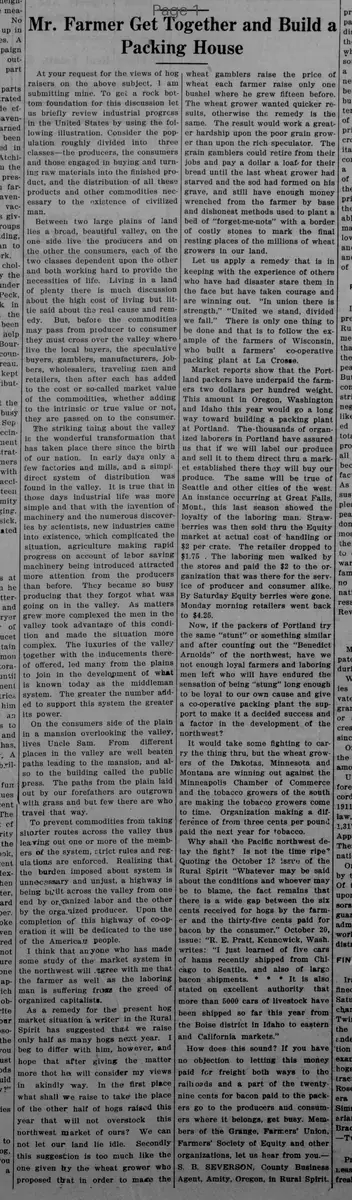
At your request for the views of hog raisers on the above subject, I am submitting mine. To get a rock bottom foundation for this discussion let us briefly review industrial progress in the United States by using the following illustration. Consider the population roughly divided into three classes—the producers, the consumers and those engaged in buying and turning raw materials into the finished product, and the distribution of all these products and other commodities necessary to the existence of civilized man.
Between two large plains of land lies a broad, beautiful valley, on the one side live the producers and on the other the consumers, each of the two classes dependent upon the other and both working hard to provide the necessities of life. Living in a land of plenty there is much discussion about the high cost of living but little said about the real cause and remedy. But, before the commodities may pass from producer to consumer they must cross over the valley where live the local buyers, the speculative buyers, gamblers, manufacturers, jobbers, wholesalers, traveling men and retailers, then after each has added to the cost or so-called market value of the commodities, whether adding to the intrinsic or true value or not, they are passed on to the consumer.
The striking thing about the valley is the wonderful transformation that has taken place there since the birth of our nation. In early days only a few factories and mills, and a simple direct system of distribution was found in the valley. It is true that in those days industrial life was more simple and that with the invention of machinery and the numerous discoveries by scientists, new industries came into existence, which complicated the situation, agriculture making rapid progress on account of labor saving machinery being introduced attracted more attention from the producers than before. They became so busy producing that they forgot what was going on in the valley. As matters grew more complex the men in the valley took advantage of this condition and made the situation more complex. The luxuries of the valley together with the inducements thereof offered, led many from the plains to join in the development of what is known today as the middleman system. The greater the number added to support this system the greater its power.
On the consumers side of the plain in a mansion overlooking the valley, lives Uncle Sam. From different places in the valley are well beaten paths leading to the mansion, and also to the building called the public press. The paths from the plain laid out by our forefathers are outgrown with grass and but few there are who travel that way.
To prevent commodities from taking shorter routes across the valley thus leaving out one or more of the members of the system, strict rules and regulations are enforced. Realizing that the burden imposed about system is unnecessary and unjust, a highway is being built across the valley from one end by organized labor and the other by the organized producer. Upon the completion of this highway of co-operation it will be dedicated to the use of the American people.
I think that anyone who has made some study of the market system in the northwest will agree with me that the farmer as well as the laboring man is suffering from the greed of organized capitalists.
As a remedy for the present hog market situation a writer in the Rural Spirit has suggested that we raise only half as many hogs next year. I beg to differ with him, however, and hope that after giving the matter more thought he will consider my views in a kindly way. In the first place what shall we raise to take the place of the other half of hogs raised this year that will not overstock this northwest market of ours? We can not let our land lie idle. Secondly this suggestion is too much like the one given by the wheat grower who proposed that in order to make the wheat gamblers raise the price of wheat each farmer raise only one bushel where he grew fifteen before.
The wheat grower wanted quicker results, otherwise the remedy is the same. The result would work a greater hardship upon the poor grain grower than upon the rich speculator. The grain gamblers could retire from their jobs and pay a dollar a loaf for their bread until the last wheat grower had starved and the sod had formed on his grave, and still have enough money wrenched from the farmer by base and dishonest methods used to plant a bed of "forget-me-nots" with a border of costly stones to mark the final resting places of the millions of wheat growers in our land.
Let us apply a remedy that is in keeping with the experience of others who have had disaster stare them in the face but have taken courage and are winning out. "In union there is strength," "United we stand, divided we fall." There is only one thing to be done and that is to follow the example of the farmers of Wisconsin, who built a farmers' co-operative packing plant at La Crosse.
Market reports show that the Portland packers have underpaid the farmers two dollars per hundred weight. This amount in Oregon, Washington and Idaho this year would go a long way toward building a packing plant at Portland. The thousands of organized laborers in Portland have assured us that if we will label our produce and sell it to them direct thru a market established there they will buy our produce. The same will be true of Seattle and other cities of the west.
An instance occurring at Great Falls, Mont., this last season showed the loyalty of the laboring man. Strawberries was then sold thru the Equity market at actual cost of handling or $2 per crate. The retailer dropped to $1.75. The laboring men walked by the stores and paid the $2 to the organization that was there for the service of producer and consumer alike. By Saturday Equity berries were gone. Monday morning retailers went back to $4.25.
Now, if the packers of Portland try the same "stunt" or something similar and after counting out the "Benedict Arnolds" of the northwest, have we not enough loyal farmers and laboring men left who will have endured the sensation of being "stung" long enough to be loyal to our own cause and give a co-operative packing plant the support to make it a decided success and a factor in the development of the northwest?
It would take some fighting to carry the thing thru, but the wheat growers of the Dakotas, Minnesota and Montana are winning out against the Minneapolis Chamber of Commerce and the tobacco growers of the south are making the tobacco growers come to time. Organization making a difference of from three cents per pound paid the next year for tobacco.
Why shall the Pacific northwest delay the fight? Is not the time ripe? Quoting the October 1 issue of the Rural Spirit "Whatever may be said about the conditions and whoever may be to blame, the fact remains that there is a wide gap between the six cents received for hogs by the farmer and the thirty-five cents paid for bacon by the consumer." October 20, issue: "R. E. Pratt, Kennowick, Wash. writes: "I just learned of five cars of hams recently shipped from Chicago to Seattle, and also of large bacon shipments. * * * It is also stated on excellent authority that more than 500 cars of livestock have been shipped so far this year from the Boise district in Idaho to eastern and California markets."
How does this sound? If you have no objection to letting this money paid for freight both ways to the railroads and a part of the twenty nine cents for bacon paid to the packers go to the producers and consumers where it belongs, get busy. Members of the Grange, Farmers' Union, Farmers' Society of Equity and other organizations, let us hear from you.—S. B. SEVERSON, County Business Agent, Amity, Oregon, in Rural Spirit.
What sub-type of article is it?
What themes does it cover?
What keywords are associated?
What entities or persons were involved?
Letter to Editor Details
Author
S. B. Severson, County Business Agent, Amity, Oregon
Recipient
Mr. Farmer
Main Argument
farmers in the northwest should organize with labor to build a cooperative packing house to eliminate middlemen exploitation in the hog market, ensuring fair prices for producers and consumers, following successful models like wisconsin's la crosse plant.
Notable Details