Thank you for visiting SNEWPapers!
Sign up free
The Daily Evansville Journal
Evansville, Vanderburgh County, Indiana
What is this article about?
Indiana Legislature passes bill granting U.S. jurisdiction over land for Indianapolis arsenal with minimal opposition, but twelve Democrats, including Reps. John A. Reitz and Thomas E. Garvin, vote against it, criticized for disloyalty amid Civil War.
Clipping
OCR Quality
Full Text
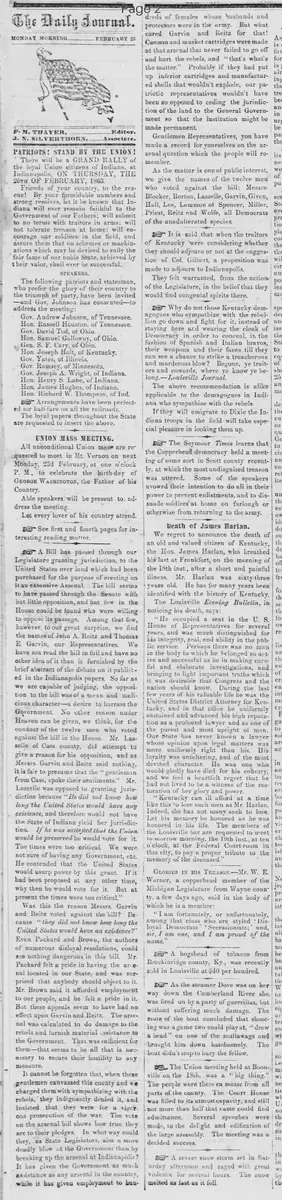
Was this the reason Messrs. Garvin and Reitz voted against the bill? Because "they did not know how long the United States would have an existence?" Even Packard and Brown, the authors of numerous disloyal resolutions, could see nothing dangerous in this bill. Mr. Packard felt a pride in having the arsenal located in our State, and was surprised that anybody should object to it. Mr. Brown said it afforded employment to our people, and he felt a pride in it. But these appeals seem to have had no effect upon Garvin and Reitz. The arsenal was calculated to do damage to the rebels and furnish material assistance to the Government. That was sufficient for them—that seems to be all that is necessary to secure their hostility to any measure.
It cannot be forgotten that, when these gentlemen canvassed this county and we charged them with sympathizing with the rebels, they indignantly denied it, and insisted that they were for a vigorous prosecution of the war. The vote on the arsenal bill shows how true they are to their pledges. In what way could they, as State Legislators, aim a more deadly blow at the Government than by breaking up the arsenal at Indianapolis? It has given the Government as much assistance as any arsenal in the country, while it has given employment to hundreds of females whose husbands and protectors were in the army. But what cared Garvin and Reitz for that! Cannon and musket cartridges were made at that arsenal that never failed to go off and hurt the rebels, and "that's what's the matter." Probably if they had put up inferior cartridges and manufactured shells that wouldn't explode, our patriotic representatives wouldn't have been so opposed to ceding the jurisdiction of the land to the General Government so that the institution might be made permanent.
Gentlemen Representatives, you have made a record for yourselves on the arsenal question which the people will remember.
As the matter is one of public interest, we give the names of the twelve men who voted against the bill: Messrs Blocker, Burton, Lasselle, Garvin, Given, Hall, Lee, Lemmon of Spencer, Miller, Priest, Reitz and Wolfe, all Democrats of the unadulterated species.
It is said that when the traitors of Kentucky were considering whether they should adjourn or not at the suggestion of Col. Gilbert, a proposition was made to adjourn to Indianapolis. They felt warranted, from the action of the Legislature, in the belief that they would find congenial spirits there. Why do not those Kentucky demagogues who sympathize with the rebellion go down and fight for it, instead of staying here and wearing the cloak of Democracy in order to conceal, in the fashion of Spanish and Italian bravos, their weapons and their faces till they can see a chance to strike a treacherous and murderous blow? Begone, ye traitors and cowards, where ye know ye belong.—Louisville Journal
The above recommendation is alike applicable to the demagogues in Indiana who sympathize with the rebels. If they will emigrate to Dixie the Indiana troops in the field will take especial pleasure in looking them up.
What sub-type of article is it?
What keywords are associated?
What entities or persons were involved?
Where did it happen?
Domestic News Details
Primary Location
Indianapolis, Indiana
Key Persons
Outcome
bill passed through legislature with little opposition; 12 democrats voted against it in the house.
Event Details
Indiana Legislature passed bill granting U.S. jurisdiction over land purchased for an extensive arsenal in Indianapolis. Opposition from 12 House members, led by reasons of uncertainty about U.S. existence amid critical times, criticized as disloyal and aimed at harassing the Government during the war.