Thank you for visiting SNEWPapers!
Sign up free
Alexandria Gazette & Daily Advertiser
Alexandria, Virginia
What is this article about?
Commentary from the Franklin Gazette on Queen Caroline's trial, quoting Blackstone on the legal status and prerogatives of the English queen consort. Discusses her importance, the political motivations behind the bill of pains and penalties, and the abandonment of the measure in the House of Lords.
Clipping
OCR Quality
Full Text
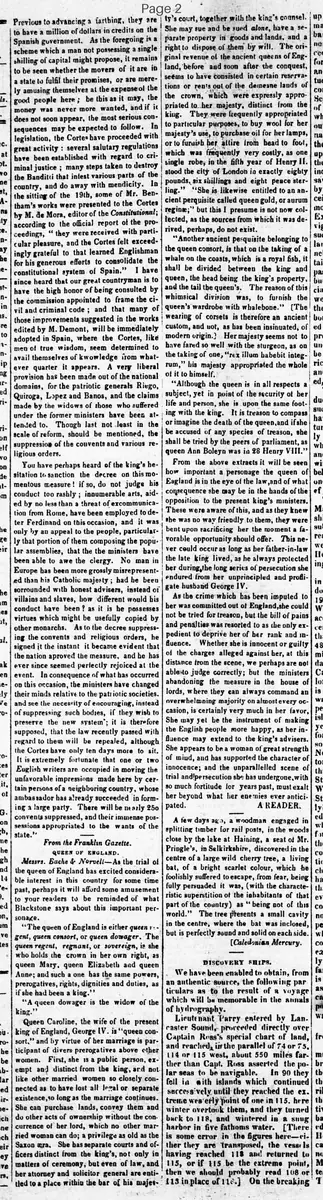
QUEEN OF ENGLAND.
Messrs. Bache & Norvell--As the trial of the queen of England has excited considerable interest in this country for some time past, perhaps it will afford some amusement to your readers to be reminded of what Blackstone says about this important personage.
"The queen of England is either queen regent, queen consort, or queen dowager. The queen regent, regnant, or sovereign, is she who holds the crown in her own right, as queen Mary, queen Elizabeth and queen Anne; and such a one has the same powers, prerogatives, rights, dignities and duties, as if she had been a king."
"A queen dowager is the widow of the king."
Queen Caroline, the wife of the present king of England, George IV. is "queen consort," and by virtue of her marriage is participant of divers prerogatives above other women. First, she is a public person, exempt and distinct from the king, and not like other married women so closely connected as to have lost all legal or separate existence, so long as the marriage continues. She can purchase lands, convey them and do other acts of ownership without the concurrence of her lord, which no other married woman can do; a privilege as old as the Saxon era. She has separate courts and officers distinct from the king's, not only in matters of ceremony; but even of law, and her attorney and solicitor general are entitled to a place within the bar of his majesty's court, together with the king's counsel. She may sue and be sued alone, have a separate property in goods and lands, and a right to dispose of them by will. The original revenue of the ancient queens of England, 'before and soon after the conquest, seems to have consisted in certain reservations or rents out of the demesne lands of the crown, which were expressly appropriated to her majesty, distinct from the king. They were frequently appropriated to particular purposes, to buy wool for her majesty's use, to purchase oil for her lamps, or to furnish her attire from head to foot, which was frequently very costly, as one single robe, in the fifth year of Henry II. stood the city of London in exactly eighty pounds, six shillings and eight pence sterling." "She is likewise entitled to an ancient perquisite called queen gold, or aurum reginae:" but this I presume is not now collected, as the sources from which it was derived, perhaps, do not exist.
"Another ancient perquisite belonging to the queen consort, is that on the taking of a whale on the coasts, which is a royal fish, it shall be divided between the king and queen, the head being the king's property, and the tail the queen's. The reason of this whimsical division was, to furnish the queen's wardrobe with whalebone." [The wearing of corsets is therefore an ancient custom, and not, as has been insinuated, of modern origin.] Her majesty seems not to have fared so well with the sturgeon, as on the taking of one, "rex illum habebit integrum," his majesty appropriated the whole of it to himself.
"Although the queen is in all respects a subject, yet in point of the security of her life and person, she is upon the same footing with the king. It is treason to compass or imagine the death of the queen, and if she be accused of any species of treason, she shall be tried by the peers of parliament, as queen Ann Boleyn was in 28 Henry VIII."
From the above extracts it will be seen how important a personage the queen of England is in the eye of the law, and of what consequence she may be in the hands of the opposition to the present king's ministers. These were aware of this, and as they knew she was no way friendly to them, they were bent upon sacrificing her the moment a favorable opportunity should offer. This never could occur as long as her father-in-law the late king lived, as he always protected her during the long series of persecution she endured from her unprincipled and profligate husband George IV.
As the crime which has been imputed to her was committed out of England, she could not be tried for treason, but the bill of pains and penalties was resorted to as the only expedient to deprive her of her rank and influence. Whether she is innocent or guilty of the charges alleged against her, at this distance from the scene, we perhaps are not able to judge correctly; but the ministers abandoning the measure in the house of lords, where they can always command an overwhelming majority on almost every occasion, is certainly very much in her favor. She may yet be the instrument of making the English people more happy, as her influence may extend to the king's advisers. She appears to be a woman of great strength of mind, and has supported the character of innocence; and the unparalleled scene of trial and persecution she has undergone, with so much fortitude for years past, must exalt her beyond what her enemies ever anticipated.
A READER.
What sub-type of article is it?
What keywords are associated?
What entities or persons were involved?
Where did it happen?
Foreign News Details
Primary Location
England
Key Persons
Outcome
ministers abandoned the bill of pains and penalties in the house of lords.
Event Details
The article discusses the trial of Queen Caroline, quoting Blackstone on the legal prerogatives of the queen consort, her historical importance, and the political efforts to deprive her of rank through a bill of pains and penalties due to alleged crimes committed abroad. The abandonment of the bill favors her innocence and potential influence.