Thank you for visiting SNEWPapers!
Sign up free
Story
June 26, 1944
The Lincoln Times
Lincolnton, Lincoln County, North Carolina
What is this article about?
A psychiatrist warns that postwar reunions of separated couples may face 'loss of tolerance' rather than lost affection, urging preparation for adjustment instead of expecting perfect happiness. Uses example of Mrs. Smith romanticizing her absent husband's return.
Clipping
OCR Quality
98%
Excellent
Full Text
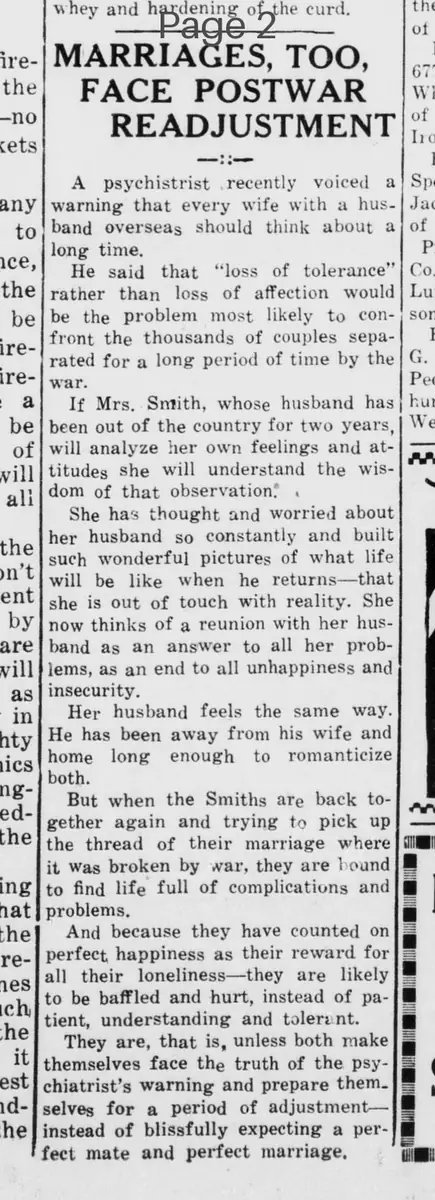
MARRIAGES, TOO,
FACE POSTWAR
READJUSTMENT
A psychiatrist recently voiced a
warning that every wife with a hus-
band overseas should think about a
long time.
He said that "loss of tolerance"
rather than loss of affection would
be the problem most likely to con-
front the thousands of couples sepa-
rated for a long period of time by the
war.
If Mrs. Smith, whose husband has
been out of the country for two years,
will analyze her own feelings and at-
titudes she will understand the wis-
dom of that observation.
She has thought and worried about
her husband so constantly and built
such wonderful pictures of what life
will be like when he returns—that
she is out of touch with reality. She
now thinks of a reunion with her hus-
band as an answer to all her prob-
lems, as an end to all unhappiness and
insecurity.
Her husband feels the same way.
He has been away from his wife and
home long enough to romanticize
both.
But when the Smiths are back to-
gether again and trying to pick up
the thread of their marriage where
it was broken by war, they are bound
to find life full of complications and
problems.
And because they have counted on
perfect happiness as their reward for
all their loneliness—they are likely
to be baffled and hurt, instead of pa-
tient, understanding and tolerant.
They are, that is, unless both make
themselves face the truth of the psy-
chiatrist's warning and prepare them-
selves for a period of adjustment—
instead of blissfully expecting a per-
fect mate and perfect marriage.
FACE POSTWAR
READJUSTMENT
A psychiatrist recently voiced a
warning that every wife with a hus-
band overseas should think about a
long time.
He said that "loss of tolerance"
rather than loss of affection would
be the problem most likely to con-
front the thousands of couples sepa-
rated for a long period of time by the
war.
If Mrs. Smith, whose husband has
been out of the country for two years,
will analyze her own feelings and at-
titudes she will understand the wis-
dom of that observation.
She has thought and worried about
her husband so constantly and built
such wonderful pictures of what life
will be like when he returns—that
she is out of touch with reality. She
now thinks of a reunion with her hus-
band as an answer to all her prob-
lems, as an end to all unhappiness and
insecurity.
Her husband feels the same way.
He has been away from his wife and
home long enough to romanticize
both.
But when the Smiths are back to-
gether again and trying to pick up
the thread of their marriage where
it was broken by war, they are bound
to find life full of complications and
problems.
And because they have counted on
perfect happiness as their reward for
all their loneliness—they are likely
to be baffled and hurt, instead of pa-
tient, understanding and tolerant.
They are, that is, unless both make
themselves face the truth of the psy-
chiatrist's warning and prepare them-
selves for a period of adjustment—
instead of blissfully expecting a per-
fect mate and perfect marriage.
What sub-type of article is it?
Family Drama
What themes does it cover?
Family
Misfortune
Recovery
What keywords are associated?
Postwar Readjustment
Marriage Reunion
Loss Of Tolerance
Family Separation
Psychiatrist Warning
What entities or persons were involved?
Mrs. Smith
Mr. Smith
Psychiatrist
Story Details
Key Persons
Mrs. Smith
Mr. Smith
Psychiatrist
Story Details
Psychiatrist warns wives with husbands overseas of postwar 'loss of tolerance' in reunions; Mrs. Smith example shows romanticized expectations leading to adjustment challenges unless prepared.