Thank you for visiting SNEWPapers!
Sign up free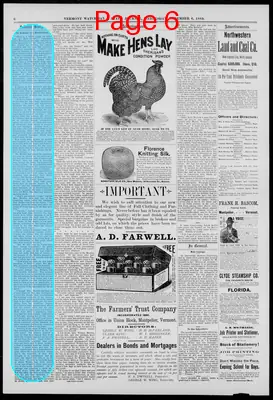
Literary
November 6, 1889
The Vermont Watchman
Montpelier, Washington County, Vermont
What is this article about?
During the Civil War battle near Dalton, GA on August 14, 1864, Ethel Merwin aids a wounded Union soldier with water and her handkerchief. Years later, after family losses, she reunites with him as Dr. St. John, hinting at romance sparked by that act of kindness.
Clipping

OCR Quality
98%
Excellent
Full Text
Selected Story
The Romance of a Handkerchief
"There is a battle going on quite near us! How terrible!" exclaimed Ethel Merwin, as she came running in from the garden to the library, where her mother sat sewing, her cheeks blanched and her pale lips parted in breathless excitement. "Don't you hear the booming of the guns, mamma? They cannot be more than a mile away! Oh, what a dreadful thing war is!"
And she dropped the roses she had been gathering in her dainty white apron into a promiscuous heap upon the table, whence their delicate perfume soon permeated the entire room, as they lay neglected there. It was the morning of August 14, 1864, hot and sultry when Hume's and Kelly's brigades of Wheeler's cavalry, who were raiding General Sherman's communications, captured Dalton after a spirited fight, taking two hundred prisoners and destroying considerable army stores.
A glance at her mother's pale face told Ethel that she was not unmindful of the truth that an engagement was taking place only a mile or two away, whence the din of battle was borne to them on the air.
"If worse comes to worst, we must do the best we can, dear," replied her mother. "Be calm and considerate, whatever the result! In the meantime we must arrange to give all needed assistance to the wounded, be they friend or foe, for if the battle lasts long, there may be need of our help." And laying down her sewing, she went to her chamber and, unlocking the drawers of an old-time bureau, commenced taking out rolls of old linen and a pile of old sheets, from which to prepare lint and bandages. Taking them in her arms, she carried them down to the sitting-room, where she and Ethel scraped from them a snowy pile of lint and prepared bandages which were rolled ready for use.
Few words were spoken by mother and daughter, as the thoughts of each were busy with the hopes and fears incident to the occasion, for the loved from under that roof had gone forth to share the fate of war, whether for defeat or victory.
Mr. Merwin had joined the confederate army as colonel at the outbreak of the war, and his two sons, Clarence and Wilmot, were not long in following him, though the latter was a mere boy of only sixteen. In all probability these two brothers were in the engagement, for they belonged to Hume's brigade.
In the midst of their preparations for the wounded, old Caesar came in with gleaming eyes showing their white circles, like the rings of Saturn.
"Dey say de Yanks done cum ter Dalton, an' dey's fitin' right smart down near de meetin' houses by de woods!" and his rheumatic legs forgot their lameness, as he hurried into the kitchen to impart the news to his deaf wife, old Milly, who was busy with her morning work.
"Don't get excited, Caesar," replied Mrs. Merwin, with pale lips, as her trembling hands rolled the bandages that Ethel tore from the sheets, but remain about the house until after the sound of firing ceases, for we may need you."
"Ya-s'm," replied Caesar, bobbing his gray head from between the half-closed door, before shutting it, as he hurried across the back yard to the kitchen, which was built separate from the house of his master, a few yards distant, according to the custom at the South in the time when the slavery system was in vogue.
About noon a messenger came hurriedly—a confederate cavalry soldier, bearing the tidings that the federals had taken refuge in a fort near the town, they having been driven back by the confederates to that point, where they were strongly fortified.
"But we will rout the Yanks from their retreat to-morrow," he added jocosely, although his face wore an expression of pain, for he had come to bear sad news with that of victory to the inmates of the Merwin plantation, and had preluded his mission with the sweet before the bitter.
"How about my sons—do you know anything of them?" asked Mrs. Merwin, anxiously scanning his features.
"I believe Clarence is well and safe—but—your younger son, Wilmot, has been slightly wounded." The surgeon wished me to say to you that the wound was not serious, but that he had advised his removal to your home, and I am sent to inform you that you had better send for him as soon as practicable, as there are very poor accommodations in the vicinity of the battlefield for the injured."
Although Mrs. Merwin had kept up a brave heart all day, this intelligence proved the weight that overbalanced the seeming equipoise of her nerves, and without speaking a word she leaned back in her chair, deadly pale, the work falling from her trembling fingers.
Restoratives were administered, which had the desired effect, and she soon opened her eyes and spoke in low tones.
With Aunt Milly's assistance, Ethel soon had her mother made comfortable in bed, and leaving her in that excellent nurse's care, she and Caesar started for the battlefield in the family carriage, which contained pillows, blankets and other necessary comforts for conveying the wounded soldier to his home.
Arriving at the scene of battle, Ethel was transfixed with horror at the terrible sights! The soldiers detailed to bury the dead were busy at their work, while the wounded had not yet all been carried from the field. Dead bodies in all conceivable positions were lying here and there, and in many instances a dead or maimed horse lay beside his rider. A vacant house and barn had been transformed into a temporary hospital, where the surgeons were attending to the wounded, as they were brought in on ambulances and laid upon the improvised cots, or on the bare floor. In order to reach the house in which Wilmot had been placed, Caesar was obliged to drive over a portion of this recent battlefield. As the carriage was rounding a curve on a grassy slope, Ethel saw lying only a few feet away the body of a Union soldier, his pale face upturned to the scorching rays of the sun. At first she thought him dead, but while she looked he slowly opened his dark blue eyes and gazed about. He had dark brown hair, a fine form and face, and could not have been over twenty-two years of age.
"Stop the horses," she called involuntarily to old Caesar, who simply turned his head with his less deaf ear towards her, and asked:
"Did yer speaks ter me, Miss Ethel?"
"Yes, stop the horses!" and old Caesar drew in the reins.
Ethel sprang out of the carriage, and in a moment was beside the wounded soldier, forgetful of everything except that here was a human being wounded and in distress.
"Can I do anything for you?" she asked, as she bent over him.
He looked into her beautiful, sympathetic face and faintly smiled, replying in a whisper, "I-am-thirsty-some-water."
Calling to Caesar, she directed him to hitch the horses and bring some water from a spring near by. Then taking his empty canteen she filled it with cool water and placed it to his parched lips.
He drank eagerly and seemed revived.
"Thank you; it is the sweetest draught I ever drank!" he whispered.
"I have suffered more from thirst since being wounded than from my wound."
"Where are you wounded?" Ethel asked anxiously, as she saw a little rivulet of blood trickling on the ground where he was lying.
"In my left arm," he replied, "and I am weak from the loss of blood, that is continually flowing from the wound. If you will please take my handkerchief from the inside pocket of my coat and bind above the wound, I think it may staunch the blood in a measure."
Ethel unbuttoned his coat and took a handkerchief from the pocket designated, and bound it above the wound, then refilled his canteen with water and left him, after telling him that she had come to take her wounded brother home. She was just about to enter the carriage, when the thought occurred—
"Poor fellow! He is lying there in the hot sun without anything to protect his face, and it may be an hour or two before he will be found and carried to the house for the wounded!" Turning back, she took her handkerchief from her pocket and, approaching him, said:
"Please let me spread my handkerchief over your face to protect it from the sun, it is nearly blistered!"
"Thank you," he replied, "you are very kind."
Then she laid it over his face in such a manner as not to obstruct the fresh air from his nostrils, and she and old Caesar went on their way for Wilmot.
They found him at the improvised hospital, with a deep flesh wound, from which he was weak with the loss of blood, but no danger apprehended.
He was placed in the carriage, tenderly wrapped and bolstered by Ethel and old Caesar, and the trio started for home, Wilmot with thankful heart that he had a home so near to which he could be taken, and Ethel with glad tears in her eyes, to find that her brother was not seriously injured. In passing the spot where the Union soldier had lain, they found him gone, and nothing but the red blood-stain there to indicate where he had lain, while the footprints in the fine, clayey soil about the place showed that he had evidently been removed to the hospital.
On the following day, General Steedman arrived with about 2,000 troops, thus relieving the Union forces who were in the fort near the town, and the confederates were obliged to retreat.
Wilmot Merwin, under the loving care of his mother and sister, rapidly recovered from his injury and in six weeks was again with his comrades in arms.
Years went by and brought many changes. They hushed the booming of cannon and rattle of musketry and unfurled the banner of peace all over our beloved country, while the grass grew green over the graves of loved ones sacrificed upon her altar, proclaiming in silent language at how great a price peace had been obtained.
Change had also come to the Merwin household. Of the three who had gone forth under the confederate flag, only the youngest, Wilmot, lived to return, Colonel Merwin and Clarence both having fallen in the same battle!—the battle at Appomattox. Ethel was twenty-five years of age, the dignity of womanhood rendering her even more beautiful than her girlhood, with all of its fresh rose tints of cheek and sparkle of eye had promised; while with her self-poise and queenly bearing that now characterized her there was an indefinable something, wrought from experience and sorrow, that seemed to permeate her whole character and displayed itself in her gentle sympathy and ready aid for the sorrowing and afflicted.
Of course suitors sought her hand, but she "said them nay."
"I am sure you cannot expect to find the whole world over a more desirable husband than Major Prince," Wilmot had said to her one day, after she had confided to him the fact of her rejection of that wealthy gentleman, whom the maidens and young widows of that section all looked upon as such a "catch."
"I do not think I shall ever marry," was Ethel's calm but positive reply.
Did the remembrance of a young soldier in blue, lying wounded on the battlefield, have anything to do with her decision? If so, she kept her secret to herself, and, perhaps, almost unconsciously from herself.
A few weeks later Wilmot Merwin, with his wife and two children, went on a trip to California, where they remained for several months. On their return a stranger accompanied them, whose acquaintance Wilmot had made in his absence, and to whom he introduced Ethel as Dr. St. John of New York, who was tall, with broad whiskers, and a remarkably expressive face.
He was on his way to Florida where he intended to spend the winter, but the friendship formed for Wilmot Merwin and his family while at the same hotel in San Jose caused him to accept the pressing invitation tendered him to spend a few days at their home on his way south.
"It seems to me that I have met you before," he said to Ethel that evening after their first introduction, as they were chatting on common-place topics by the parlor grate, "but I cannot re-
The Romance of a Handkerchief
"There is a battle going on quite near us! How terrible!" exclaimed Ethel Merwin, as she came running in from the garden to the library, where her mother sat sewing, her cheeks blanched and her pale lips parted in breathless excitement. "Don't you hear the booming of the guns, mamma? They cannot be more than a mile away! Oh, what a dreadful thing war is!"
And she dropped the roses she had been gathering in her dainty white apron into a promiscuous heap upon the table, whence their delicate perfume soon permeated the entire room, as they lay neglected there. It was the morning of August 14, 1864, hot and sultry when Hume's and Kelly's brigades of Wheeler's cavalry, who were raiding General Sherman's communications, captured Dalton after a spirited fight, taking two hundred prisoners and destroying considerable army stores.
A glance at her mother's pale face told Ethel that she was not unmindful of the truth that an engagement was taking place only a mile or two away, whence the din of battle was borne to them on the air.
"If worse comes to worst, we must do the best we can, dear," replied her mother. "Be calm and considerate, whatever the result! In the meantime we must arrange to give all needed assistance to the wounded, be they friend or foe, for if the battle lasts long, there may be need of our help." And laying down her sewing, she went to her chamber and, unlocking the drawers of an old-time bureau, commenced taking out rolls of old linen and a pile of old sheets, from which to prepare lint and bandages. Taking them in her arms, she carried them down to the sitting-room, where she and Ethel scraped from them a snowy pile of lint and prepared bandages which were rolled ready for use.
Few words were spoken by mother and daughter, as the thoughts of each were busy with the hopes and fears incident to the occasion, for the loved from under that roof had gone forth to share the fate of war, whether for defeat or victory.
Mr. Merwin had joined the confederate army as colonel at the outbreak of the war, and his two sons, Clarence and Wilmot, were not long in following him, though the latter was a mere boy of only sixteen. In all probability these two brothers were in the engagement, for they belonged to Hume's brigade.
In the midst of their preparations for the wounded, old Caesar came in with gleaming eyes showing their white circles, like the rings of Saturn.
"Dey say de Yanks done cum ter Dalton, an' dey's fitin' right smart down near de meetin' houses by de woods!" and his rheumatic legs forgot their lameness, as he hurried into the kitchen to impart the news to his deaf wife, old Milly, who was busy with her morning work.
"Don't get excited, Caesar," replied Mrs. Merwin, with pale lips, as her trembling hands rolled the bandages that Ethel tore from the sheets, but remain about the house until after the sound of firing ceases, for we may need you."
"Ya-s'm," replied Caesar, bobbing his gray head from between the half-closed door, before shutting it, as he hurried across the back yard to the kitchen, which was built separate from the house of his master, a few yards distant, according to the custom at the South in the time when the slavery system was in vogue.
About noon a messenger came hurriedly—a confederate cavalry soldier, bearing the tidings that the federals had taken refuge in a fort near the town, they having been driven back by the confederates to that point, where they were strongly fortified.
"But we will rout the Yanks from their retreat to-morrow," he added jocosely, although his face wore an expression of pain, for he had come to bear sad news with that of victory to the inmates of the Merwin plantation, and had preluded his mission with the sweet before the bitter.
"How about my sons—do you know anything of them?" asked Mrs. Merwin, anxiously scanning his features.
"I believe Clarence is well and safe—but—your younger son, Wilmot, has been slightly wounded." The surgeon wished me to say to you that the wound was not serious, but that he had advised his removal to your home, and I am sent to inform you that you had better send for him as soon as practicable, as there are very poor accommodations in the vicinity of the battlefield for the injured."
Although Mrs. Merwin had kept up a brave heart all day, this intelligence proved the weight that overbalanced the seeming equipoise of her nerves, and without speaking a word she leaned back in her chair, deadly pale, the work falling from her trembling fingers.
Restoratives were administered, which had the desired effect, and she soon opened her eyes and spoke in low tones.
With Aunt Milly's assistance, Ethel soon had her mother made comfortable in bed, and leaving her in that excellent nurse's care, she and Caesar started for the battlefield in the family carriage, which contained pillows, blankets and other necessary comforts for conveying the wounded soldier to his home.
Arriving at the scene of battle, Ethel was transfixed with horror at the terrible sights! The soldiers detailed to bury the dead were busy at their work, while the wounded had not yet all been carried from the field. Dead bodies in all conceivable positions were lying here and there, and in many instances a dead or maimed horse lay beside his rider. A vacant house and barn had been transformed into a temporary hospital, where the surgeons were attending to the wounded, as they were brought in on ambulances and laid upon the improvised cots, or on the bare floor. In order to reach the house in which Wilmot had been placed, Caesar was obliged to drive over a portion of this recent battlefield. As the carriage was rounding a curve on a grassy slope, Ethel saw lying only a few feet away the body of a Union soldier, his pale face upturned to the scorching rays of the sun. At first she thought him dead, but while she looked he slowly opened his dark blue eyes and gazed about. He had dark brown hair, a fine form and face, and could not have been over twenty-two years of age.
"Stop the horses," she called involuntarily to old Caesar, who simply turned his head with his less deaf ear towards her, and asked:
"Did yer speaks ter me, Miss Ethel?"
"Yes, stop the horses!" and old Caesar drew in the reins.
Ethel sprang out of the carriage, and in a moment was beside the wounded soldier, forgetful of everything except that here was a human being wounded and in distress.
"Can I do anything for you?" she asked, as she bent over him.
He looked into her beautiful, sympathetic face and faintly smiled, replying in a whisper, "I-am-thirsty-some-water."
Calling to Caesar, she directed him to hitch the horses and bring some water from a spring near by. Then taking his empty canteen she filled it with cool water and placed it to his parched lips.
He drank eagerly and seemed revived.
"Thank you; it is the sweetest draught I ever drank!" he whispered.
"I have suffered more from thirst since being wounded than from my wound."
"Where are you wounded?" Ethel asked anxiously, as she saw a little rivulet of blood trickling on the ground where he was lying.
"In my left arm," he replied, "and I am weak from the loss of blood, that is continually flowing from the wound. If you will please take my handkerchief from the inside pocket of my coat and bind above the wound, I think it may staunch the blood in a measure."
Ethel unbuttoned his coat and took a handkerchief from the pocket designated, and bound it above the wound, then refilled his canteen with water and left him, after telling him that she had come to take her wounded brother home. She was just about to enter the carriage, when the thought occurred—
"Poor fellow! He is lying there in the hot sun without anything to protect his face, and it may be an hour or two before he will be found and carried to the house for the wounded!" Turning back, she took her handkerchief from her pocket and, approaching him, said:
"Please let me spread my handkerchief over your face to protect it from the sun, it is nearly blistered!"
"Thank you," he replied, "you are very kind."
Then she laid it over his face in such a manner as not to obstruct the fresh air from his nostrils, and she and old Caesar went on their way for Wilmot.
They found him at the improvised hospital, with a deep flesh wound, from which he was weak with the loss of blood, but no danger apprehended.
He was placed in the carriage, tenderly wrapped and bolstered by Ethel and old Caesar, and the trio started for home, Wilmot with thankful heart that he had a home so near to which he could be taken, and Ethel with glad tears in her eyes, to find that her brother was not seriously injured. In passing the spot where the Union soldier had lain, they found him gone, and nothing but the red blood-stain there to indicate where he had lain, while the footprints in the fine, clayey soil about the place showed that he had evidently been removed to the hospital.
On the following day, General Steedman arrived with about 2,000 troops, thus relieving the Union forces who were in the fort near the town, and the confederates were obliged to retreat.
Wilmot Merwin, under the loving care of his mother and sister, rapidly recovered from his injury and in six weeks was again with his comrades in arms.
Years went by and brought many changes. They hushed the booming of cannon and rattle of musketry and unfurled the banner of peace all over our beloved country, while the grass grew green over the graves of loved ones sacrificed upon her altar, proclaiming in silent language at how great a price peace had been obtained.
Change had also come to the Merwin household. Of the three who had gone forth under the confederate flag, only the youngest, Wilmot, lived to return, Colonel Merwin and Clarence both having fallen in the same battle!—the battle at Appomattox. Ethel was twenty-five years of age, the dignity of womanhood rendering her even more beautiful than her girlhood, with all of its fresh rose tints of cheek and sparkle of eye had promised; while with her self-poise and queenly bearing that now characterized her there was an indefinable something, wrought from experience and sorrow, that seemed to permeate her whole character and displayed itself in her gentle sympathy and ready aid for the sorrowing and afflicted.
Of course suitors sought her hand, but she "said them nay."
"I am sure you cannot expect to find the whole world over a more desirable husband than Major Prince," Wilmot had said to her one day, after she had confided to him the fact of her rejection of that wealthy gentleman, whom the maidens and young widows of that section all looked upon as such a "catch."
"I do not think I shall ever marry," was Ethel's calm but positive reply.
Did the remembrance of a young soldier in blue, lying wounded on the battlefield, have anything to do with her decision? If so, she kept her secret to herself, and, perhaps, almost unconsciously from herself.
A few weeks later Wilmot Merwin, with his wife and two children, went on a trip to California, where they remained for several months. On their return a stranger accompanied them, whose acquaintance Wilmot had made in his absence, and to whom he introduced Ethel as Dr. St. John of New York, who was tall, with broad whiskers, and a remarkably expressive face.
He was on his way to Florida where he intended to spend the winter, but the friendship formed for Wilmot Merwin and his family while at the same hotel in San Jose caused him to accept the pressing invitation tendered him to spend a few days at their home on his way south.
"It seems to me that I have met you before," he said to Ethel that evening after their first introduction, as they were chatting on common-place topics by the parlor grate, "but I cannot re-
What sub-type of article is it?
Prose Fiction
What themes does it cover?
War Peace
Love Romance
Death Mortality
What keywords are associated?
Civil War
Battle Dalton
Wounded Soldier
Handkerchief
Romance
Confederate
Union
Family Loss
Reunion
Literary Details
Title
The Romance Of A Handkerchief
Key Lines
"There Is A Battle Going On Quite Near Us! How Terrible!" Exclaimed Ethel Merwin...
"I Am Thirsty Some Water."
"Thank You; It Is The Sweetest Draught I Ever Drank!"
Did The Remembrance Of A Young Soldier In Blue, Lying Wounded On The Battlefield, Have Anything To Do With Her Decision?
"It Seems To Me That I Have Met You Before," He Said To Ethel...