Thank you for visiting SNEWPapers!
Sign up free
Story
June 8, 1935
Peninsula Enterprise
Accomac, Accomack County, Virginia
What is this article about?
1935 article celebrating the 158th anniversary of the U.S. flag, 'Old Glory,' adopted June 14, 1777. Covers its origins, Betsy Ross legend, evolution with new states, colonial precursors, and symbolism of liberty and separation from Britain.
Clipping
OCR Quality
95%
Excellent
Full Text
OLD GLORY CELEBRATES BIRTHDAY
SYMBOL OF NATION FOR 158 YEARS
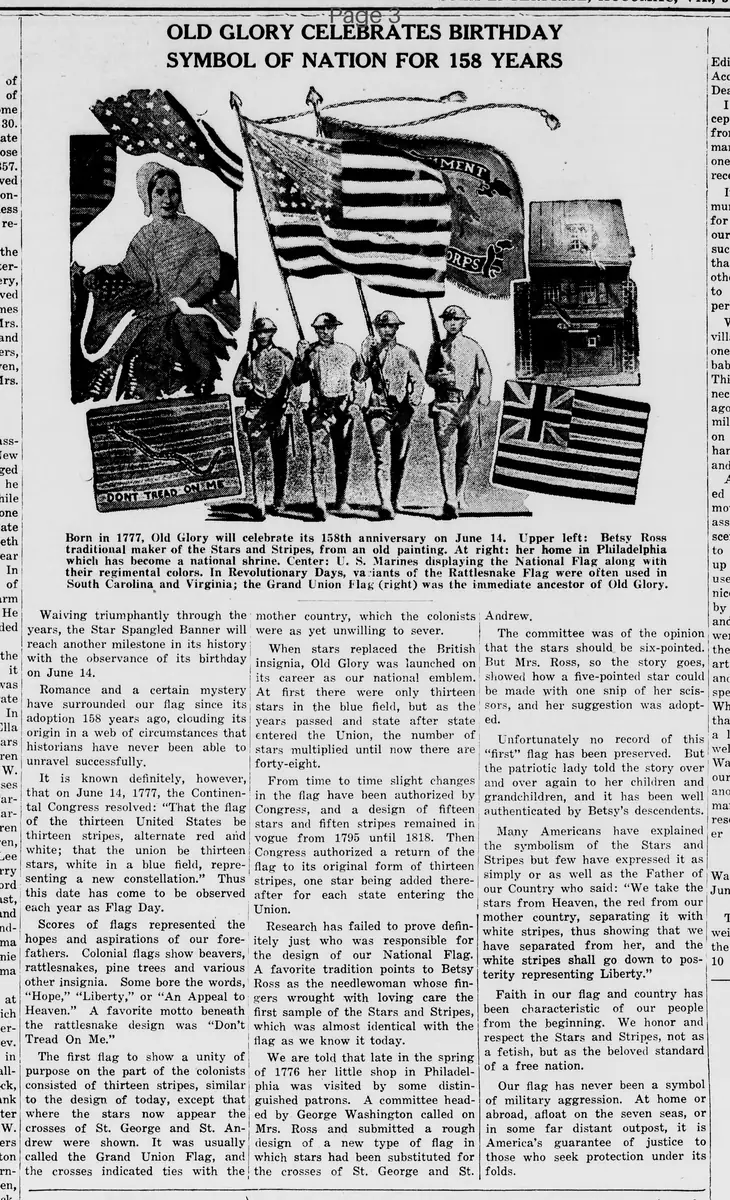
Born in 1777, Old Glory will celebrate its 158th anniversary on June 14. Upper left: Betsy Ross traditional maker of the Stars and Stripes, from an old painting. At right: her home in Philadelphia which has become a national shrine. Center: U. S. Marines displaying the National Flag along with their regimental colors. In Revolutionary Days, variants of the Rattlesnake Flag were often used in South Carolina and Virginia; the Grand Union Flag (right) was the immediate ancestor of Old Glory.
Waiving triumphantly through the years, the Star Spangled Banner will reach another milestone in its history with the observance of its birthday on June 14.
Romance and a certain mystery have surrounded our flag since its adoption 158 years ago, clouding its origin in a web of circumstances that historians have never been able to unravel successfully.
It is known definitely, however, that on June 14, 1777, the Continental Congress resolved: "That the flag of the thirteen United States be thirteen stripes, alternate red and white; that the union be thirteen stars, white in a blue field, representing a new constellation." Thus this date has come to be observed each year as Flag Day.
Scores of flags represented the hopes and aspirations of our forefathers. Colonial flags show beavers, rattlesnakes, pine trees and various other insignia. Some bore the words, "Hope," "Liberty," or "An Appeal to Heaven." A favorite motto beneath the rattlesnake design was "Don't Tread On Me."
The first flag to show a unity of purpose on the part of the colonists consisted of thirteen stripes, similar to the design of today, except that where the stars now appear the crosses of St. George and St. Andrew were shown. It was usually called the Grand Union Flag, and the crosses indicated ties with the mother country, which the colonists were as yet unwilling to sever.
When stars replaced the British insignia, Old Glory was launched on its career as our national emblem.
At first there were only thirteen stars in the blue field, but as the years passed and state after state entered the Union, the number of stars multiplied until now there are forty-eight.
From time to time slight changes in the flag have been authorized by Congress, and a design of fifteen stars and fifteen stripes remained in vogue from 1795 until 1818. Then Congress authorized a return of the flag to its original form of thirteen stripes, one star being added thereafter for each state entering the Union.
Research has failed to prove definitely just who was responsible for the design of our National Flag.
A favorite tradition points to Betsy Ross as the needlewoman whose fingers wrought with loving care the first sample of the Stars and Stripes, which was almost identical with the flag as we know it today.
We are told that late in the spring of 1776 her little shop in Philadelphia was visited by some distinguished patrons. A committee headed by George Washington called on Mrs. Ross and submitted a rough design of a new type of flag in which stars had been substituted for the crosses of St. George and St. Andrew.
The committee was of the opinion that the stars should be six-pointed. But Mrs. Ross, so the story goes, showed how a five-pointed star could be made with one snip of her scissors, and her suggestion was adopted.
Unfortunately no record of this "first" flag has been preserved. But the patriotic lady told the story over and over again to her children and grandchildren, and it has been well authenticated by Betsy's descendents.
Many Americans have explained the symbolism of the Stars and Stripes but few have expressed it as simply or as well as the Father of our Country who said: "We take the stars from Heaven, the red from our mother country, separating it with white stripes, thus showing that we have separated from her, and the white stripes shall go down to posterity representing Liberty."
Faith in our flag and country has been characteristic of our people from the beginning. We honor and respect the Stars and Stripes, not as a fetish, but as the beloved standard of a free nation.
Our flag has never been a symbol of military aggression. At home or abroad, afloat on the seven seas, or in some far distant outpost, it is America's guarantee of justice to those who seek protection under its folds.
SYMBOL OF NATION FOR 158 YEARS
Born in 1777, Old Glory will celebrate its 158th anniversary on June 14. Upper left: Betsy Ross traditional maker of the Stars and Stripes, from an old painting. At right: her home in Philadelphia which has become a national shrine. Center: U. S. Marines displaying the National Flag along with their regimental colors. In Revolutionary Days, variants of the Rattlesnake Flag were often used in South Carolina and Virginia; the Grand Union Flag (right) was the immediate ancestor of Old Glory.
Waiving triumphantly through the years, the Star Spangled Banner will reach another milestone in its history with the observance of its birthday on June 14.
Romance and a certain mystery have surrounded our flag since its adoption 158 years ago, clouding its origin in a web of circumstances that historians have never been able to unravel successfully.
It is known definitely, however, that on June 14, 1777, the Continental Congress resolved: "That the flag of the thirteen United States be thirteen stripes, alternate red and white; that the union be thirteen stars, white in a blue field, representing a new constellation." Thus this date has come to be observed each year as Flag Day.
Scores of flags represented the hopes and aspirations of our forefathers. Colonial flags show beavers, rattlesnakes, pine trees and various other insignia. Some bore the words, "Hope," "Liberty," or "An Appeal to Heaven." A favorite motto beneath the rattlesnake design was "Don't Tread On Me."
The first flag to show a unity of purpose on the part of the colonists consisted of thirteen stripes, similar to the design of today, except that where the stars now appear the crosses of St. George and St. Andrew were shown. It was usually called the Grand Union Flag, and the crosses indicated ties with the mother country, which the colonists were as yet unwilling to sever.
When stars replaced the British insignia, Old Glory was launched on its career as our national emblem.
At first there were only thirteen stars in the blue field, but as the years passed and state after state entered the Union, the number of stars multiplied until now there are forty-eight.
From time to time slight changes in the flag have been authorized by Congress, and a design of fifteen stars and fifteen stripes remained in vogue from 1795 until 1818. Then Congress authorized a return of the flag to its original form of thirteen stripes, one star being added thereafter for each state entering the Union.
Research has failed to prove definitely just who was responsible for the design of our National Flag.
A favorite tradition points to Betsy Ross as the needlewoman whose fingers wrought with loving care the first sample of the Stars and Stripes, which was almost identical with the flag as we know it today.
We are told that late in the spring of 1776 her little shop in Philadelphia was visited by some distinguished patrons. A committee headed by George Washington called on Mrs. Ross and submitted a rough design of a new type of flag in which stars had been substituted for the crosses of St. George and St. Andrew.
The committee was of the opinion that the stars should be six-pointed. But Mrs. Ross, so the story goes, showed how a five-pointed star could be made with one snip of her scissors, and her suggestion was adopted.
Unfortunately no record of this "first" flag has been preserved. But the patriotic lady told the story over and over again to her children and grandchildren, and it has been well authenticated by Betsy's descendents.
Many Americans have explained the symbolism of the Stars and Stripes but few have expressed it as simply or as well as the Father of our Country who said: "We take the stars from Heaven, the red from our mother country, separating it with white stripes, thus showing that we have separated from her, and the white stripes shall go down to posterity representing Liberty."
Faith in our flag and country has been characteristic of our people from the beginning. We honor and respect the Stars and Stripes, not as a fetish, but as the beloved standard of a free nation.
Our flag has never been a symbol of military aggression. At home or abroad, afloat on the seven seas, or in some far distant outpost, it is America's guarantee of justice to those who seek protection under its folds.
What sub-type of article is it?
Historical Event
Biography
What themes does it cover?
Moral Virtue
Triumph
Justice
What keywords are associated?
American Flag
Old Glory
Betsy Ross
Flag Day
Stars And Stripes
Grand Union Flag
What entities or persons were involved?
Betsy Ross
George Washington
Where did it happen?
Philadelphia
Story Details
Key Persons
Betsy Ross
George Washington
Location
Philadelphia
Event Date
June 14, 1777
Story Details
The article recounts the history of the American flag, adopted on June 14, 1777, by the Continental Congress, with thirteen stripes and stars. It discusses colonial flags, the Grand Union Flag, the legend of Betsy Ross creating the first flag at Washington's request, changes over time as states joined, and the symbolism explained by Washington.