Thank you for visiting SNEWPapers!
Sign up free
Daily National Intelligencer
Washington, District Of Columbia
What is this article about?
Editorial from the National Advocate reflects on the desecration of a church to celebrate Bourbon restoration, critiques the counter-revolution in Europe, celebrates Napoleon's return from Elba as a triumph of revolutionary principles, advocates for French success against coalition, and urges U.S. neutrality in the impending conflict.
Merged-components note: Continuation of the editorial opinion piece from page 2 onto page 3, relabeled from foreign_news to editorial as it is an analytical commentary on European events rather than straight news reporting.
Clippings
1 of 2
OCR Quality
Full Text
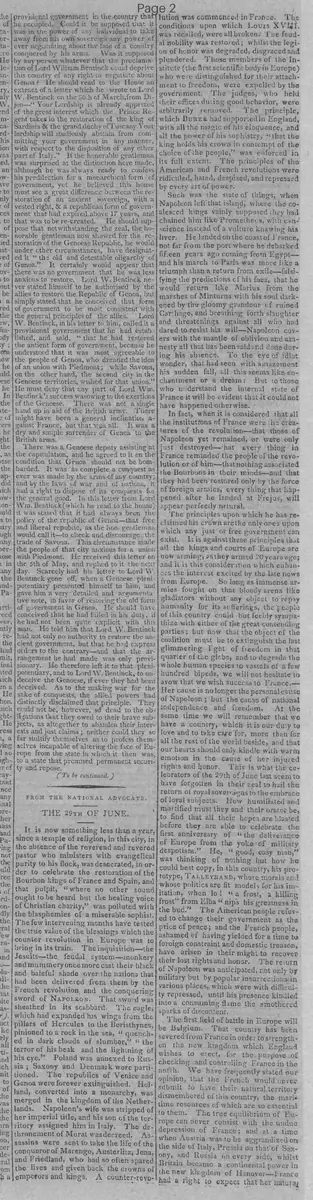
THE 29TH OF JUNE.
It is now something less than a year, since a temple of religion, in this city, in the absence of the reverend and revered pastor who ministers with evangelical purity to his flock, was desecrated, in order to celebrate the restoration of the Bourbon kings of France and Spain, and that pulpit, "where no other sound ought to be heard but the healing voice of Christian charity," was polluted with the blasphemies of a miserable sophist.
The few intervening months have tested the true value of the blessings which the counter revolution in Europe was to bring in its train. The inquisition—the Jesuits—the feudal system—monkery and mummery once more cast their black and baleful shade over the nations that had been delivered from them by the French revolution and the conquering sword of Napoleon. That sword was sheathed in its scabbard. The eagle, which had expanded his wings from the pillars of Hercules to the Boristhenes, pinioned to a rock in the sea, "quenched in dark clouds of slumber," "the terror of his beak and the lightning of his eye." Poland was annexed to Russia; Saxony and Denmark were partitioned. The republics of Venice and Genoa were forever extinguished. Holland, converted into a monarchy, was merged in the kingdom of the Netherlands. Napoleon's wife was stripped of her imperial title, and his son of the territory assigned him in Italy. The dethronement of Murat was decreed. Assassins were sent to take the life of the conqueror of Marengo, Austerlitz, Jena, and Friedland, who had so often spared the lives and given back the crowns of emperors and kings. A counter-revolution was commenced in France. The conditions upon which Louis XVIII. was recalled, were all broken. The feudal nobility was restored; whilst the legion of honor was degraded, disgraced and plundered. Those members of the Institute (the first scientific body in Europe) who were distinguished for their attachment to freedom, were expelled by the government. The judges, who held their offices during good behavior, were arbitrarily removed. The principle, which Burke had supported in England, with all the magic of his eloquence, and all the power of his sophistry, "that the king holds his crown in contempt of the choice of the people," was enforced in its full extent. The principles of the American and French revolutions were ridiculed, hated, despised, and repressed by every art of power.
Such was the state of things, when Napoleon left that island, where the coalesced kings vainly supposed they had chained him like Prometheus, with conscience instead of a vulture gnawing his liver. He landed on the coast of France, not far from the port where he debarked fifteen years ago coming from Egypt—and his march to Paris was more like a triumph than a return from exile—falsifying the predictions of his foes, that he would return like Marius from the marshes of Minturna with his soul darkened by the gloomy grandeur of ruined Carthage, and breathing forth slaughter and threatenings against all who had dared to resist his will—Napoleon covers with the mantle of oblivion and amnesty all that has been said and done during his absence. To the eye of idiot wonder, that had seen with amazement his sudden fall, all this seems like enchantment or a dream: But to those who understand the internal state of France it will be evident that it could not have happened otherwise.
In fact, when it is considered that all the institutions of France were the creatures of the revolution—that those of Napoleon yet remained, or were only just destroyed—that every thing in France reminded the people of the revolution or of him—that nothing associated the Bourbons in their minds—and that they had been restored only by the force of foreign armies, every thing that happened after he landed at Frejus, will appear perfectly natural.
The principles upon which he has reclaimed his crown are the only ones upon which any just or free government can exist. It is against these principles that all the kings and courts of Europe are now arming, as they armed 20 years ago; and it is this consideration which enhances the interest excited by the late news from Europe. So long as immense armies fought on that bloody arena like gladiators without any object to repay humanity for its sufferings, the people of this country could but feebly sympathize with either of the great contending parties; but now that the object of the coalition must be to extinguish the last glimmering light of freedom in that quarter of the globe, and to degrade the whole human species to vassals of a few hundred bipeds, we will not hesitate to avow that we wish success to France. Her cause is no longer the personal cause of Napoleon; but the cause of national independence and freedom. At the same time we will remember that we have a country, which it is our duty to love and to take care for, more than for all the rest of the world beside, and that our hearts should only kindle with warm emotion in the cause of her injured rights and honor. This is what the celebrators of the 29th of June last seem to have forgotten in their zeal to hail the return of royal sovereigns to the embrace of loyal subjects. How humiliated and mortified must they and their orator be, to find that all their hopes are blasted before they are able to celebrate the first anniversary of "the deliverance of Europe from the yoke of military despotism." He, "good, easy man," was thinking of nothing but how he could best copy, in this country, his prototype, TALLEYRAND, whose morals and whose politics are fit models for his imitation, when lo! "a frost, a killing frost" from Elba "nips his greatness in the bud." The American people refused to change their government as the price of peace; and the French people, ashamed of having yielded for a time to foreign constraint and domestic treason, have arisen in their might to recover their lost rights and honor. The return of Napoleon was anticipated, not only by military but by popular insurrections in various places, which were with difficulty repressed, until his presence kindled into a consuming flame the smothered sparks of discontent.
The first field of battle in Europe will be Belgium. That country has been severed from France in order to strengthen this new kingdom which England wishes to erect, for the purpose of checking and controlling France in the north. We have frequently stated our opinion, that the French would never submit to have their natural territory dismembered of this country, the maritime resources of which are so essential to them. The true equilibrium of Europe can never consist with the undue depression of France; and at a time when Austria was to be aggrandized on the side of Italy, Prussia on that of Saxony, and Russia on every side, whilst Britain became a continental power in the new kingdom of Hanover—France had a right to expect that her natural boundaries would be restored to her.
boundaries would have been preserved to her. In this expectation she has been disappointed by the Congress of Vienna; and that disappointment may be considered as one of the proximate causes of Napoleon's restoration.
How the United States are likely to be affected by this new contest is a question of the most important nature. But we have not, at present, time nor room to examine it at length. It will be sufficient to remark, that it is the obvious policy of this country, whatever may be our feelings, to remain in a state of impartial neutrality. But will the belligerent powers respect that neutrality?
The French emperor must certainly have learnt, by this time, to respect the American national character too much to hazard any more experiments upon our tameness and forbearance. It would also appear strange if the British government should risk another encounter with us, by infringing our acknowledged rights. Time will disclose their views and intentions, and, in the meantime, the greatest caution and distrust should direct the measures of our government.
What sub-type of article is it?
What keywords are associated?
What entities or persons were involved?
Editorial Details
Primary Topic
Napoleon's Return From Elba And European Counter Revolution
Stance / Tone
Supportive Of French Independence And U.S. Neutrality
Key Figures
Key Arguments