Thank you for visiting SNEWPapers!
Sign up free
Imperial Valley Press
El Centro, Imperial County, California
What is this article about?
In Tokyo on Oct. 19, Japanese Commerce Minister Shinji Yoshino stated Japan has considered potential world boycotts and sanctions over its actions in China, asserting self-sufficiency in resources and industry, and affirming equal trade opportunities for foreigners in China post-war.
Clipping
OCR Quality
Full Text
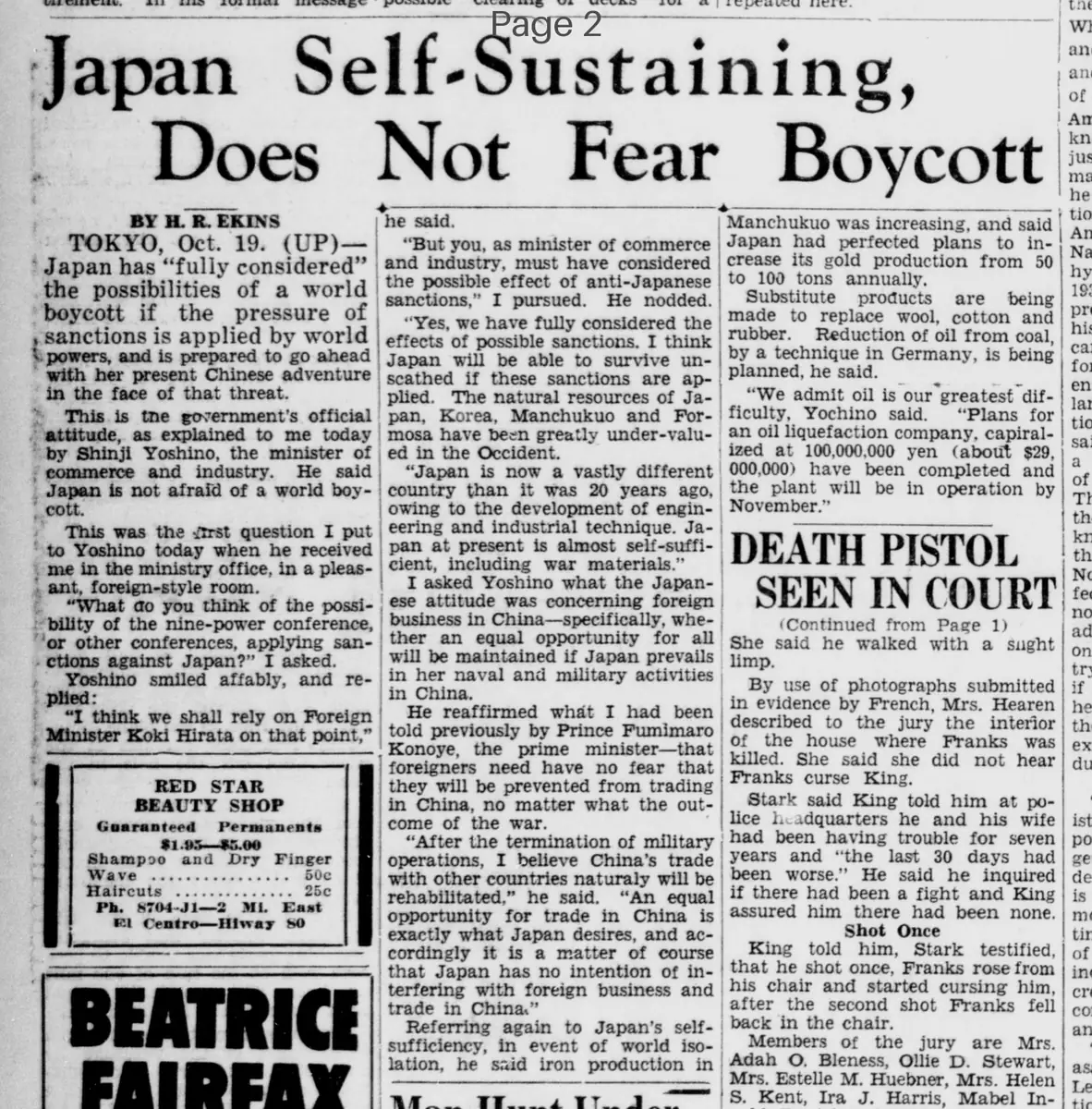
BY H. R. EKINS TOKYO, Oct. 19. (UP)— Japan has "fully considered" the possibilities of a world boycott if the pressure of sanctions is applied by world powers, and is prepared to go ahead with her present Chinese adventure in the face of that threat. This is the government's official attitude, as explained to me today by Shinji Yoshino, the minister of commerce and industry. He said Japan is not afraid of a world boycott. This was the first question I put to Yoshino today when he received me in the ministry office, in a pleasant foreign-style room. "What do you think of the possibility of the nine-power conference, or other conferences, applying sanctions against Japan?" I asked. Yoshino smiled affably, and replied: "I think we shall rely on Foreign Minister Koki Hirota on that point," he said. "But you, as minister of commerce and industry, must have considered the possible effect of anti-Japanese sanctions." I pursued. He nodded. "Yes, we have fully considered the effects of possible sanctions, I think Japan will be able to survive unscathed if these sanctions are applied. The natural resources of Japan, Korea, Manchukuo and Formosa have been greatly under-valued in the Occident. "Japan is now a vastly different country than it was 20 years ago, owing to the development of engineering and industrial technique. Japan at present is almost self-sufficient, including war materials." I asked Yoshino what the Japanese attitude was concerning foreign business in China—Specifically, whether an equal opportunity for all will be maintained if Japan prevails in her naval and military activities in China. He reaffirmed what I had been told previously by Prince Fumimaro Konoye, the prime minister—that foreigners need have no fear that they will be prevented from trading in China, no matter what the outcome of the war. "After the termination of military operations, I believe China's trade with other countries naturally will be rehabilitated." he said. "An equal opportunity for trade in China is exactly what Japan desires, and accordingly it is a matter of course that Japan has no intention of interfering with foreign business and trade in China.' Referring again to Japan's self-sufficiency, in event of world isolation, he said iron production in Manchukuo was increasing, and said Japan had perfected plans to increase its gold production from 50 to 100 tons annually. Substitute products are being made to replace wool, cotton and rubber. Reduction of oil from coal by a technique in Germany, is being planned, he said. "We admit oil is our greatest difficulty," Yoshino said. "Plans for an oil liquefaction company, capitalized at 100,000,000 yen (about $29,000,000) have been completed and the plant will be in operation by November."
What sub-type of article is it?
What keywords are associated?
What entities or persons were involved?
Where did it happen?
Foreign News Details
Primary Location
Tokyo
Event Date
Oct. 19
Key Persons
Outcome
japan prepared to survive sanctions unscathed; equal trade opportunities in china post-war; plans for increased production and substitutes.
Event Details
Japanese Commerce Minister Shinji Yoshino explained government's attitude: Japan has considered sanctions from world powers over Chinese adventure, is self-sufficient with resources from Japan, Korea, Manchukuo, Formosa; developed industry; not afraid of boycott; equal trade in China assured; increasing iron and gold production; substitutes for imports; oil liquefaction plant by November.