Thank you for visiting SNEWPapers!
Sign up free
Alexandria Daily Advertiser
Alexandria, Virginia
What is this article about?
Late November 1803 intelligence from Europe details French preparations for invading Britain under Napoleon: flotilla reinforcements at Boulogne and Ostend, troop training, camp setups, and support from Germany, Batavian, Italian, and Helvetic Republics, including loans and troop movements.
Clipping
OCR Quality
Full Text
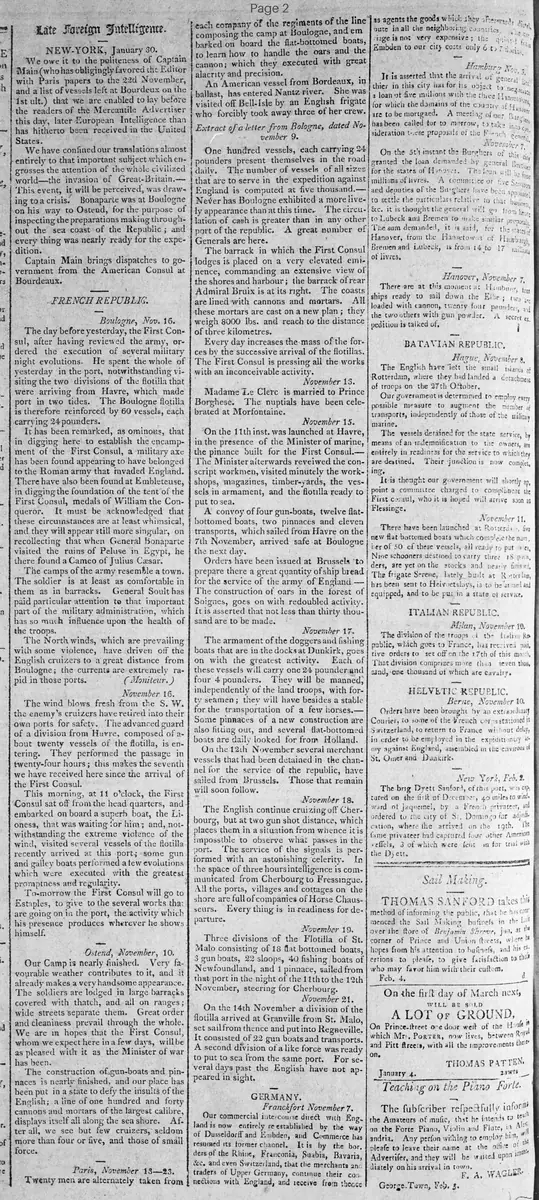
NEW-YORK, January 30.
We owe it to the politeness of Captain
Main (who has obligingly favored the Editor
with Paris papers to the 22d November,
and a list of vessels left at Bordeaux on the
1st ult.) that we are enabled to lay before
the readers of the Mercantile Advertiser
this day, later European Intelligence than
has hitherto been received in the United
States.
We have confined our translations almost
entirely to that important subject which engrosses
the attention of the whole civilized
world--the invasion of Great-Britain.--
This event, it will be perceived, was drawing
to a crisis. Bonaparte was at Boulogne
on his way to Ostend, for the purpose of
inspecting the preparations making throughout
the sea coast of the Republic; and
every thing was nearly ready for the expedition.
Captain Main brings dispatches to government
from the American Consul at Bourdeaux.
FRENCH REPUBLIC.
Boulogne, Nov. 16.
The day before yesterday, the First Consul,
after having reviewed the army, ordered
the execution of several military
night evolutions. He spent the whole of
yesterday in the port, notwithstanding visiting
the two divisions of the flotilla that
were arriving from Havre, which made
port in two tides. The Boulogne flotilla
is therefore reinforced by 60 vessels, each
carrying 24 pounders.
It has been remarked, as ominous, that
in digging here to establish the encampment
of the First Consul, a military axe
has been found appearing to have belonged
to the Roman army that invaded England.
There have also been found at Etratat, in digging the foundation of the tent of the
First Consul, medals of William the Conqueror.
It must be acknowledged that
these circumstances are at least whimsical,
and they will appear still more singular, on
recollecting that when General Bonaparte
visited the ruins of Pelusium in Egypt, he
there found a Cameo of Julius Caesar.
The camps of the army resemble a town.
The soldier is at least as comfortable in
them as in barracks. General Soult has
paid particular attention to that important
part of the military administration, which
has so much influence upon the health of
the troops.
The North winds, which are prevailing
with some violence, have driven off the
English cruizers to a great distance from
Boulogne; the currents are extremely rapid
in those ports.
(Moniteur.)
November 16.
The wind blows fresh from the S. W.
the enemy's cruizers have retired into their
own ports for safety. The advanced guard
of a division from Havre, composed of about
twenty vessels of the flotilla, is entering.
They performed the passage in
twenty-four hours; this makes the seventh
we have received here since the arrival of
the First Consul.
This morning, at 11 o'clock, the First
Consul set off from the head quarters, and
embarked on board a superb boat, the Lioness,
that was waiting for him; and, notwithstanding
the extreme violence of the
wind, visited several vessels of the flotilla
recently arrived at this port; some gun
and galley boats performed a few evolutions
which were executed with the greatest
promptness and regularity.
To-morrow the First Consul will go to
Etaples, to give to the several works that
are going on in the port, the activity which
his presence produces wherever he shows
himself.
Ostend, November, 10.
Our Camp is nearly finished. Very favourable
weather contributes to it, and it
already makes a very handsome appearance.
The soldiers are lodged in large barracks
covered with thatch, and all on ranges;
wide streets separate them. Great order
and cleanliness prevail through the whole.
We are in hopes that the First Consul,
whom we expect here in a few days, will be
as pleased with it as the Minister of war
has been.
The construction of gun-boats and pinnaces
is nearly finished, and our place has
been put in a state to defy the insults of the
English; a line of one hundred and forty
cannons and mortars of the largest calibre,
displays itself all along the sea shore. After
all, we see but few cruizers, seldom
more than four or five, and those of small
force.
Paris, November 13-23.
Twenty men are alternately taken from
each company of the regiments of the line
embarked on board the flat-bottomed boats,
composing the camp at Boulogne, and embarked
to learn how to handle the oars and the
cannon; which they executed with great
alacrity and precision.
An American vessel from Bordeaux, in
ballast, has entered Nantes river. She was
visited off Bell-Isle by an English frigate
who forcibly took away three of her crew.
Extract of a letter from Boulogne, dated November 9.
One hundred vessels, each carrying 24
pounders present themselves in the road
daily. The number of vessels of all sizes
that are to serve in the expedition against
England is computed at five thousand.--
Never has Boulogne exhibited a more lively
appearance than at this time. The circulating
of cash is greater than in any other
port of the republic. A great number of
Generals are here.
The barrack in which the First Consul
lodges is placed on a very elevated eminence,
commanding an extensive view of
the shores and harbour; the barrack of rear
Admiral Bruix is at its right. The coasts
are lined with cannons and mortars. All
these mortars are cast on a new plan; they
weigh 8000 lbs. and reach to the distance
of three kilometres.
Every day increases the mass of the forces
by the successive arrival of the flotillas.
The First Consul is pressing all the works
with an inconceivable activity.
November 13.
Madame Le Clerc is married to Prince
Borghese. The nuptials have been celebrated
at Morfontaine.
November 15.
On the 11th inst. was launched at Havre,
in the presence of the Minister of marine,
the pinnace built for the First Consul.--
The Minister afterwards reviewed the conscript
workmen, visited minutely the workshops,
magazines, timber-yards, the vessels
in armament, and the flotilla ready to
put to sea.
A convoy of four gun-boats, twelve flat-bottomed
boats, two pinnaces and eleven
transports, which sailed from Havre on the
7th November, arrived safe at Boulogne
the next day.
Orders have been issued at Brussels to
prepare there a great quantity of ship bread
for the service of the army of England --
The construction of oars in the forest of
Soignes, goes on with redoubled activity.
It is asserted that not less than thirty thousand
are to be made.
November 17.
The armament of the doggers and fishing
boats that are in the docks at Dunkirk, goes
on with the greatest activity. Each of
these vessels will carry one 24 pounder and
four 4 pounders. They will be manned,
independently of the land troops, with forty
seamen; they will have besides a stable
for the transportation of a few horses.-
Some pinnaces of a new construction are
also fitting out, and several flat-bottomed
boats are daily looked for from Holland.
On the 12th November several merchant
vessels that had been detained in the channel
for the service of the republic, have
sailed from Brussels. Those that remain
will soon follow.
November 18.
The English continue cruising off Cherbourg,
but at two gun shot distance, which
places them in a situation from whence it is
impossible to observe what passes in the
port. The service of the signals is performed
with an astonishing celerity. In
the space of three hours intelligence is communicated
from Cherbourg to Fressinguelle.
All the ports, villages and cottages on the
shore are full of companies of Horse Chausseurs.
Every thing is in readiness for departure.
November 19.
Three divisions of the Flotilla of St.
Malo consisting of 18 flat bottomed boats,
3 gun boats, 22 sloops, 40 fishing boats of
Newfoundland, and 1 pinnace, sailed from
that port in the night of the 11th to the 12th
November, steering for Cherbourg.
November 21.
On the 14th November a division of the
flotilla arrived at Granville from St. Malo,
set sail from thence and put into Regneville.
It consisted of 22 gun boats and transports.
A second division of a like force was ready
to put to sea from the same port. For several
days past the English have not appeared
in sight.
GERMANY.
Frankfort November 7.
Our commercial intercourse direct with England
is now entirely re-established by the way
of Dusseldorf and Emden, and Commerce has
resumed its former channel. It is by the borders
of the Rhine, Franconia, Suabia, Bavaria,
&c. and even Switzerland, that the merchants and
traders of Upper Germany, continue their connections
with England, and receive from the ocean
vast quantities of goods which they are all in the neighboring
countries. Carriage is not very expensive; the quick
route from Emden to our city costs only 6 to 7 dollars.
Hamburg Nov.5.
It is asserted that the arrival of
general Berthier in this city has for its object to obtain
a loan of five millions
with the domains of the country of Hanover
are to be mortgaged.
A meeting of our
Burghers
has been called for to-morrow, to take
into consideration the proposals of the French general.
November 7.
On the 5th instant the Burghers of this city
granted the loan demanded by general Berthier
for the states of Hanover. The loan will be five
millions of livres. A committee of five Senators
and deputies of the Burghers have been appointed
to settle the particulars relative to that business.
It is thought the general will go from here
to Lubeck and Bremen to make similar proposals.
The sum demanded, it is said, for the states of
Hanover, from the Hanse Towns of Hamburg,
Bremen and Lubeck, is from 14 to 17 millions
of livres.
Hanover, November 7.
There are at this moment at Hamburg, ten
ships ready to sail down the Elbe ; two are
loaded with cannon, twenty four pounders, and
the two others with gun powder. A secret expedition
is talked of.
BATAVIAN REPUBLIC.
Hague, November 8.
The English have left the small islands of
Rotterdam, where they had landed a detachment
of troops on the 27th October.
Our government is determined to employ every
possible measure to augment the number of
transports, independently of those of the military
marine.
The vessels detained for the state service, by
means of an indemnification to the owners, are
entirely in readiness for the service to which they
are destined. Their junction is now completing.
It is thought our government will shortly appoint
a committee charged to compliment the
First consul, who it is hoped will arrive soon at
Flushing.
November 11.
There have been launched at Rotterdam, five
new flat bottomed boats which complete the number
of 50 of these vessels, all ready to put to sea.
Nine schooners destined to carry three 18 pounders,
are yet on the stocks and nearly finished.
The frigate Serene, lately built at Rotterdam,
has been sent to Helvoetsluys, is to be armed and
equipped, and to be put in a state of service.
ITALIAN REPUBLIC.
Milan, November 10.
The division of the troops of the Italian Republic,
which goes to France, has received positive
orders to set off on the 17th of this month.
That division comprises more than seven thousand,
one thousand of which are cavalry.
HELVETIC REPUBLIC.
Berne, November 10.
Orders have been brought by an extraordinary
Courier, to some of the French corps stationed in
Switzerland, to return to France without delay,
in order to be employed in the expeditionary army
against England, assembled in the environs of
St. Omer and Dunkirk.
What sub-type of article is it?
What keywords are associated?
What entities or persons were involved?
Where did it happen?
Foreign News Details
Primary Location
Boulogne
Event Date
November 1803
Key Persons
Outcome
preparations for invasion advancing with flotilla reinforcements, troop training, and allied support; no casualties reported.
Event Details
Napoleon reviews army and flotilla at Boulogne, inspects preparations along French coast; reinforcements from Havre and other ports; camps and defenses built at Ostend; training in Paris; loans and shipments from Germany; vessel constructions in Batavian Republic; Italian troops to France; Swiss French corps recalled for expedition.