Thank you for visiting SNEWPapers!
Sign up free
Springfield Weekly Republican
Springfield, Hampden County, Massachusetts
What is this article about?
A Boston correspondent's letter from December 27 details the quiet political transition from Governor Butler to Mr. Robinson, legislative expectations, city administration changes under Gen. Martin, postmaster reappointment, unveiling of Harriet Martineau statue by Anne Whitney, and Christmas observances in Boston.
Clipping
OCR Quality
Full Text
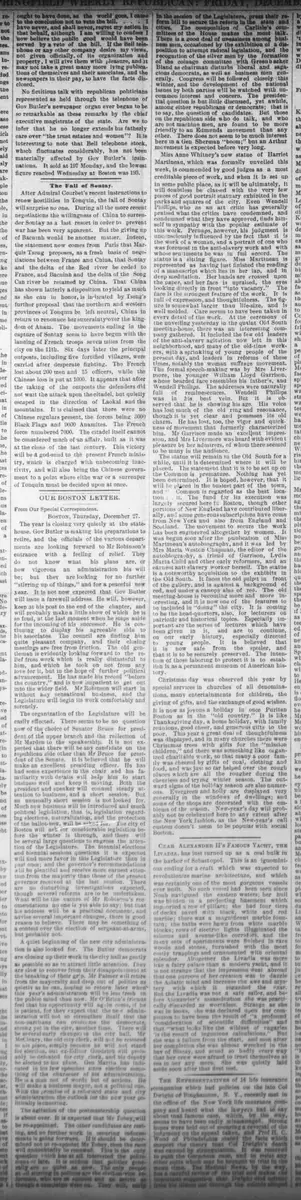
From Our Special Correspondent.
Boston, Thursday, December 27.
The year is closing very quietly at the state-house. Gov Butler is making his preparations to retire, and the officials of the various departments are looking forward to Mr Robinson's entrance with a feeling of relief. They do not know what his plans are, or how vigorous an administration his will be; but they are looking for no further "stirring up of things," and for a peaceful new year. It is not now expected that Gov Butler will issue a farewell address. He will, however, keep at his post to the end of the chapter, and will probably make a little show of which he is so fond, at the last moment when he steps aside for the incoming of his successor. He is continuing to display his agreeable side to his associates. The council are finding him quite pleasant company, and their closing meetings are free from friction. The old gentleman is evidently looking forward to the relief from work which is really distasteful to him, and which he took on not from any love for it, but in the hope of further political advancement. He has made his record "before the country," and is now impatient to get out into the wider field. Mr Robinson will start in without any sensational business, and the Legislature will begin its work comfortably and serenely.
The organization of the Legislature will be easily effected. There seems to be no question now of the choice of Senator Bruce for president of the upper branch and the reelection of Mr Marden to the speakership. It is not expected that there will be any candidate on the republican side other than Mr Bruce for president of the Senate. It is believed that he will make an excellent presiding officer. He has had some experience in the chair and his familiarity with details will help him to start business well and keep it moving. Both the president and speaker will counsel steady attention to business, and a short session. But an unusually short session is not looked for. Much new business will be introduced and much political legislation, that is, legislation regarding elections, naturalization, and the protection of the ballot-box, will be asked for. The city of Boston will ask for considerable legislation before the winter is through, and there will be several large questions to engross the attention of the Legislature. The biennial elections and biennial sessions questions it is expected will find more favor in this Legislature than in past ones; and the governor's recommendations will be plentiful and receive more earnest attention from the majority than those of the present governor received at the last session. There are no disturbing investigations expected, though several reforms are to be undertaken. What will be the nature of Mr Robinson's recommendations no one is yet able to say; but that his address will be a practical document, and advise several important changes, there is good reason to believe. There may be something of a contest over the election of sergeant-at-arms, but probably not.
A quiet beginning of the new city administration is also looked for. The Butler democrats are closing up their work in the city hall as gently as possible so as to attract little attention. They are slow to recover from their disappointment at the breaking of their grip. Mr Palmer will retire from the mayoralty and drop out of politics as quietly as he can, hoping to return later when this year's administration will be less fresh in the public mind than now. Mr O'Brien's friends feel that his opportunity will again come, if he is patient, for they expect that the new administration will not so strengthen itself that the non-partisans can overcome the democrats, strong yet in the city, another time. There will be several early changes in the city hall. Mr McCleary, the old city clerk, will not be restored to his place, simply because he will not stand for election, our ex-Editor Goodrich will probably be defeated for city clerk, and his deputy be elected to his place. Gen Martin has indicated in his few speeches since election something of the character of his administration. He is a man not of words but of actions. He will make a business mayor, not a political one. With the promise of a reformed state and city administration the outlook for the new year politically is cheering.
The agitation of the postmastership question is about over. It is expected that Mr Robey will be re-appointed. The other candidates are resting, and no further work in securing indorsements is going forward. If it should be determined not to re-appoint Mr Robey, then the race will undoubtedly be renewed. This is the only question which has at all interested the politicians of late. It is understood that politics generally are quiet as now. The only people stirring in politics are the civil-service reformers, who are as earnest and earnest as though a campaign were on. They will, early in the session of the Legislature, press their reform bill to secure the reform in the state and cities. The composition of Carlisle's committees of the House makes the most talk. There is a good deal of uneasiness among business men, occasioned by the exhibition of a disposition to attempt radical legislation, and the recognition of the silver men by the formation of the coinage committee with Greenbacker Bland as chairman disturbs liberal and sagacious democrats, as well as business men generally. Congress will be followed closely this winter, and the development of the national issues by both parties will be watched with uncommon interest and concern. The presidential question is but little discussed, yet awhile, among either republicans or democrats; that is to say, the question of candidates. But those on the republican side who do talk, and who are not machine men, are found to be more friendly to an Edmunds movement than any other. There does not seem to be much interest here in a Gen Sherman "boom;" but an Arthur movement is expected before very long.
Miss Anne Whitney's new statue of Harriet Martineau, which was formally unveiled this week, is commended by good judges as a most creditable piece of work, and when it is set up in some public place, as it will be ultimately, it will doubtless be classed with the very few pieces of good portrait statuary exhibited in the parks and squares of the city. Even Wendell Phillips, who as an art critic has generally praised what the critics have condemned, and condemned what they have approved, finds himself in sympathy with the popular estimate of this work. Perhaps, however, his judgment is unconsciously influenced by the fact that it is the work of a woman, and a portrait of one who was foremost in the anti-slavery work and with whose sentiments he was in full accord. The statue is a sitting figure. Miss Martineau is represented as having just finished the reading of a manuscript which lies in her lap, and in deep meditation. Her hands are crossed upon the paper, and her face is upraised, the eyes looking directly in front "into vacancy."
The face is the strongest feature of the work. It is full of expression, and thoughtfulness. The figure is somewhat larger than life-size, and is well molded. Care seems to have been taken in every detail of the work. At the ceremony of the unveiling yesterday in the quaint Old South meeting-house, there was an interesting company gathered. It included the few old leaders of the anti-slavery agitation now left in this neighborhood, and many of the old-time workers, with a sprinkling of young people of the present day, and leaders in reforms of these times, notably the woman suffrage movement. The formal speech-making was by Mrs Livermore, the younger William Lloyd Garrison, whose bearded face resembles his father's, and Wendell Phillips. The addresses were naturally full of reminiscences.
Wendell Phillips was in his best vein. But it is observed that he is showing his age. His voice has lost much of the old ring and resonance, though it is yet clear and possesses its old charm. He has lost, too, the vigor and quickness of movement that formerly characterized him. Mr Garrison made an excellent impression, and Mrs Livermore was heard with evident pleasure by her admirers, of whom there seemed to be many in the audience.
The statue will remain in the Old South for a while, until it is determined where it will be placed. The statement that it is to be set up on the Common is premature. Nothing has yet been determined. It is hoped, however, that it will be placed in the busiest part of the town, and Common is regarded as the best location for it. The fund for its execution was largely secured here in Boston, though other portions of New England have contributed liberally, and some generous subscriptions have come from New York and also from England and Scotland. The movement to secure the work has been engineered altogether by women. It was begun soon after the publication of Miss Martineau's autobiography, and it was led by Mrs Maria Weston Chapman, the editor of the autobiography, a friend of Garrison, Lydia Maria Child and other early reformers, and an earnest anti-slavery worker herself. The statue is a noteworthy acquisition to the exhibits in the Old South. It faces the old pulpit in front of the gallery, and is against a background of red, and under a canopy also of red. The old meeting-house is becoming more and more interesting, and it is now one of the features to be included in "doing" the city. It is coming to be the head-quarters, also, for lecturers on patriotic and historical topics. Especially important are the series of lectures which have been given in it, and are to continue, on our early history, especially directed to young people.
It is believed that it is now safe from the spoiler, and that it is to be securely preserved. The intention of those laboring to protect it is to establish it as a permanent museum of American history.
Christmas day was observed this year by special services in churches of all denominations, many entertainments for children, the giving of gifts, and the exchange of good wishes. It is now as joyous a holiday in once Puritan Boston as in the "old country." It is like Thanksgiving day, a home holiday, with family reunions, good cheer, and generous gifts to the poor. This year a great deal of thoughtfulness was displayed, and in many churches there were Christmas trees with gifts for the "mission children," and there was something like organized charitable work, so that many a poor family was cheered by gifts of coal, clothing and food, and was just so far helped over the rough places which are all the rougher during the cheerless and trying winter season. The outward signs of the holiday season are also numerous. Evergreen and holly are displayed very generally in the windows of dwellings; and some of the shops are decorated with the emblems of the season. New-year's day will probably not be celebrated here to any extent after the New York fashion, as the New-year's call custom doesn't seem to be popular with social Boston.
What sub-type of article is it?
What themes does it cover?
What keywords are associated?
What entities or persons were involved?
Where did it happen?
Story Details
Key Persons
Location
Boston
Event Date
Thursday, December 27
Story Details
The letter describes the quiet retirement of Governor Butler and anticipation of a stable administration under Mr. Robinson, smooth legislative organization with Senator Bruce and Mr. Marden, city changes under Gen. Martin, postmaster reappointment of Mr. Robey, civil service reforms, national political concerns, the unveiling of Anne Whitney's statue of Harriet Martineau with speeches by reformers, and Christmas celebrations with charitable acts in Boston.