Thank you for visiting SNEWPapers!
Sign up free
The Prison Mirror
Stillwater, Washington County, Minnesota
What is this article about?
A prisoner's reflective essay critiques modern poetry's obscurity, advocates clarity inspired by classics and Shakespeare, includes his rejected sonnet 'At Shakespeare's Monument,' and blames publications for promoting puzzling verse over accessible art, affecting poets and readers.
Merged-components note: Merged continuation of the essay on poetry and blame from page 1 to page 3, as indicated by '(Continued on page 3. col. 3)'.
Clippings
1 of 2
OCR Quality
Full Text
By Mr. J. A. K.
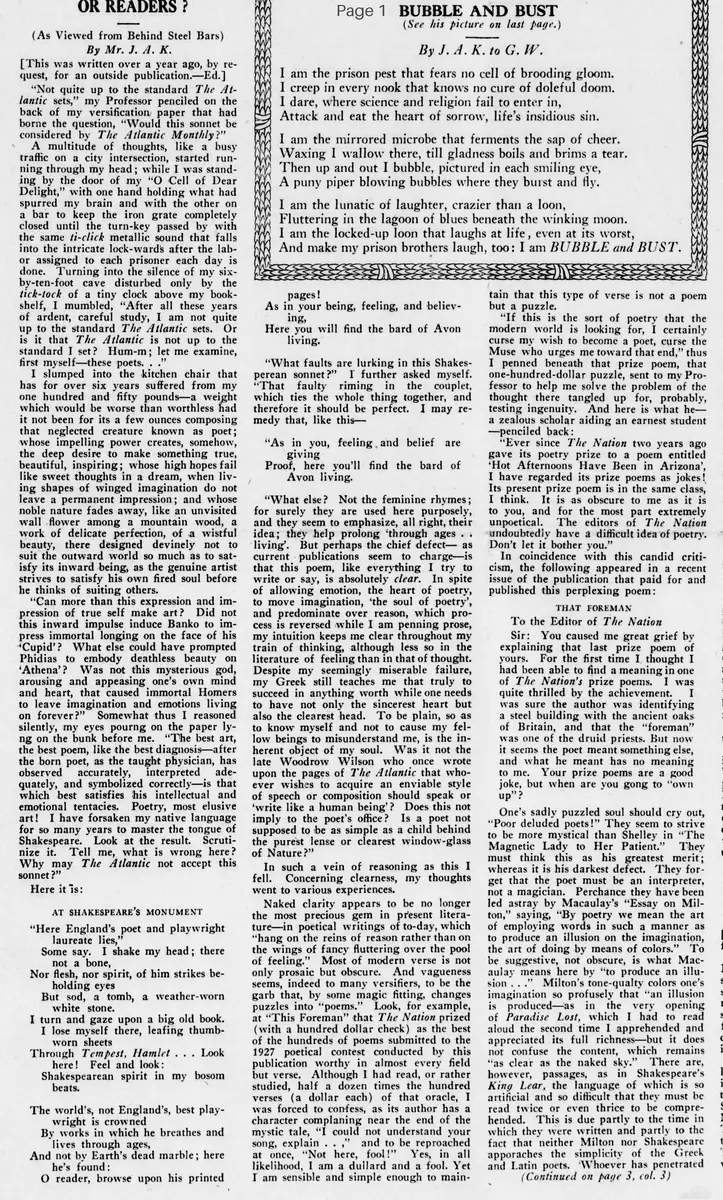
[This was written over a year ago, by request, for an outside publication.-Ed.]
"Not quite up to the standard The Atlantic sets," my Professor penciled on the back of my versification paper that had borne the question, "Would this sonnet be considered by The Atlantic Monthly?"
A multitude of thoughts, like a busy traffic on a city intersection, started running through my head; while I was standing by the door of my "O Cell of Dear Delight," with one hand holding what had spurred my brain and with the other on a bar to keep the iron grate completely closed until the turn-key passed by with the same ti-click metallic sound that falls into the intricate lock-wards after the labor assigned to each prisoner each day is done. Turning into the silence of my six-by-ten-foot cave disturbed only by the tick-tock of a tiny clock above my book-shelf. I mumbled, "After all these years of ardent, careful study, I am not quite up to the standard The Atlantic sets. Or is it that The Atlantic is not up to the standard I set? Hum-m; let me examine, first myself these poets..."
I slumped into the kitchen chair that has for over six years suffered from my one hundred and fifty pounds--a weight which would be worse than worthless had it not been for its a few ounces composing that neglected creature known as poet; whose impelling power creates, somehow, the deep desire to make something true, beautiful, inspiring; whose high hopes fail like sweet thoughts in a dream, when living shapes of winged imagination do not leave a permanent impression; and whose noble nature fades away, like an unvisited wall flower among a mountain wood, a work of delicate perfection, of a wistful beauty, there designed divinely not to suit the outward world so much as to satisfy its inward being, as the genuine artist strives to satisfy his own fired soul before he thinks of suiting others.
"Can more than this expression and impression of true self make art? Did not this inward impulse induce Banko to impress immortal longing on the face of his Cupid? What else could have prompted Phidias to embody deathless beauty on 'Athena'? Was not this mysterious god, arousing and appeasing one's own mind and heart, that caused immortal Homers to leave imagination and emotions living on forever?" Somewhat thus I reasoned silently, my eyes pouring on the paper lying on the bunk before me. "The best art, the best poem, like the best diagnosis--after the born poet, as the taught physician, has observed accurately, interpreted adequately, and symbolized correctly--is that which best satisfies his intellectual and emotional tendencies. Poetry, most elusive art! I have forsaken my native language for so many years to master the tongue of Shakespeare. Look at the result. Scrutinize it. Tell me, what is wrong here? Why may The Atlantic not accept this sonnet?"
Here it is:
AT SHAKESPEARE'S MONUMENT
"Here England's poet and playwright laureate lies,
Some say. I shake my head; there not a bone,
Nor flesh, nor spirit, of him strikes beholding eyes
But sod, a tomb, a weather-worn white stone.
I turn and gaze upon a big old book.
I lose myself there, leafing thumb-worn sheets
Through Tempest, Hamlet... Look here! Feel and look:
Shakespearean spirit in my bosom beats.
The world's, not England's, best playwright is crowned
By works in which he breathes and lives through ages,
And not by Earth's dead marble; here he's found:
O reader, browse upon his printed pages!
As in your being, feeling, and believing,
Here you will find the bard of Avon living."
(See his picture on last page.)
"What faults are lurking in this Shakespearean sonnet?" I further asked myself. "That faulty riming in the couplet, which ties the whole thing together, and therefore it should be perfect. I may remedy that, like this:
As in you, feeling and belief are giving
Proof, here you'll find the bard of Avon living."
"What else? Not the feminine rhymes; for surely they are used here purposely, and they seem to emphasize, all right, their idea; they help prolong 'through ages... living'. But perhaps the chief defect--as current publications seem to charge--is that this poem, like everything I try to write or say, is absolutely clear. In spite of allowing emotion, the heart of poetry, to move imagination, the soul of poetry, and predominate over reason, which process is reversed while I am penning prose, my intuition keeps me clear throughout my train of thinking, although less so in the literature of feeling than in that of thought. Despite my seemingly miserable failure, my Greek still teaches me that truly to succeed in anything worth while one needs to have not only the sincerest heart but also the clearest head. To be plain, so as to know myself and not to cause my fellow beings to misunderstand me, is the inherent object of my soul. Was it not the late Woodrow Wilson who once wrote upon the pages of The Atlantic that whoever wishes to acquire an enviable style of speech or composition should speak or 'write like a human being'? Does this not imply to the poet's office? Is a poet not supposed to be as simple as a child behind the purest lens or clearest window-glass of Nature?"
In such a vein of reasoning as this I fell. Concerning clearness, my thoughts went to various experiences. Naked clarity appears to be no longer the most precious gem in present literature--in poetical writings of to-day, which "hang on the reins of reason rather than on the wings of fancy fluttering over the pool of feeling." Most of modern verse is not only prosaic but obscure. And vagueness seems, indeed to many versifiers, to be the garb that, by some magic fitting, changes puzzles into "poems." Look, for example, at "This Foreman" that The Nation prized (with a hundred dollar check) as the best of the hundreds of poems submitted to the 1927 poetical contest conducted by this publication worthy in almost every field but verse. Although I had read, or rather studied, half a dozen times the hundred verses (a dollar each) of that oracle, I was forced to confess, as its author has a character complaining near the end of the mystic tale, "I could not understand your song, explain...," and to be reproached at once, "Not here, fool!" Yes, in all likelihood, I am a dullard and a fool. Yet I am sensible and simple enough to maintain that this type of verse is not a poem but a puzzle.
"If this is the sort of poetry that the modern world is looking for, I certainly curse my wish to become a poet, curse the Muse who urges me toward that end," thus I penned beneath that prize poem, that one-hundred-dollar puzzle, sent to my Professor to help me solve the problem of the thought there tangled up for, probably, testing ingenuity. And here is what he--a zealous scholar aiding an earnest student--penciled back:
"Ever since The Nation two years ago gave its poetry prize to a poem entitled 'Hot Afternoons Have Been in Arizona', I have regarded its prize poems as jokes! Its present prize poem is in the same class, I think. It is as obscure to me as it is to you, and for the most part extremely unpoetical. The editors of The Nation undoubtedly have a difficult idea of poetry. Don't let it bother you."
In coincidence with this candid criticism, the following appeared in a recent issue of the publication that paid for and published this perplexing poem:
THAT FOREMAN
To the Editor of The Nation
Sir: You caused me great grief by explaining that last prize poem of yours. For the first time I thought I had been able to find a meaning in one of The Nation's prize poems. I was quite thrilled by the achievement. I was sure the author was identifying a steel building with the ancient oaks of Britain, and that the "foreman" was one of the druid priests. But now it seems the poet meant something else, and what he meant has no meaning to me. Your prize poems are a good joke, but when are you going to "own up"?
One's sadly puzzled soul should cry out, "Poor deluded poets!" They seem to strive to be more mystical than Shelley in "The Magnetic Lady to Her Patient." They must think this as his greatest merit; whereas it is his darkest defect. They forget that the poet must be an interpreter, not a magician. Perchance they have been led astray by Macaulay's "Essay on Milton," saying, "By poetry we mean the art of employing words in such a manner as to produce an illusion on the imagination, the art of doing by means of colors." To be suggestive, not obscure, is what Macaulay means here by "to produce an illusion..." Milton's tone-quality colors one's imagination so profusely that "an illusion is produced--as in the very opening of Paradise Lost, which I had to read aloud the second time I apprehended and appreciated its full richness--but it does not confuse the content, which remains "as clear as the naked sky." There are, however, passages, as in Shakespeare's King Lear, the language of which is so artificial and so difficult that they must be read twice or even thrice to be comprehended. This is due partly to the time in which they were written and partly to the fact that neither Milton nor Shakespeare approaches the simplicity of the Greek and Latin poets. Whoever has penetrated
(Continued on page 3. col. 3)
WHO ARE TO BLAME—POETS OR READERS?
(Continued from page 1)
...the spirit of the classical works has felt their intense significance, their noble simplicity, their calm pathos, their profound impression, their unmistaken train of thought. Nothing else constitutes the grandeur of the classics and renders them immortal. How did the ancients achieve this end? They thought clearly, felt nobly, and delineated firmly. Wise thought well executed or, as Goethe would say, "clear conception suggestively presented" is the fundamental part of art. No matter how rich the imagery may be, if the head or trail of the theme remains uncertain, the whole poem becomes accordingly cloudy and disinteresting. "What is not interesting," says Aristotle, "is that which is vaguely conceived and loosely drawn; a representation which is general, indeterminate, and faint, instead of being particular, precise, and firm." This does not imply that the versifier should turn mechanical, and prosaic. Let him choose the concrete and embody the emotional. The genuine poet is more concerned with words suggesting than with terms communicating thoughts. His product is precise and implicit, not full and explicit. And yet his poem remains a New Testament and not an ancient Oracle.
An illusion and an oracle are two different terms. An "illusion," as indicated in the foregoing paragraph, is found in such as in Gray's verse,
And leave the world to darkness
and to me.
Or in Coleridge's lines,
I looked upon the rotting sea,
And drew mine eyes away;
I looked upon the rotting deck
And there the dead men lay.
The "world to darkness" and "the rotting sea" are far-fetched figures, to be sure, not understood at once; but they are clear allusions when connected with their preceding and following lines. An oracle, on the other hand, is that expression which is wrapped in such a mystery as to mean nothing. Take what seems to be the theme of The Nation's prize poem, "This Foreman," as an illustration:
"Let my green steel stiffen in the frost
To snare what men love most!"
"What men love most? He sang of that?"
"I could not understand your song,
Explain ... to me."
"Not here, fool! ..."
Yes, the reader pleads, "what men love most?" The poet here may know but does not say explicitly or implicitly. When his theme is cloaked in vagueness, what effect does he expect to make? Let misled modern poets sing intelligibly to cover up their other minor blemishes: for their chief sin seems to be an unintelligible theme.
If current publications of established reputation would awake to ban this kind of mystic verse from all their pages, neither poets nor readers of to-day would be so much to blame. But as long as reputable periodicals continue to publish such stuff as is discussed in the foregoing and following pages, so long they will extoll a wrong to poets and readers, since when one versifier sees how another "spoofed" the editors of such and such a magazine with so and so a mystic song and won a prize, all versifiers strive to follow suit, and then all readers suffer.
The public responds to the printing press much like an engine to the engineer's controlling. As in a throbbing engine room, long rods of polished steel keep dancing to the strokes they strike; so in a streaming street, people of many walks of life and sorts of colors move toward the aims they have in mind. Most human beings motivate like the mechanical implements in motion; some one must supply the power. They act according to the thoughts of others; for they are incapable of thinking for themselves. The printing press supplies most likely nine-tenths of their power for thinking—mental food quite cheap, often coarse and detrimental, seldom fine and nutritive. "Lindbergh Lands in New York To-day," the head line of a morning daily declares, and thousands of spectators swarm the aviation fields with nothing in their heads but comments gleaned from the pages of that paper. "Peaches in the Follies To-night," a tabloid flares across its famous (and infamous) forehead, and innumerable masses swallow the suggestive filth on the front sheet or go out to appease their emotional arousings. "Governor Smith Replies," a magazine announces above the crown Atlantic, and countless intellectuals feverishly finger pages after pages and alertly look for some fresh fact to put it on their lips and banter it about for weeks to come. "The New Prophet" reads the title in an obscure corner of a publication, and—oh, how a few are so poetically inclined as to read and ponder upon poetry that they may be enobled and inspired to higher things in life! Why? Who are to blame? The people? Hardly. Who opens and shapes their thinking alleys? The current publications more than the living poets; for the latter are at the mercy of the former.
The readers, nevertheless, remain not wholly irresponsible. Do they lack that deep divine desire which urges man to culture and devotion? No. It dwells in them; but it is dormant in the tenements of clay, half-stunned, half-stupefied, due either to their mental laziness or to their hidden ignorance. Even those whom the upper strata of society stigmatize "incorrigible criminals" possess the willingness and aptitude to cultivate and live what is regarded good, if only they were shown what is and how to do that good. (I know; misfortune has for many long years made me speak and eat, work and grin, sleep and suffer with them—poor, unguided souls!) Teach them to understand and appreciate such precious pearls as poetry picked out of the deepest streams of life, and they will shun or even spurn to death immodest magazines and smutty tabloids. But how can they be taught thus when circulating newspapers, periodicals, and books—their only teachers—serve them with but little verse, most of which is oraculous, puzzling, meaningless?
(This judgment needs be modified now; since current publications show a change decidedly for more and better verse. Some offer prizes. "$1000.00 for a masterpiece.. to stimulate genius" is an advertising man's award, announced in last week's Outlook, for the best submitted poem. Even The Mercury devoted, for July, 1928, its opening three pages to a poem "The Virginians Are Coming Again," the author of which is one of America's leading poets, Lindsay, stating clearly that the Babbitt-tribe's infamous day is passing away and that the literary pendulum is swaying back to balance. Are "the Babbitts" not the supporters of The Mercury? And was its Editor Mencken not regarded as "an enemy to poetry"? Whether he knows it or not, Mencken is a poet at heart, and his judgement is maturing with his age. This is the latest encouraging sign for American literature.)
Every thinker knows that the hardest work in the world, the most tiresome task, is to think—to think hard. The masses never seem to take this trouble seriously. If they ever think hard enough to learn how loathsome mental laziness is, the credit will go to the time when literature of the highest order ceases to perplex the ordinary reader.
Is it not the oraculous perplexity that forces ordinary readers to abandon poetry? They read enjoyingly Longfellow, because he, although not a great genius, stands as the foremost poet in the English speaking world who approaches nearest the simplicity of the classics. They gaze uncomfortably at such as The Ring and the Book, Hyperion, and Epipsychidion, because here Browning, Keats, and Shelley struggle to be anything but simple. Although I must admit that Shelley's Epipsychidion is composed so that it adequately expresses his deepest spiritual yearning, still I do not quite agree with his exclusive attitude in the prologue—
My song, I fear that thou wilt find
but few
Who fitly shall conceive thy reasoning,
My last delight! tell them that they
are dull,
And bid them own that thou art
beautiful.
Without this "tell them," they will fly away. To over a dozen of learned inmates here I put the question, Can you understand "This Foreman"? Most of them shrugged their shoulders. One confessed, "That kind of poetry makes me fly from poets as I would fly from fortune tellers."
Such obscurity must be the central force that drives the friends of verse away from the refreshing fields of fancy, feeling, beauty, meditation, and delight.
(To be concluded next week)
What sub-type of article is it?
What themes does it cover?
What keywords are associated?
What entities or persons were involved?
Literary Details
Title
(As Viewed From Behind Steel Bars)
Author
By Mr. J. A. K.
Subject
Written By Request For An Outside Publication, Reflecting On Poetry Standards From Prison
Form / Style
Reflective Prose Essay With Embedded Shakespearean Sonnet
Key Lines