Thank you for visiting SNEWPapers!
Sign up free
Editorial
December 18, 1850
Port Tobacco Times, And Charles County Advertiser
Port Tobacco, Charles County, Maryland
What is this article about?
Editorial condemns telling falsehoods even in jest, citing Wilberforce's view equating it to stealing, virtues of Aristides and Epaminondas, Christian prohibitions against lying in serious or mirthful contexts, and Paul's warnings on idle words.
Clipping
OCR Quality
98%
Excellent
Full Text
THE RIGHT TO TELL A FALSEHOOD.
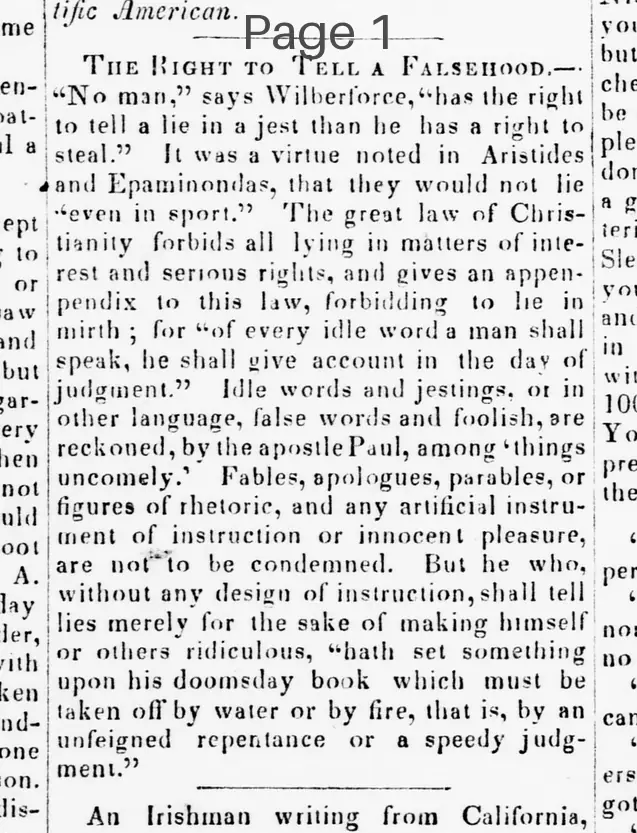
"No man," says Wilberforce, "has the right to tell a lie in a jest than he has a right to steal." It was a virtue noted in Aristides and Epaminondas, that they would not lie "even in sport." The great law of Christianity forbids all lying in matters of interest and serious rights, and gives an appendix to this law, forbidding to lie in mirth; for "of every idle word a man shall speak, he shall give account in the day of judgment." Idle words and jestings, or in other language, false words and foolish, are reckoned, by the apostle Paul, among 'things uncomely.' Fables, apologues, parables, or figures of rhetoric, and any artificial instrument of instruction or innocent pleasure are not to be condemned. But he who, without any design of instruction, shall tell lies merely for the sake of making himself or others ridiculous, "hath set something upon his doomsday book which must be taken off by water or by fire, that is, by an unfeigned repentance or a speedy judgment."
"No man," says Wilberforce, "has the right to tell a lie in a jest than he has a right to steal." It was a virtue noted in Aristides and Epaminondas, that they would not lie "even in sport." The great law of Christianity forbids all lying in matters of interest and serious rights, and gives an appendix to this law, forbidding to lie in mirth; for "of every idle word a man shall speak, he shall give account in the day of judgment." Idle words and jestings, or in other language, false words and foolish, are reckoned, by the apostle Paul, among 'things uncomely.' Fables, apologues, parables, or figures of rhetoric, and any artificial instrument of instruction or innocent pleasure are not to be condemned. But he who, without any design of instruction, shall tell lies merely for the sake of making himself or others ridiculous, "hath set something upon his doomsday book which must be taken off by water or by fire, that is, by an unfeigned repentance or a speedy judgment."
What sub-type of article is it?
Moral Or Religious
What keywords are associated?
Lying
Falsehood
Christian Morality
Jesting
Idle Words
Repentance
What entities or persons were involved?
Wilberforce
Aristides
Epaminondas
Christianity
Apostle Paul
Editorial Details
Primary Topic
Condemnation Of Lying Even In Jest
Stance / Tone
Strongly Against Falsehoods In All Contexts
Key Figures
Wilberforce
Aristides
Epaminondas
Christianity
Apostle Paul
Key Arguments
No Right To Lie In Jest, Equivalent To Stealing
Ancient Virtues Avoided Lying Even In Sport
Christianity Forbids Lying In Serious Matters And Mirth
Idle Words Require Judgment
Lies For Ridicule Demand Repentance Or Judgment
Fables And Rhetoric For Instruction Are Acceptable