Thank you for visiting SNEWPapers!
Sign up free
Southern Telegraph
Rodney, Jefferson County, Mississippi
What is this article about?
Biographical sketch of John Quincy Adams' political career, detailing his roles as U.S. Senator from Massachusetts (1803-1808), support for Jefferson's embargo, appointment as Minister to Prussia, Secretary of State, President (1825), and later Congressman, with commentary on his party shifts and character.
Clipping
OCR Quality
Full Text
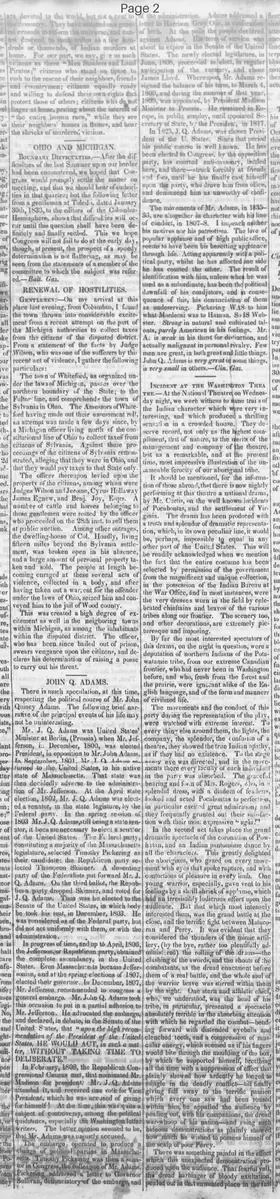
There is much speculation, at this time, respecting the political course of Mr. John Quincy Adams. The following brief narrative of the principal events of his life may not be uninteresting. Mr. J. Q. Adams was United States' Minister at Berlin, (Prussia) when Mr. Jefferson, in December, 1800, was elected President, in opposition to Mr. John Adams. In September, 1801, Mr. J. Q. Adams returned to the United States, to his native state of Massachusetts. That state was then decidedly adverse to the administration of Mr. Jefferson. At the April state election, 1802, Mr. J. Q. Adams was elected a senator, in the state legislature, by the Federal party. In the spring session of 1803 Mr. J. Q. Adams, still being a state senator, it became necessary to elect a senator of the United States. The Federal party, constituting a majority of the Massachusetts legislature, selected Timothy Pickering as their candidate: the Republican party selected Thompson Skinner. A dissenting party of the Federalists put forward Mr. J. Q. Adams. On the third ballot, the Republican party dropped Skinner, and voted for J. Q. Adams. Thus was he elected to the Senate of the United States, in which body he took his seat, in December, 1803. He was considered as of the Federal party, but did not act uniformly with them, or with the administration. In progress of time, and up to April, 1806, the Jefferson, or Republican party, obtained the complete ascendancy, in the United States. Even Massachusetts became Jeffersonian, and at the spring elections of 1807, elected their governor. In December, 1807, Mr. Jefferson recommended to congress a general embargo. Mr. John Q. Adams took this occasion to put in a partial adhesion to Mr. Jefferson. He advocated the embargo, and declared, in debate, in the Senate of the United States, that "upon the high recommendation of the President of the United States, HE WOULD ACT, in such a matter, WITHOUT TAKING TIME TO DELIBERATE." In February, 1808, the Republican Congressional Caucus met, that nominated Mr. Madison for president. Mr. J. Q. Adams attended it, and received one vote for Vice President, which he was accused of giving for himself! At the time, this was quite a subject of controversy, among the political quidnuncs, especially the Washington letter writers. The better opinion seemed to be, that Mr. Adams was unjustly accused. The embargo operated to produce a change of political parties in Massachusetts. Timothy Pickering was then a senator in Congress, the colleague of Mr. Adams. Pickering addressed a letter to Governor Sullivan, denunciatory of the embargo, and of the administration. Adams addressed a letter to Harrison Grey Otis, in vindication of both. At the polls the people declared against Adams. His term of service was about to expire in the Senate of the United States. The newly elected legislature, in June, 1808, proceeded to elect, in regular anticipation of the vacancy, and chose James Lloyd. Whereupon Mr. Adams resigned the balance of his term, to March 4, 1809, and during the summer of that year, 1809, was appointed, by President Madison Minister to Prussia. He remained in Europe, in public employ, until appointed Secretary of State, by the President, in 1817. In 1825, J. Q. Adams, was chosen President of the U. States. Since that period his public course is well known. He has been elected to Congress by the opposition party, has courted anti-masonry, fluttered here, and there—struck forcibly at friends and foes, until he has finally cast himself upon the party, who drove him from office, and denounced him as unworthy of confidence. The movements of Mr. Adams, in 1835-36, are altogether in character with his line of conduct, in 1807-8. I impeach neither his motives nor his patriotism. The love of popular applause and of high public office, seems to have been his besetting appetite through life. Acting apparently with a political party, whilst he has affected one side he has courted the other. The result of identification with him, unless where he was used as a subordinate, has been the political downfall of his coadjutors, and in consequence of this, his denunciation of them as undeserving. Pickering was to him what Mordecai was to Haman. So is Webster. Strong in natural and cultivated talents, purely American in his feelings, Mr. A. is weak in his thirst for distinction, and actually malignant in personal rivalry. Few men are great, in both great and little things. John Q. Adams is very great in some things, is very small in others.—Cin. Gaz.
What sub-type of article is it?
What keywords are associated?
What entities or persons were involved?
Where did it happen?
Domestic News Details
Primary Location
Massachusetts, United States
Event Date
1800 1836
Key Persons
Outcome
adams elected u.s. senator (1803), supported embargo (1807), resigned senate (1808), appointed minister to prussia (1809), secretary of state (1817), president (1825), elected to congress; noted political shifts and rivalries leading to downfalls of associates.
Event Details
Narrative of John Quincy Adams' political life: minister in Prussia (pre-1801), return to Massachusetts, state senator (1802), U.S. Senator elected with Republican support (1803), partial alignment with Jefferson on embargo (1807), attendance at caucus (1808), resignation after public opposition (1808), diplomatic roles in Europe, presidency (1825), congressional service with opposition party, characterized by inconsistent party affiliations and pursuit of office.