Thank you for visiting SNEWPapers!
Sign up free
Virginia Argus
Richmond, Virginia
What is this article about?
French General Moreau's maneuvers forced Austrian General Kray to retreat from Ulm in June, with victories at Hochstedt (16-18 June) and Dillingen (19 June), capturing thousands of prisoners and artillery. Austrians evacuate Grisons; armistice rumors unconfirmed.
Clipping
OCR Quality
Full Text
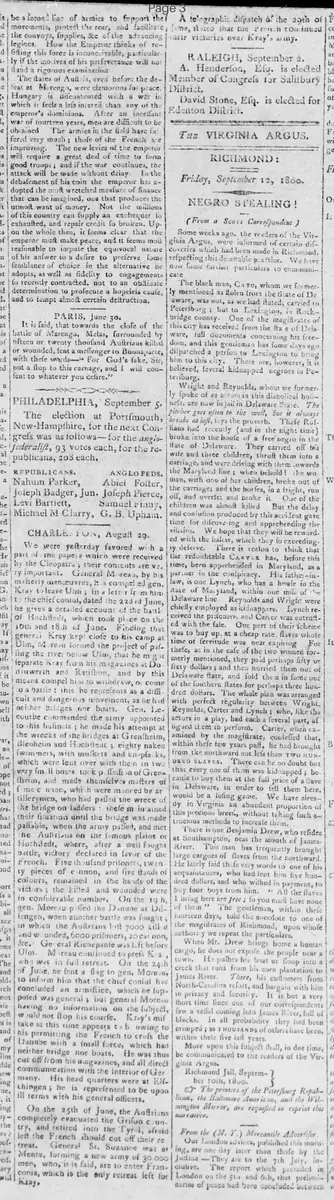
We were yesterday favored with a part of the papers which were received by the Cleopatra; their contents are very important. General Moreau, by his masterly manoeuvres, has compelled gen. Kray to leave Ulm; in a letter from him to the chief consul, dated the 22d of June, he gives a detailed account of the battle of Hochstedt, which took place on the 16th and 18th of June. Finding that general Kray kept close to his camp at Ulm, Moreau formed the project of passing the river below Ulm, that he might separate Kray from his magazines at Donauwerth and Ratisbon, and by this means compel him to withdraw, or come to a battle: this he represents as a difficult and dangerous movement, as he had neither bridges nor boats. Gen. Lecourbe commanded the army appointed to his business; he made his attempt at the wrecks of the bridges at Guntersheim, Bleichen and Hochstedt; eighty naked swimmers, with muskets and knapsacks, which were sent over with them in two very small boats took possession of Guntersheim, and made themselves masters of some cannon, which were manned by artillerymen, who had passed the wreck of the bridge on ladders: these maintained their situation until the bridge was made passable, when the army passed, and met the Austrians on the famous plains of Hochstedt, where, after a well fought battle, victory declared in favor of the French. Five thousand prisoners, twenty pieces of cannon, and five standards of colours, remained in the hands of the victors; the killed and wounded were in considerable number. On the 19th, gen. Moreau passed the Danube at Dillingen, when another battle was fought; in which the Austrians lost 7000 killed and wounded, 6000 prisoners, 20 cannon, &c. General Rieskamp was left before Ulm. Moreau continued to press Kray, who was in full retreat. On the 24th of June, he sent a flag to gen. Moreau, to inform him that the chief consul had concluded an armistice, which he supposed was general; but general Moreau having no information on the subject, would not stop his course. Kray's mistake at this time appears to be owing to his permitting the French to cross the Danube with a small force, which had neither bridge nor boats. He was thus cut off from his magazines, and all direct communication with the interior of Germany. His head quarters were at Elchingen; he is represented to be upon ill terms with his general officers. On the 25th of June, the Austrians completely evacuated the Grisons country, and retired into the Tyrol, afraid lest the French should cut off their retreat. General St. Cyr was at Mentz, forming a new army of 30,000 men, who, it is said, are to enter Franconia, which is the only retreat left for Kray.
A telegraphic dispatch of the 29th of June, stated that the French continued their victories over Kray's army.
What sub-type of article is it?
What keywords are associated?
What entities or persons were involved?
Where did it happen?
Foreign News Details
Primary Location
Ulm
Event Date
16th To 29th Of June
Key Persons
Outcome
at hochstedt: 5000 prisoners, 20 cannon, 5 standards; considerable killed and wounded. at dillingen: 7000 austrians killed/wounded, 6000 prisoners, 20 cannon. french victories, austrian retreat.
Event Details
Moreau compelled Kray to leave Ulm by crossing Danube below, separating him from magazines. Lecourbe's force crossed at Guntersheim, Bleichen, Hochstedt using swimmers and bridge wrecks, leading to battle on plains of Hochstedt where French won. Moreau then crossed at Dillingen for another victory. Rieskamp left before Ulm; Moreau pressed retreating Kray. Kray sent flag about armistice, but Moreau continued. Austrians evacuated Grisons to Tyrol. St. Cyr forming army at Mentz for Franconia. Telegraphic dispatch confirms continued victories.