Thank you for visiting SNEWPapers!
Sign up free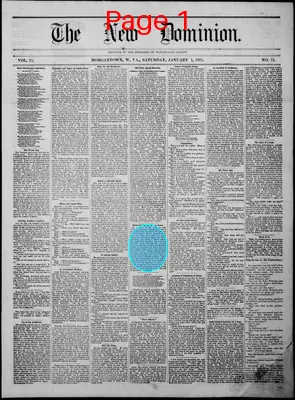
Story
January 1, 1881
The New Dominion
Morgantown, Monongalia County, West Virginia
What is this article about?
In 1853, the Dutch Government drained the Haarlem Lake, site of many shipwrecks and deaths, but found no human bones despite extensive digging; only artifacts like weapons, coins, and wrecked vessels were discovered, illustrating bone destructibility.
Clipping
OCR Quality
98%
Excellent
Full Text
Destructibility of Human Bones.
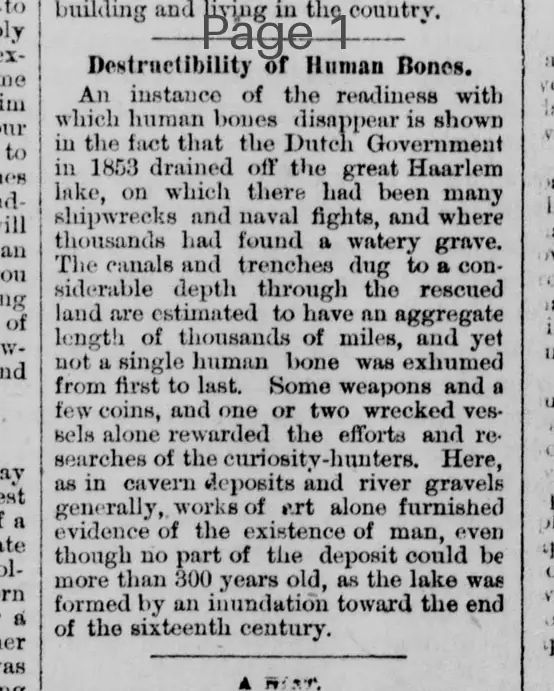
An instance of the readiness with which human bones disappear is shown in the fact that the Dutch Government in 1853 drained off the great Haarlem lake, on which there had been many shipwrecks and naval fights, and where thousands had found a watery grave. The canals and trenches dug to a considerable depth through the rescued land are estimated to have an aggregate length of thousands of miles, and yet not a single human bone was exhumed from first to last. Some weapons and a few coins, and one or two wrecked vessels alone rewarded the efforts and researches of the curiosity-hunters. Here, as in cavern deposits and river gravels generally, works of art alone furnished evidence of the existence of man, even though no part of the deposit could be more than 300 years old, as the lake was formed by an inundation toward the end of the sixteenth century.
An instance of the readiness with which human bones disappear is shown in the fact that the Dutch Government in 1853 drained off the great Haarlem lake, on which there had been many shipwrecks and naval fights, and where thousands had found a watery grave. The canals and trenches dug to a considerable depth through the rescued land are estimated to have an aggregate length of thousands of miles, and yet not a single human bone was exhumed from first to last. Some weapons and a few coins, and one or two wrecked vessels alone rewarded the efforts and researches of the curiosity-hunters. Here, as in cavern deposits and river gravels generally, works of art alone furnished evidence of the existence of man, even though no part of the deposit could be more than 300 years old, as the lake was formed by an inundation toward the end of the sixteenth century.
What sub-type of article is it?
Curiosity
Historical Event
Extraordinary Event
What themes does it cover?
Nature
Misfortune
What keywords are associated?
Human Bones
Haarlem Lake
Draining
Shipwrecks
Artifacts
Bone Destructibility
What entities or persons were involved?
Dutch Government
Where did it happen?
Haarlem Lake
Story Details
Key Persons
Dutch Government
Location
Haarlem Lake
Event Date
1853
Story Details
Draining of Haarlem Lake in 1853 revealed no human bones from past shipwrecks and deaths, only artifacts, showing rapid bone disappearance in such environments.