Thank you for visiting SNEWPapers!
Sign up free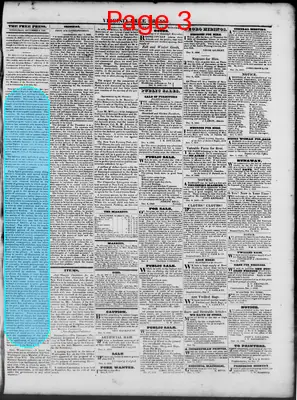
Editorial
December 8, 1830
Virginia Free Press & Farmers' Repository
Charles Town, Jefferson County, West Virginia
What is this article about?
An editorial decries local efforts to stir party strife, defends the paper's impartiality, and quotes an article lambasting party spirit for undermining morals, policy, and freedom, advocating intelligence and moral purity as remedies.
Clipping

OCR Quality
95%
Excellent
Full Text
Some persons of our county, who have pretended highly to deprecate the influence of party spirit, have lately been very busy in stirring the political cauldron, and throwing into it all the elements of strife. They seem to be desirous to destroy those friendly relations of life, which have happily existed for the last two years in our community. And all this is done under the pretence, that their party has been denied the means of presenting its views to public consideration. This is not true. We have uniformly granted to our opponents every thing which has been asked in reason. For the last two years, we have studiously avoided giving the slightest cause of offence; whilst we have maintained with becoming firmness our own views--though we have seldom deemed it necessary to state those views. We were glad to see resumed, those civilities and decencies of life, which tend so much to enhance the comforts of society; and it now remains to be seen, whether the independent citizens of our county, will suffer themselves to be drilled into partizan legions, by men, some of whom, despairing of success upon their own personal merits, raise the banner of party, and hope to ride into power upon the backs of the unsuspecting yeomanry.
The following article, perfectly in point, we find in one of our last mail papers. We know not its source; but believe there are very few reflecting men who will not subscribe to the truth of almost every sentiment it contains.
PARTY SPIRIT.
Party Spirit prostrates every thing which is venerable and sacred within the sphere of its commotion. It directs the attention of the people from their own common interest to the means of gaining ends to which prejudice and passion may direct them; and the attention of the government from public good to the means of its own political existence. It renders a wise and comprehensive policy impossible; for party spirit has no magnanimity, no conscience, no consistency, to withhold it from resisting as readily what is wise as what is unwise, and its victories are too transient to admit of prospective wisdom. It is eminently hostile to the laws which watch over the morals of the nation; for who will execute them when partizans on both sides fear that they may feel the consequence of fidelity, at the very next election? Too often from the nearly balanced state of parties, the most worthless portion of the community actually hold the sway in the elections, even in a state of society comparatively virtuous--occasioning impunity in the violation of law, and clothing with political consequence, and too often surrounding with adulation, men whom our fathers would have expelled from good society, and sent to the work house or the pillory. It tends to destroy in society all distinction of talent, and learning, and moral character, as qualifications for office, while it reconciles the people, under the plea of necessity, to such preposterous sacrifices of conscience and common sense as they would never consent to, unstimulated by madness. Indeed, in all but the name, it rears beneath the forms of freedom a real and most terrific despotism. For every party has a soul--some master-spirit who, without a crown and sceptre, governs with absolute sway. He is surrounded by a nobility, each of whom is commissioned to govern the public opinion within his sphere, and bring his retainers to the polls, to subserve in simplicity the interests of the king and the aristocracy. It needs only to kindle the watch-fire, and every clansman is at his post; and the argument might as well avail against bullets in the day of battle, as in these determined contests of parties. There is no remedy for this state of things, but that intelligence which qualifies the people to understand their rights, interests and duties; and that calmness of feeling to which the public mind, undisturbed by partizan efforts, will not fail to come--and that deep conviction of the importance of moral purity, which shall turn the expectations of the people from party men and party measures, to the application of moral power, by the institutions of religion, and the interposition of the Holy Spirit.
The following article, perfectly in point, we find in one of our last mail papers. We know not its source; but believe there are very few reflecting men who will not subscribe to the truth of almost every sentiment it contains.
PARTY SPIRIT.
Party Spirit prostrates every thing which is venerable and sacred within the sphere of its commotion. It directs the attention of the people from their own common interest to the means of gaining ends to which prejudice and passion may direct them; and the attention of the government from public good to the means of its own political existence. It renders a wise and comprehensive policy impossible; for party spirit has no magnanimity, no conscience, no consistency, to withhold it from resisting as readily what is wise as what is unwise, and its victories are too transient to admit of prospective wisdom. It is eminently hostile to the laws which watch over the morals of the nation; for who will execute them when partizans on both sides fear that they may feel the consequence of fidelity, at the very next election? Too often from the nearly balanced state of parties, the most worthless portion of the community actually hold the sway in the elections, even in a state of society comparatively virtuous--occasioning impunity in the violation of law, and clothing with political consequence, and too often surrounding with adulation, men whom our fathers would have expelled from good society, and sent to the work house or the pillory. It tends to destroy in society all distinction of talent, and learning, and moral character, as qualifications for office, while it reconciles the people, under the plea of necessity, to such preposterous sacrifices of conscience and common sense as they would never consent to, unstimulated by madness. Indeed, in all but the name, it rears beneath the forms of freedom a real and most terrific despotism. For every party has a soul--some master-spirit who, without a crown and sceptre, governs with absolute sway. He is surrounded by a nobility, each of whom is commissioned to govern the public opinion within his sphere, and bring his retainers to the polls, to subserve in simplicity the interests of the king and the aristocracy. It needs only to kindle the watch-fire, and every clansman is at his post; and the argument might as well avail against bullets in the day of battle, as in these determined contests of parties. There is no remedy for this state of things, but that intelligence which qualifies the people to understand their rights, interests and duties; and that calmness of feeling to which the public mind, undisturbed by partizan efforts, will not fail to come--and that deep conviction of the importance of moral purity, which shall turn the expectations of the people from party men and party measures, to the application of moral power, by the institutions of religion, and the interposition of the Holy Spirit.
What sub-type of article is it?
Partisan Politics
Moral Or Religious
What keywords are associated?
Party Spirit
Partisanship
Elections
Moral Purity
Political Despotism
Community Harmony
Public Intelligence
Editorial Details
Primary Topic
Dangers Of Party Spirit
Stance / Tone
Strong Condemnation Of Partisanship Advocating Moral And Intelligent Public Discourse
Key Arguments
Party Spirit Destroys Community Harmony And Friendly Relations
Opponents Falsely Claim Denial Of Views Presentation
Party Spirit Diverts Attention From Common Interests To Prejudice
It Prevents Wise Policy Due To Lack Of Magnanimity And Consistency
Hostile To Moral Laws Fearing Electoral Consequences
Empowers Worthless Individuals In Elections
Destroys Merit Based Qualifications For Office
Creates Despotism Under Freedom's Forms
Remedy In Public Intelligence Calmness And Moral Purity Via Religion