Thank you for visiting SNEWPapers!
Sign up free
Kentucky Gazette And General Advertiser
Lexington, Fayette County, Kentucky
What is this article about?
This dissertation analyzes Thomas Paine's 'Rights of Man,' critiquing hereditary monarchies for producing incompetent rulers and instability, while praising republican governments for their rationality, adaptability, and promotion of liberty. It draws historical examples from Rome, France, Sweden, and others to argue for republican superiority.
Merged-components note: Continuation of the dissertation on the political character and writings of Thomas Paine across pages, as indicated by the incomplete sentence at the end of the first component.
Clippings
1 of 2
OCR Quality
Full Text
On the Political Character and Writings of
THOMAS PAINE,
Author of Common Sense, Rights of
Man, &c. &c. &c.
NO.6.
RIGHTS OF MAN."
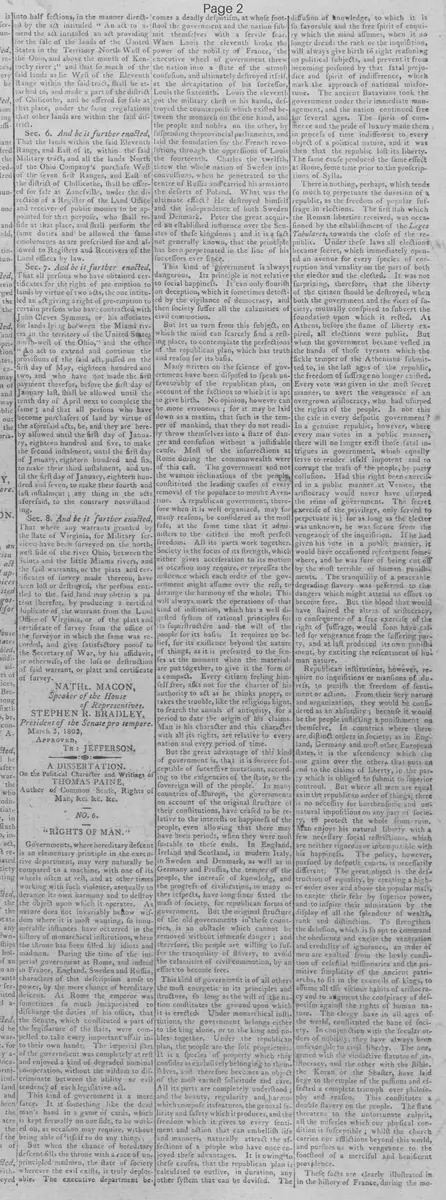
Governments, where hereditary descent is an elementary principle in the executive department, may very naturally be compared to a machine, with one of its wheels often at rest, and at other times working with such violence, as equally to derange its own harmony and to destroy the object upon which it operates. As nature does not invariably bestow wisdom where it is most wanting, so innumerable instances have occurred in the history of monarchical institutions, where the throne has been filled by idiots and madmen. During the time of the imperial government at Rome, and indeed in France, England, Sweden and Russia, characters of this description rose to power, by the mere chance of hereditary descent. At Rome the emperor was sometimes so much incapacitated to discharge the duties of his office, that the Senate, which constituted a part of the legislature of the state, were compelled to take every important affair into their own hands, The imperial part of the government was completely at rest and enjoyed a kind of degraded nominal co-operation, without the wisdom to discriminate between the utility or evil tendency of each legislative act.
This kind of government is a mere farce. It is something like the dead man's hand in a game of cards, which is kept formally on one side, to be worked on, as occasion may require, without being able of itself to do any thing
But when the chance of hereditary descent fills the throne with a race of unprincipled madmen, the state of society wherever the evil exists, is truly deplorable. The executive department becomes a deadly despotism, at whose footstool the government and the nation submit themselves with a servile fear.
When Louis the eleventh broke the power of the nobility of France, the executive wheel of government threw the nation into a state of the utmost confusion, and ultimately destroyed itself, at the decapitation of his successor, Louis the sixteenth. Louis the eleventh got the military chest in his hands, destroyed the counterpoise which existed between the monarch on the one hand, and the people and nobles on the other, by suspending the provincial parliaments, and laid the foundation for the French revolution, through the oppressions of Louis the fourteenth. Charles the twelfth. threw the whole nation of Sweden into convulsions, when he penetrated to the centre of Russia and carried his arms into the deserts of Poland. What was the ultimate effect? He destroyed himself and the independence of both Sweden and Denmark. Peter the great acquired an established influence over the Senates of these kingdoms; and it is a fact not generally known, that the principle has been perpetuated in the line of his successors ever since.
This kind of government is always dangerous. Its principle is not relative to social happiness. It can only flourish on deception, which it sometimes detected by the vigilance of democracy, and then society suffer all the calamities of civil commotion.
But let us turn from this subject, on which the mind can scarcely find a resting place, to contemplate the perfections of the republican plan, which has truth and reason for its basis.
Many writers on the science of government have been disposed to speak unfavourably of the republican plan, on account of the factions to which it is apt to give birth. No opinion, however can be more erroneous: for it may be laid down as a maxim, that such is the temper of mankind, that they do not readily throw themselves into a state of danger and confusion without a justifiable cause. Most of the insurrections at Rome during the commonwealth were of this cast. The government and not the wanton inclinations of the people, constituted the leading causes of every removal of the populace to mount Aventine. A republican government, therefore when it is well organized, may for many reasons, be considered as the most safe, at the same time that it administers to the citizen the most perfect freedom. All its parts work together. Society is the focus of its strength, which either gives acceleration to its motion as occasion may require, or represses the influence which each order of the government might assume over the rest, to derange the harmony of the whole. This will always mark the operations of that kind of institution, which has a well digested system of rational principles for its superstructure and the will of the people for its basis. It requires no belief. for its existence beyond the nature of things, as it is presented to the senses at the moment when the materials are put together, to give it the form of a compact. Every citizen feeling himself free, asks not for the charter of his authority to act as he thinks proper, or takes the trouble, like the religious bigot, to search the annals of antiquity, for a period to date the origin of his claims. Man is his character and this character with all its rights, are relative to every nation and every period of time.
But the great advantage of this kind of government is, that it is forever susceptible of successive mutations, according to the exigencies of the state, by the sovereign will of the people. In many countries of Europe, the governments on account of the original structure of their constitutions, have ceased to be relative to the interests or happiness of the people, even allowing that there may have been periods, when they were most suitable to these ends. In England. Ireland and Scotland, in modern Italy, in Sweden and Denmark, as well as in Germany and Prussia, the temper of the people, the increase of knowledge, and the progress of civilization, in many other respects, have long since fitted the mass of society, for republican forms of government. But the original structure of the old governments in these countries, is an obstacle which cannot be removed without immense danger; and therefore, the people are willing to suffer the tranquility of slavery, to avoid the calamities of civil commotion, by an effort to become free.
This kind of government is of all others the most energetic in its principles and structure, so long as the will of the nation constitutes the ground upon which it is erected Under monarchical institutions, the government belongs either to the king alone, or to the king and nobles together. Under the republican plan, the people are the sole proprietors. It is a species of property which they consider as exclusively belonging to themselves, and therefore becomes an object of the most earnest solicitude and care. All its parts are completely understood; and the beauty, regularity and harmony which compose its features, the general felicity and safety which it produces, and the freedom which it gives to every sentiment and action that can embellish life and manners, naturally attract the affections of a people who have once enjoyed these advantages. It is owing to these causes, that the republican plan is calculated to outlive, in duration, any other system that can be devised. The diffusion of knowledge, to which it is so favorable and the free spirit of enquiry which the mind assumes, when it no longer dreads the rack or the inquisition, will always give birth to right reasoning on political subjects, and prevent it from becoming poisoned by that fatal prejudice and spirit of indifference, which mark the approach of national misfortune. The ancient Batavians took the government under their immediate management, and the nation continued free for several ages. The spirit of commerce and the pride of luxury made them in process of time indifferent to every object of a political nature, and it was then that the republic lost its liberty The same cause produced the same effect at Rome, some time prior to the proscriptions of Sylla.
There is nothing, perhaps, which tends so much to perpetuate the duration of a republic, as the freedom of popular suffrage in elections. The first stab which the Roman liberties received, was occasioned by the establishment of the Leges Tabulares, towards the close of the republic. Under these laws all elections became secret, which immediately opened an avenue for every species of corruption and venality on the part of both the elector and the elected. It was not surprising, therefore, that the liberty of the citizen should be destroyed, when both the government and the vices of society, mutually conspired to subvert the foundation upon which it rested. At Athens, before the flame of liberty expired, all elections were public. But when the government became vested in the hands of those tyrants which the fickle temper of the Athenians submitted to, in the last ages of the republic, the freedom of suffrage no longer existed. Every vote was given in the most secret manner, to avert the vengeance of an overgrown aristocracy, who had usurped the rights of the people. Is not this the case in every despotic government?
In a genuine republic, however, where every man votes in a public manner, there will no longer exist those fatal intrigues in government, which equally serve to render itself impotent and to corrupt the mass of the people, by party collusion. Had this right been exercised in a public manner at Venice, the aristocracy would never have usurped the reins of government. The secret exercise of the privilege, only served to perpetuate it; for as long as the elector was unknown, he was secure from the vengeance of the inquisition. If he had given his vote in a public manner, it would have occasioned resentment somewhere, and he was sure of being cut off by the most terrible of human punishments. The tranquility of a peaceable degrading slavery was preferred to the dangers which might attend an effort to become free. But the blood that would have stained the altars of aristocracy, in consequence of a free exercise of the right of suffrage, would soon have called for vengeance from the suffering party, and at last produced its own punishment, by exciting the resentment of human nature.
Republican institutions, however, require no inquisitions or mansions of durres, to punish the freedom of sentiment or action. From their very nature and organization, they would be considered as an absurdity; because it would be the people inflicting a punishment on themselves. In countries where there are distinct orders in society, as in England, Germany and most other European states, it is the ascendency which the one gains over the other that puts an end to the claims of liberty, in the party which is obliged to submit to superior controul. But where all men are equal as in the republican order of things, there is no necessity for burthensome and unnatural impositions on any part of society, to protect the whole from ruin.
Man enjoys his natural liberty with a few necessary social restrictions, which are neither rigorous or incompatible with his happiness. The policy, however, pursued by despotic courts, is necessarily different. The great object is the destruction of equality, by creating a higher order over and above the popular mass, to excite their fear by superior power, and to inspire their admiration by the display of all the splendour of wealth, rank and distinction. To strengthen the delusion, which is so apt to command the obedience and excite the veneration and credulity of ignorance, an order of men are exalted from the lowly condition of celestial missionaries and the primitive simplicity of the ancient patriarchs, to sit in the councils of kings, to assume all the vicious habits of aristocracy and to augment the conspiracy of despotism against the rights of human nature. The clergy have in all ages of the world, constituted the bane of society. In conjunction with the secular orders of nobility, they have always been unfavorable to civil liberty. The one, armed with the vindictive statutes of aristocracy, and the other with the Bible, the Koran or the Shaster, have laid siege to the empire of the passions and effected a complete triumph over philosophy and reason. This constitutes a double slavery on the people. The state threatens to the unfortunate culprit, all the miseries which our physical condition is susceptible; whilst the church carries our afflictions beyond this world, and pursues us with vengeance to the footstool of a merciful and beneficent providence.
These facts are clearly illustrated in the history of France, during the mo-
Anarchy, and that of Spain and Portugal, from the period when a union took place between church and state. Oliver Cromwell, by siding with each ecclesiastical order of England, would have been declared king, provided his ambitious career had not been frustrated by death. It was by a hypocritical semblance of friendship which he exhibited to the nation, the protestant church and the Romish hierarchy, and by deceiving in reality all three of them, that he became possessed of such unbounded influence as to enable him to awe all Europe. What was the cause, after the expulsion of Tarquin, and the destruction of patrician influence at Rome, that the people so soon submitted again to tyranny? Because Servius Tullus, blended the church with the state, made it a fundamental law, that all great appointments as well as every important project, should be submitted to the determination of soothsayers, who by imposing on the ignorance and credulity of the people, threw the state into convulsions, and opened an avenue for patrician usurpation.
In republican governments, the people are acquainted with the characters they entrust. The confidence which this circumstance inspires, not only adds to the general felicity, but when the people are themselves deceived, they can apply an appropriate remedy to the evil and remove it at once. The case is different in monarchical states. The king, who has nothing to answer for to the people, makes all great appointments, and the government which this order pleases to impose upon them they are compelled to submit to. In England, every change of minister produces a temporary convulsion in the nation. If his principles are supposed to be hostile to the privileged orders, it excites the opposition of the aristocracy; and if they are of a different stamp, the people, who suffer all the calamities of a mad administration, in their turn, complain of the imposition. Besides, the minister is entirely unknown to the very body of society which is to suffer most, by an improper management of affairs. No confidence can be reposed in the character whose principles are doubtful. When Lord North and the Marquis of Rockingham were appointed ministers in England, they were not known by a tenth part of the nation. The impolicy of their administration was an evil which the people could not remedy, even when the drift and talents of these men were fully discovered. Had the government, however, been in the hands of the people, what would have been the punishment of such a mad scheme as North's to subjugate the Americans, at the expense of the national blood and treasure, and the feelings of humanity? The people would have turned him out of office, and consigned him to oblivion, as they have done in America by John Adams. But in England a nd every country whose government is not relative to the natural rights of mankind, the happiness and claims of the people are objects of the last consideration. Governments of a despotic kind are naturally lazy in the administration of justice. When the power over the multitude is complete, the one becomes every thing and the other nothing. This is the cause why European monarchs compose a mere nominal executive, by doing nothing themselves and confiding every thing to their ministers, and why Asiatic despotism is committed to the hands of viziers, who having no motive to cultivate the affections of any other than the despot they represent, oppress the people with the most unfeeling barbarity to gratify the cravings of avarice. These ministers act like the savages of Loufiana, who, when they are desirous of fruit, cut the tree to the root, and then gather it.
I have attempted in this number, to illustrate the principles of Mr. Paine, by historical deduction and example, and by some degree of moral reasoning. They will have a tendency to show the impositions under which mankind have laboured by the false conceptions they have entertained of the principles of government, and by submitting themselves to an authority that grounds itself on usurpation.
STILPO.
+ Monteque vol. I. p. 83.
What sub-type of article is it?
What keywords are associated?
What entities or persons were involved?
Editorial Details
Primary Topic
Defense Of Republican Government And Critique Of Hereditary Monarchy In Thomas Paine's Rights Of Man
Stance / Tone
Strongly Pro Republican And Anti Monarchical
Key Figures
Key Arguments