Thank you for visiting SNEWPapers!
Sign up free
Foreign News
October 20, 1842
Watchman Of The South
Richmond, Virginia
What is this article about?
Detailed description of Chinese Mandarins' and soldiers' weapons during the Second Campaign in China, including swords, quivers, arrows, shields, matchlocks, spears, and armor, from Mackensie's Narrative.
Clipping
OCR Quality
98%
Excellent
Full Text
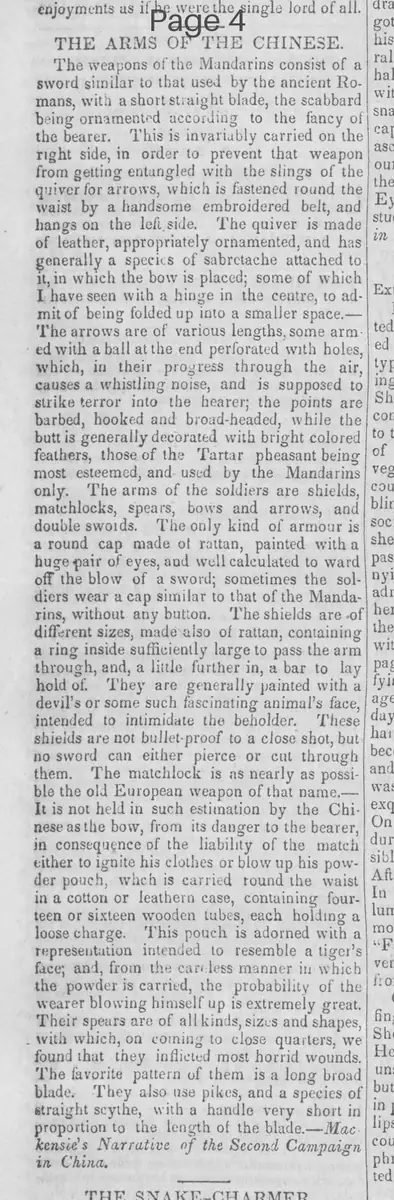
THE ARMS OF THE CHINESE.
The weapons of the Mandarins consist of a sword similar to that used by the ancient Romans, with a short straight blade, the scabbard being ornamented according to the fancy of the bearer. This is invariably carried on the right side, in order to prevent that weapon from getting entangled with the slings of the quiver for arrows, which is fastened round the waist by a handsome embroidered belt, and hangs on the left side. The quiver is made of leather, appropriately ornamented, and has generally a species of sabretache attached to it, in which the bow is placed; some of which I have seen with a hinge in the centre, to admit of being folded up into a smaller space.—The arrows are of various lengths, some armed with a ball at the end perforated with holes which, in their progress through the air, causes a whistling noise, and is supposed to strike terror into the hearer; the points are barbed, hooked and broad-headed, while the butt is generally decorated with bright colored feathers, those of the Tartar pheasant being most esteemed, and used by the Mandarins only. The arms of the soldiers are shields matchlocks, spears, bows and arrows, and double swords. The only kind of armour is a round cap made of rattan, painted with a huge pair of eyes, and well calculated to ward off the blow of a sword; sometimes the soldiers wear a cap similar to that of the Mandarins, without any button. The shields are of different sizes, made also of rattan, containing a ring inside sufficiently large to pass the arm through, and, a little further in, a bar to lay hold of. They are generally painted with a devil's or some such fascinating animal's face, intended to intimidate the beholder. These shields are not bullet-proof to a close shot, but no sword can either pierce or cut through them. The matchlock is as nearly as possible the old European weapon of that name.—It is not held in such estimation by the Chinese as the bow, from its danger to the bearer, in consequence of the liability of the match either to ignite his clothes or blow up his powder pouch, which is carried round the waist in a cotton or leathern case, containing fourteen or sixteen wooden tubes, each holding a loose charge. This pouch is adorned with a representation intended to resemble a tiger's face; and, from the careless manner in which the powder is carried, the probability of the wearer blowing himself up is extremely great. Their spears are of all kinds, sizes and shapes, with which, on coming to close quarters, we found that they inflicted most horrid wounds. The favorite pattern of them is a long broad blade. They also use pikes, and a species of straight scythe, with a handle very short in proportion to the length of the blade.—Mackensie's Narrative of the Second Campaign in China.
The weapons of the Mandarins consist of a sword similar to that used by the ancient Romans, with a short straight blade, the scabbard being ornamented according to the fancy of the bearer. This is invariably carried on the right side, in order to prevent that weapon from getting entangled with the slings of the quiver for arrows, which is fastened round the waist by a handsome embroidered belt, and hangs on the left side. The quiver is made of leather, appropriately ornamented, and has generally a species of sabretache attached to it, in which the bow is placed; some of which I have seen with a hinge in the centre, to admit of being folded up into a smaller space.—The arrows are of various lengths, some armed with a ball at the end perforated with holes which, in their progress through the air, causes a whistling noise, and is supposed to strike terror into the hearer; the points are barbed, hooked and broad-headed, while the butt is generally decorated with bright colored feathers, those of the Tartar pheasant being most esteemed, and used by the Mandarins only. The arms of the soldiers are shields matchlocks, spears, bows and arrows, and double swords. The only kind of armour is a round cap made of rattan, painted with a huge pair of eyes, and well calculated to ward off the blow of a sword; sometimes the soldiers wear a cap similar to that of the Mandarins, without any button. The shields are of different sizes, made also of rattan, containing a ring inside sufficiently large to pass the arm through, and, a little further in, a bar to lay hold of. They are generally painted with a devil's or some such fascinating animal's face, intended to intimidate the beholder. These shields are not bullet-proof to a close shot, but no sword can either pierce or cut through them. The matchlock is as nearly as possible the old European weapon of that name.—It is not held in such estimation by the Chinese as the bow, from its danger to the bearer, in consequence of the liability of the match either to ignite his clothes or blow up his powder pouch, which is carried round the waist in a cotton or leathern case, containing fourteen or sixteen wooden tubes, each holding a loose charge. This pouch is adorned with a representation intended to resemble a tiger's face; and, from the careless manner in which the powder is carried, the probability of the wearer blowing himself up is extremely great. Their spears are of all kinds, sizes and shapes, with which, on coming to close quarters, we found that they inflicted most horrid wounds. The favorite pattern of them is a long broad blade. They also use pikes, and a species of straight scythe, with a handle very short in proportion to the length of the blade.—Mackensie's Narrative of the Second Campaign in China.
What sub-type of article is it?
Military Campaign
What keywords are associated?
Chinese Arms
Mandarins Weapons
Soldiers Equipment
Bows Arrows
Matchlocks
Rattan Shields
Spears Pikes
Where did it happen?
China
Foreign News Details
Primary Location
China
Event Details
Description of Mandarins' weapons including Roman-style swords, quivers with bows, whistling arrows with feathers; soldiers' arms: shields, matchlocks, spears, bows, arrows, double swords; armor: rattan caps; shields painted to intimidate, not bullet-proof but sword-resistant; matchlocks dangerous due to powder pouches; spears causing horrid wounds, including pikes and scythes.