Thank you for visiting SNEWPapers!
Sign up free
Eastern Times
Bath, Sagadahoc County, Maine
What is this article about?
A letter from San Francisco dated Jan. 8, 1850, reports severe postal delays due to inadequate U.S. government facilities handling high mail volumes; describes early rainy season halting mining, causing shortages and migration; details filthy city conditions, uneven mining profits, high interest rates, falling wages, rising crime, and a recent election.
Clipping
OCR Quality
Full Text
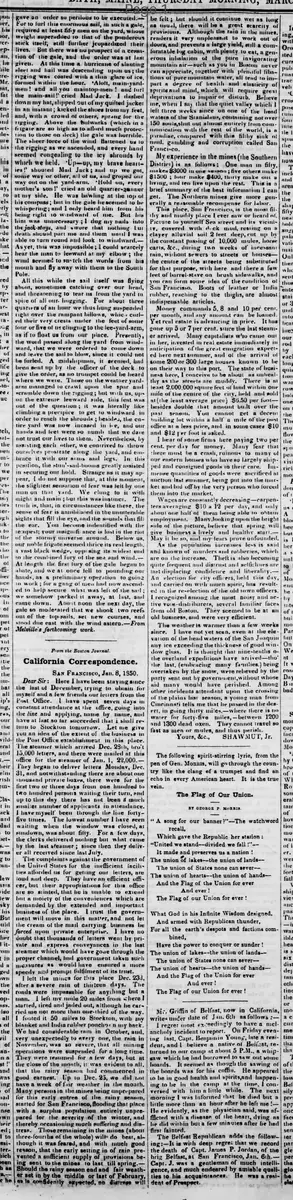
California Correspondence.
San Francisco, Jan. 8, 1850.
Dear Sir: Here I have been staying since the last of December, trying to obtain for myself and a few friends our letters from the Post Office. I have spent seven days in constant attendance at the office, going into the line and applying, name by name, and have at last so far succeeded that I shall return to Stockton tomorrow. Let me give you an idea of the extent of the business in the Post Office establishment in this place. The steamer which arrived Dec. 28th, brought 15,000 letters, and there were mailed at this office for the steamer of Jan. 1, 22,000. - They began to deliver letters Monday, Dec. 31, and notwithstanding there are about one thousand private boxes, there were for the first two or three days from one hundred to two hundred persons waiting their turn, and up to this day there has not been a much smaller number of applicants in attendance. I have myself been through the line forty-five times. The lowest number I have seen waiting when the window was closed, at sundown, was about fifty. For a few days, the clerks delivered nothing but what came by the last steamer; since then they deliver all received since last July.
The complaints against the government of the United States for the inefficient facilities afforded us for getting our letters, are loud and deep. They have an efficient officer, but their appropriations for this office are so stinted, that he is unable to extend but a moiety of the conveniences which are demanded by the extended and important business of the place. I trust the government will move in this matter, and not let the cream of the mail carrying business be forced upon private enterprise. I have no doubt that thousands of letters went by private and express conveyances in the last steamer which would have gone through the proper channel, had government taken such measures as would have ensured a more speedy and prompt fulfilment of its trust.
I left the mines for this place Dec. 23d., after a severe rain of thirteen days. The roads were impassable for anything but man. I left my mule 20 miles from where I started, tired and jaded out, although he carried me not more than one-third of the way. I footed it 50 miles to Stockton, with my blanket and India rubber poncho on my back. We had considerable rain in October, and, very unexpectedly to every one, the rain in November, was so severe, that all mining operations were suspended for a long time. They were resumed for a few days, but at the close of the month, it was evident to all, that the rainy season had commenced in good earnest. Up to Dec. 25, we did not have a week of fair weather in the month. Many persons in the mines being unprepared for this early entry of the rainy season, started for San Francisco, flooding that place with a surplus population entirely unprepared for the severity of the winter, and thereby occasioning much suffering and distress.
Those remaining in the mines (about three-fourths of the whole) will do best, although it was feared, and with much good reason, that the early setting in of rain prevented a sufficient supply of provisions being sent to the mines, to last till spring. — Should the rainy season end and fair weather set in by the middle or last of February, as is confidently expected, no distress will be felt; but should it continue wet as long as usual, there will be a great scarcity of provisions. Although the rain in the mines, renders it very unpleasant to work out of doors, and prevents a large yield, still a comfortable log cabin, with plenty to eat, a generous inhalation of the pure invigorating mountain air - such as you in Boston never can appreciate, together with plentiful libations of pure mountain water, all tend to impart a degree of health and elasticity of spirits and mind, which will require great deprivations to impair or disturb. Believe me, when I say that the quiet valley which I left three weeks since on one of the head waters of the Stanislaus, containing not over 150 souls, shut out almost entirely from communication with the rest of the world, is a paradise, compared with this filthy sink of mud, gambling and corruption called San Francisco.
My experience in the mines (the Southern District) is as follows: One man out of fifty, makes $3000 in one season; five others make $1500; four make $400, thirty make out living, and ten live upon the rest. This is a brief summary of the best information I can get. The Northern mines give more generally a reasonable recompense for labor.
This place, San Francisco, is the most filthy and muddy place I ever saw or heard of. Picture to yourself Sea street and its vicinity, covered with thick mud, resting on a clayey alluvial soil 2 feet deep, cut up by the constant passing of 10,000 mules, horse carts, &c., during two weeks of incessant rain, without sewers to streets or houses - the centre of the streets being substituted for that purpose, with here and there a few feet of barrel-stave on brush sidewalks, and you can form some idea of the condition of San Francisco. Boots of leather or India rubber, reaching to the thighs, are almost indispensable articles.
Money commands 5, 8 and 10 per cent. per month, and any amount can be loaned. Yet real estate is advancing in price. It has gone up 5 or 7 per cent. since the last steamer arrived. Many capitalists who came out in her, invested in real estate immediately in anticipation of the great emigration expected here next summer, and of the arrival of some 200 or 300 large houses known to be on their way to this port. The state of business here, I conceive to be about as unhealthy as the streets are muddy. There is at least 2,000,000 square feet of land within one mile of the centre of the city, held and sold at (the least average price) $6.50 per foot - besides double that amount built over the past season. You cannot get a decent building lot within a half a mile of the post office at a less price, and in some cases $10 and $1 per foot is asked.
I hear of some firms here paying two per cent. per day for money. Many fear that there must be a crash, ruinous to many of our eastern houses who have so largely shipped and consigned goods to their care. Immense quantities of goods were sacrificed at auction last summer, being put into the market and bid off by the very person who forced them into the market.
Wages are constantly decreasing - carpenters averaging $10 a 12 per day, and only about one half of them being able to obtain employment. Many, looking upon the bright side of the picture, believe that spring will give business a lively and healthy start. - May it be so, and my fears prove unfounded.
As the population increases less is said and known of murders and robberies, which are on the increase. Theft is also becoming quite frequent and distrust and selfishness are fast displacing confidence and liberality. -
An election for city officers, held this day, and carried on with much spirit, has resulted in the re-election of the old town officers. I recognized among the most noisy and active vote-distributors, several familiar faces from old Boston. They seemed to be at their old business, and were very efficient.
The weather is warmer than a few weeks since. I have not yet seen, even at the elevation of the head waters of the San Joaquin any ice exceeding the thickness of good window glass. It is thought that nine-tenths of the overland expeditions have arrived - tho the last, (embracing many families,) being overtaken by the snow, were relieved by the party sent out by government, without whose aid many would have perished. Among other incidents attendant upon the crossing of the plains last season, a young man from Cincinnati tells me that he passed in the desert, in going thirty miles, - where there is no water for forty-five miles. - between 1200 and 1300 dead oxen. They cannot travel so fast as men or mules, and thus perish.
Yours, &c.
SHAWMUT, Jr.
What sub-type of article is it?
What themes does it cover?
What keywords are associated?
What entities or persons were involved?
Letter to Editor Details
Author
Shawmut, Jr.
Recipient
Dear Sir
Main Argument
the u.s. government must improve postal facilities in san francisco to handle the high volume of mail efficiently, rather than allowing private enterprises to take over; reports on the adverse effects of early rains on mining, potential provision shortages, filthy urban conditions, uneven mining profits, high interest rates, declining wages, and rising crime.
Notable Details