Thank you for visiting SNEWPapers!
Sign up free
Gazette Of The United States
Philadelphia, Philadelphia County, Pennsylvania
What is this article about?
This editorial, 'CATO-NO. VI.', critiques the Jay Treaty for undermining American commerce by preserving British navigation laws while limiting U.S. retaliatory measures, harming trade with Britain, West Indies, and Europe, and reducing American shipping.
Merged-components note: Continuation of the 'CATO-NO. VI.' editorial from page 2 to page 3; the content flows directly as a single opinion piece on the treaty and commerce.
Clippings
1 of 2
OCR Quality
Full Text
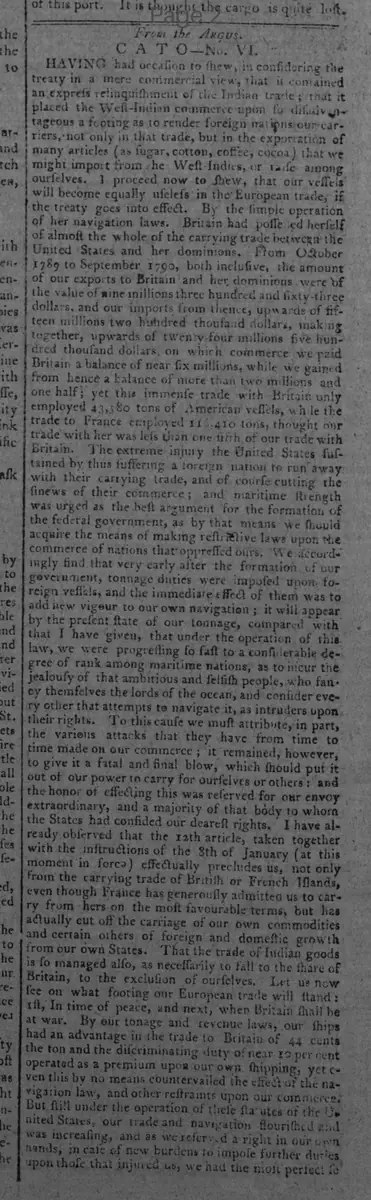
CATO-NO. VI.
HAVING had occasion to shew, in considering the treaty in a mere commercial view, that it contained an express relinquishment of the Indian trade; that it placed the West-Indian commerce upon so disadvantageous a footing as to render foreign nations our carriers, not only in that trade, but in the exportation of many articles (as sugar, cotton, coffee, cocoa) that we might import from the West Indies, or raise among ourselves. I proceed now to shew, that our vessels will become equally useless in the European trade, if the treaty goes into effect. By the simple operation of her navigation laws. Britain had possessed herself of almost the whole of the carrying trade between the United States and her dominions. From October 1789 to September 1790, both inclusive, the amount of our exports to Britain and her dominions were of the value of nine millions three hundred and sixty-three dollars, and our imports from thence, upwards of fifteen millions two hundred thousand dollars, making together, upwards of twenty four millions five hundred thousand dollars, on which commerce we paid Britain a balance of near six millions, while we gained from hence a balance of more than two millions and one half; yet thus immense trade with Britain only employed 43,500 tons of American vessels, while the trade to France employed 114,410 tons, though our trade with her was less than one fifth of our trade with Britain. The extreme injury the United States sustained by thus suffering a foreign nation to run away with their carrying trade, and of course cutting the sinews of their commerce; and maritime strength was urged as the best argument for the formation of the federal government, as by that means we should acquire the means of making retaliative laws upon the commerce of nations that oppressed ours. We accordingly find that very early after the formation of our government, tonnage duties were imposed upon foreign vessels, and the immediate effect of them was to add new vigour to our own navigation; it will appear by the present state of our tonnage, compared with that I have given, that under the operation of this law, we were progressing so fast to a considerable degree of rank among maritime nations, as to incur the jealousy of that ambitious and selfish people, who fancy themselves the lords of the ocean, and consider every other that attempts to navigate it, as intruders upon their rights. To this cause we must attribute, in part, the various attacks that they have from time to time made on our commerce; it remained, however, to give it a fatal and final blow, which should put it out of our power to carry for ourselves or others: and the honor of effecting this was reserved for our envoy extraordinary, and a majority of that body to whom the States had consigned our dearest rights. I have already observed that the 12th article, taken together with the instructions of the 8th of January (at this moment in force) effectually precludes us, not only from the carrying trade of British or French Islands, even though France has generously admitted us to carry from hers on the most favorable terms, but has actually cut off the carriage of our own commodities and certain others of foreign and domestic growth from our own States. That the trade of Indian goods is so managed also, as necessarily to fall to the share of Britain, to the exclusion of ourselves. Let us now see on what footing our European trade will stand: 1st, In time of peace, and next, when Britain shall be at war. By our tonnage and revenue laws, our ships had an advantage in the trade to Britain of 44 cents the ton and the discriminating duty of near 10 per cent operated as a premium upon our own shipping, yet even this by no means countervailed the effect of the navigation law, and other restraints upon our commerce. But still under the operation of these statutes of the United States, our trade and navigation flourished and was increasing, and as we reserved a right in our own hands, in case of new burdens to impose further duties upon those that injured us, we had the most perfect security against any further legal attacks upon our commerce. Because such was the nature of our commodities as to be essential to the nations with whom we dealt while a variety of markets could furnish upon nearly equal terms, those that we wanted. To Britain we paid an annual balance of near six millions of dollars, which she must necessarily and perhaps forever, have lost, if by a commercial warfare she diverted it into any other channel. What, however, she did not dare to attempt openly by her laws, she has fully effected by her treaty.
By the 14th and 15th articles we agree that she shall impose upon American vessels, a tonnage duty, equal to what her ships pay here, that she shall also impose a duty which shall countervail the foreign duty on American vessels. At first view this appears to be just, for why, say the apologists of the treaty, should they not impose upon your trade the restrictions you impose on hers? Does not France reserve a right to do the same? Undoubtedly; had the article stopped at this point, it would have been perfectly just, and in the navigation of each nation would have then depended upon the means they respectively had of building, victualling and sailing their ships, which is exactly the case between us and France. But unfortunately the articles referred to while they affect to be reciprocal, leave in full force the British navigation act, and all their other restrictive laws by this artful appendix to the 14th article, to wit:
But subject always as to what respects this article to the laws and statutes of the two countries respectively,
had the matter even rested here, it might again have been reciprocal (though extremely unwise on our part) since while it left the British trade laws in force it also left ours in equal force. But this was not the intention of the contracting parties. Words of reciprocity were very well to make a parade with; they would deceive the ignorant and superficial reader, but the greatest point was, while it preserved to Britain the navigation and commercial acts, by which they have raised their commerce at the expense of other nations, to beat down the barriers with which we fenced ours, and even to take from us the means, by any future arrangements of preventing the ruin of our trade.
Mr. Jay therefore agrees in the 14th article, that all our laws as well as those of Britain shall remain in force, but in the 15th article he evades the provision so far as respects us, and expressly stipulates, that we shall lay no additional charge upon Britain to countervail her navigation and other restrictive laws, but that she may, while she preserves them in full force, impose a tonnage and other duties to countervail those we had imposed, in order to enable us to bear up against them. I ask then in what this article is reciprocal? Britain had already gone as far as she dare go in oppressing our trade, and her contents that if we will permit her to continue all the burthens she has imposed upon us, and at the same time agree to let her lay such others as she thinks equivalent for our having presumed to relieve ourselves, that she will agree with us that no further partial duties shall be imposed by either. Let us enquire into the effect of these articles upon our commerce and national character.
Remainder in our next
What sub-type of article is it?
What keywords are associated?
What entities or persons were involved?
Editorial Details
Primary Topic
Critique Of Jay Treaty Provisions On Navigation And Commerce
Stance / Tone
Strongly Critical Of The Treaty And British Commercial Dominance
Key Figures
Key Arguments