Thank you for visiting SNEWPapers!
Sign up free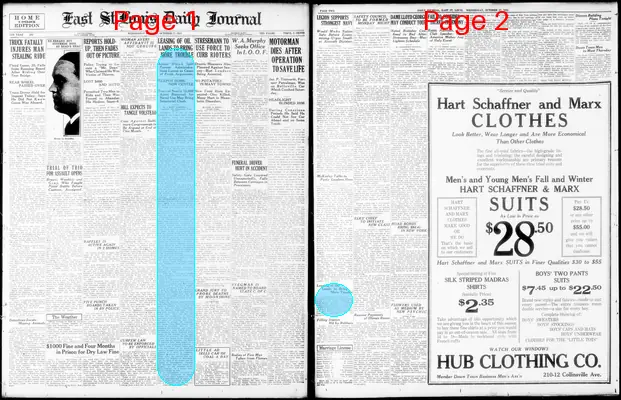
East St. Louis Daily Journal
East Saint Louis, Saint Clair County, Illinois
What is this article about?
The Senate Public Lands Committee begins hearings in Washington, D.C., on October 17, 1923, investigating the leasing of Teapot Dome and other naval oil reserves to private oil companies under Secretary Fall, sparking debates on conservation and potential congressional clashes.
Merged-components note: Continuation of the Teapot Dome oil reserve story from page 1 to page 2; merged for coherent article.
Clippings

1 of 2
OCR Quality
Full Text
Action Which Split Former Administrations Looms as Cause of Fresh Arguments.
TEAPOT DOME NOW CENTER Tract of Nearly 10,000 Acres Reserved for Naval Use May Bring Senatorial Clash.
By J. BART CAMPBELL.
(Copyright 1923, Washington Press Service)
Washington, D. C., Oct. 17.-The leasing of the Teapot Dome Naval Oil Reserve, which was severely criticised and as warmly defended at the last session of congress by Democratic and Republican senators in the course of a fiery debate, will be under investigation here all week in hearings before the Public Lands Committee of the senate
Illinois has no representation on this committee, but Illinois senators and congressmen have taken a leading part in the controversy which was raged over the naval oil reserves. Chairman Smoot of Utah, Senator Jones of New Mexico, and Senator Walsh of Montana were the only members on the ground for the hearing on Sunday A quorum of five is necessary before the hearings can get under way
Washington is alive with reports to the effect that evidence will be produced before the committee to show that not only the Teapot Dome oil fields in Wyoming but every foot of the naval oil reserve lands, set aside under the Taft and Wilson administrations, have been leased to private oil interests and that the oil reserves of the navy will be exhausted before these lands revert to the government.
It is conceded on all sides that a battle between the defenders of the lease and their critics is looming up as one of the chief features of the next session of congress, convening in a little over six weeks "Conservation the issue which split the Taft administration and caused the Ballinger-Pinchot controversy, seems likely again to go thundering down the halls of congress producing bitter feeling and comments on both sides
The naval oil reserves have been the subject of much debate in congress for more than a decade President Roosevelt began the policy of "conservation of public oil lands soon after he succeeded McKinley, withdrawing thousands of acres of western lands from entry President Taft adopted the policy of his predecessor in respect to the oil lands. In 1913, it was announced that the United States Navy would burn oil instead of coal on its vessels and the naval oil reserves were built up from that date President Wilson was committed to the policy, and at one time is reported to have served notice on one of his cabinet officers that the latter's resignation would be demanded if he signed a lease alienating one of the naval reserves to private interests
The five reserves which were set aside for the future needs of the navy were the following 1 Teapot Dome, Wyoming, 9,481 acres withdrawn from entry April 30, 1915 2 Buena Vista Hills California, 29,341 acres, withdrawn from entry December 13, 1912 3. Elk Hills, California, 38,969 acres, withdrawn from entry September 2, 1912 4 and 5. Shale oil reserves
These reserves were intact as late as 1921, it is stated, and were being administered by the Navy Department as emergency stores of oil, to be used in time of war Secretary of the Navy Daniels had vigorously opposed every suggestion that the reserves be turned over to the Interior Department or leased to private interests.
When the Harding administration took office March 4, 1921, steps were taken to transfer the naval oil reserves from the Navy Department to the Interior Department This was done on May 31, 1921, by executive order Since that date, and during the incumbency of former Secretary of the Interior Fall, all of the naval oil reserves have been alienated to private oil concerns The Buena Vista Hills reserve was leased by Secretary Fall to the Standard Oil interests, and certain portions of it were turned over to the Southern Pacific Railroad when claims of the railroad were found valid by the secretary; the Elk Hills reserve was leased to the Standard Oil and Doheny interests; the Shale oil reserves have been leased to a number of oil producing concerns.
The leasing of Teapot Dome, said to be the richest of the naval oil reserves, brought the naval reserves question to a head in congress. Senator Kendrick of Wyoming, in whose state the reserve lies, and Senator La Follette of Wisconsin, took the floor of the senate and demanded an investigation, charging that Secretary Fall had leased the property to his personal friend, Harry Sinclair, by a secret lease, without asking for bids
At an investigation conducted by the Senate Committee on Manufactures, of which Senator La Follette is chairman, and in which the Teapot Dome lease was referred to only in a general way, Mr. Sinclair (Continued on Page Two)
Leasing of Oil
Lands to Bring
More Trouble
(Continued from Page One.)
estimated that Teapot Dome repre-
sents a value in oil resources of
$100,000,000. Senator La Follette
stated that oil experts of the gov-
errnment have found the property to
be worth nearer a quarter of a bil-
lion, and that the lease provided
inadequate compensation for the
government.
What sub-type of article is it?
What keywords are associated?
What entities or persons were involved?
Where did it happen?
Domestic News Details
Primary Location
Washington, D. C.
Event Date
Oct. 17
Key Persons
Outcome
ongoing senate public lands committee hearings investigating leases of naval oil reserves to private interests; potential major congressional battle on conservation; reserves transferred to interior department in 1921 and leased out, including teapot dome to harry sinclair without bids; estimated value discrepancies from $100 million to $250 million with inadequate government compensation.
Event Details
The Senate Public Lands Committee is holding hearings on the leasing of Teapot Dome Naval Oil Reserve and other naval reserves, criticized and defended in prior congressional debates. Reports suggest all reserves set aside under previous administrations have been leased to private oil interests, potentially exhausting navy supplies. Historical context includes conservation policies from Roosevelt, Taft, and Wilson administrations, with reserves intact until 1921 when transferred to Interior Department under Harding, leading to leases by Secretary Fall to companies like Standard Oil, Doheny interests, and Sinclair. Senators Kendrick and La Follette demanded investigation into secret Teapot Dome lease.