Thank you for visiting SNEWPapers!
Sign up free
Literary
December 15, 1928
The Arkansas Farmer
Little Rock, Pulaski County, Arkansas
What is this article about?
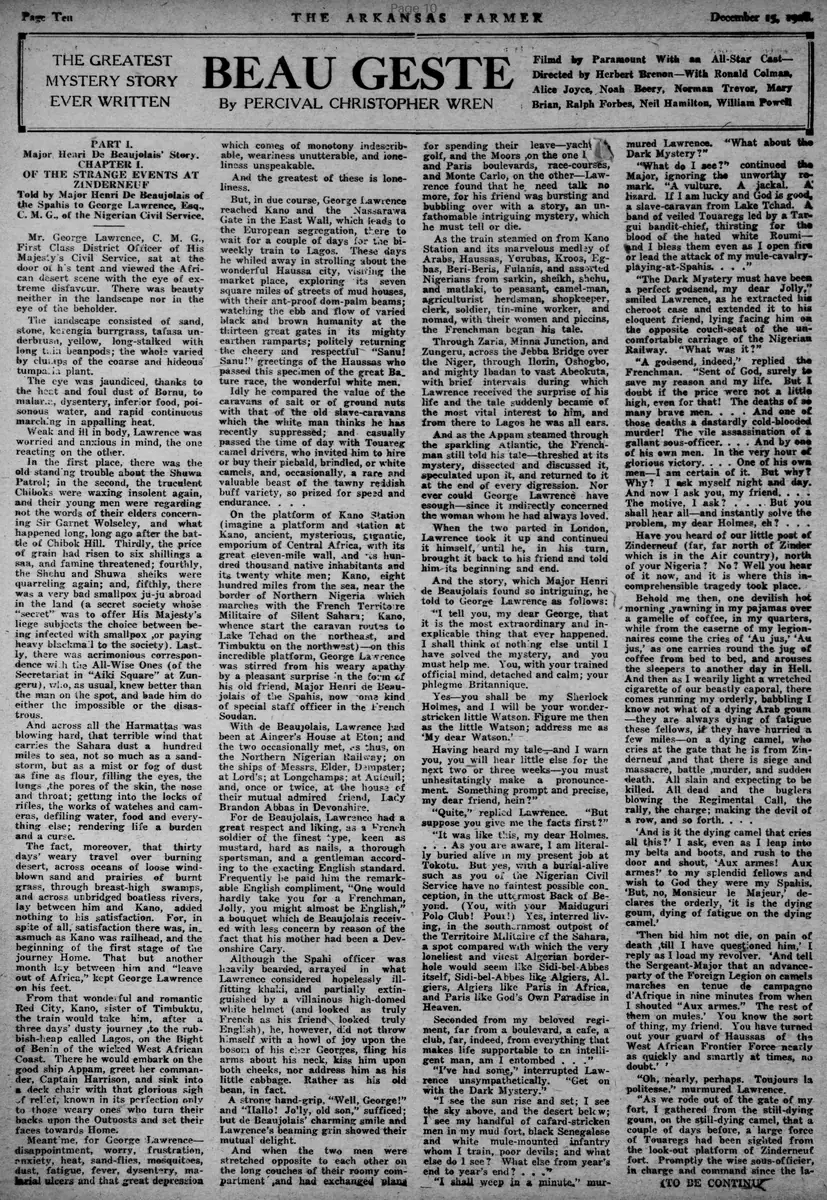
In Kano, Nigeria, weary British officer George Lawrence reunites with old friend Major Henri de Beaujolais, a French Spahi. The Major begins recounting a mysterious tale of a siege and massacre at the remote French outpost of Zinderneuf, involving Touareg attackers and inexplicable events among the defenders.
Clipping
OCR Quality
95%
Excellent
Full Text
Ten
BEAU GESTE
By PERCIVAL CHRISTOPHER WREN
THE GREATEST
MYSTERY STORY
EVER WRITTEN
PART I.
Major, Henri De Beaujolais' Story.
CHAPTER I.
OF THE STRANGE EVENTS AT
ZINDERNEUF
Told by Major Henri De Beaujolais of
the Spahis to George Lawrence, Esq.
C. M. G., of the Nigerian Civil Service.
Mr. George Lawrence, C. M. G.,
First Class District Officer of His
Majesty's Civil Service, sat at the
door of his tent and viewed the African
desert scene with the eye of extreme
disfavor. There was beauty
neither in the landscape nor in the
eye of the beholder.
The landscape consisted of sand,
stone, karengia burrgrass, tafasa underbrush, yellow, long-stalked with
long thin beanpods; the whole varied
by clumps of the coarse and hideous
tumpalia plant.
The eye was jaundiced, thanks to
the heat and foul dust of Bornu, to
malaria, dysentery, inferior food, poi-
sonous water, and rapid continuous
marching in appalling heat.
Weak and ill in body, Lawrence was
worried and anxious in mind, the one
reacting on the other.
In the first place, there was the
old standing trouble about the Shuwa
Patrol; in the second, the truculent
Chiboks were waxing insolent again,
and their young men were regarding
not the words of their elders concern-
ing Sir Garnet Wolseley, and what
happened long, long ago after the bat-
tle of Chibok Hill. Thirdly, the price
of grain had risen to six shillings a
saa, and famine threatened; fourthly,
the Shehu and Shuwa sheiks were
quarreling again; and, fifthly, there
was a very bad smallpox ju-ju abroad
in the land (a secret society whose
"secret" was to offer His Majesty's
liege subjects the choice between be-
ing infected with smallpox, or paying
heavy blackmail to the society). Lastly,
there was acrimonious correspon-
dence with the All-Wise Ones (of the
Secretariat in Aiki Square at Zun-
geru), who, as usual, knew better than
the man on the spot, and bade him do
either the impossible or the disas-
trous.
And across all the Harmattas was
blowing hard, that terrible wind that
carries the Sahara dust a hundred
miles to sea, not so much as a sand-
storm, but as a mist or fog of dust
as fine as flour, filling the eyes, the
lungs, the pores of the skin, the nose
and throat: getting into the locks of
rifles, the works of watches and cam-
eras, defiling water, food and every-
thing else; rendering life a burden
and a curse.
The fact, moreover, that thirty
days' weary travel over burning
desert, across oceans of loose wind-
b lown sand and prairies of burnt
grass, through breast-high swamps,
and across unbridged boatless rivers,
lay between him and Kano, added
nothing to his satisfaction. For, in
spite of all, satisfaction there was, in-
as much as Kano was railhead, and the
beginning of the first stage of the
journey Home. That but another
month lay between him and leave
out of Africa, kept George Lawrence
on his feet.
From that wonderful and romantic
Red City, Kano, sister of Timbuktu,
the train would take him, after a
three days' dusty journey, to the rub-
bish-heap called Lagos, on the Bight
of Benin of the wicked West African
Coast. There he would embark on the
good ship Appam, greet her comman-
der, Captain Harrison, and sink into
deck chair with that glorious sigh
of relief, known in its perfection only
to those weary ones who turn their
backs upon the Outposts and set their
faces towards Home.
Meanwhile, for George Lawrence-
disappointment, worry, frustration,
anxiety, heat, sand-flies, mosquitoes.
dust, fatigue, fever, dysentery, ma-
larial ulcers and that great depression
which comes of monotony indescrib-
able, weariness unutterable, and lone-
liness unspeakable.
And the greatest of these is lone-
liness.
But, in due course, George Lawrence
reached Kano and the Nassarawa
Gate in the East Wall, which leads to
the European segregation, there to
wait for a couple of days for the bi-
weekly train to Lagos. These days
he whiled away in strolling about the
wonderful Haussa city, visiting the
market place, exploring its seven
square miles of streets of mud houses,
with their ant-proof dom-palm beams;
watching the ebb and flow of varied
black and brown humanity at the
thirteen great gates in its mighty
earth en ramparts; politely returning
the cheery and respectful "Sanu!
Sanu!" greetings of the Haussas who
passed this specimen of the great Ba-
fure race, the wonderful white men.
Idly he compared the value of the
caravans of salt or of ground nuts
with that of the old slave-caravans
which the white man thinks he has
recently suppressed; and casually
passed the time of day with Touareg
camel drivers, who invited him to hire
or buy their piebald, brindled, or white
camels, and, occasionally, a rare and
valuable beast of the tawny reddish
buff variety, so prized for speed and
endurance.
On the platform of Kano Station
(imagine a platform and station at
Kano, ancient, mysterious, gigantic,
emporium of Central Africa, with its
great eleven-mile wall, and its hun-
dred thousand native inhabitants and
its twenty white men; Kano, eight
hundred miles from the sea, near the
border of Northern Nigeria which
marches with the French Territoire
Militaire of Silent Sahara; Kano,
whence start the caravan routes to
Lake Tchad on the northeast, and
Timbuktu on the northwest)-on this
incredible platform, George Lawrence
was stirred from his weary apathy
by a pleasant surprise in the form of
his old friend, Major Henri de Beau-
jolais of the Spahis, now some kind
of special staff officer in the French
Soudan.
With de Beaujolais, Lawrence had
been at Ainger's House at Eton; and
the two occasionally met, as thus, on
the Northern Nigerian Railway; on
the ships of Messrs. Elder, Dempster;
at Lord's; at Longchamps; at Auteuil;
and, once or twice, at the house of
their mutual admired friend, Lady
Brandon Abbas in Devonshire.
For de Beaujolais, Lawrence had a
great respect and liking, as a French
soldier of the finest type, keen as
mustard, hard as nails, a thorough
sportsman, and a gentleman accord-
ing to the exacting English standard.
Frequently he paid him the remark-
able English compliment, "One would
hardly take you for a Frenchman,
Jolly, you might almost be English,"
a bouquet which de Beaujolais receiv-
ed with less concern by reason of the
fact that his mother had been a Dev-
onshire Cary.
Although the Spahi officer was
heavily bearded, arrayed in what
Lawrence considered hopelessly ill-
fitting khaki, and partially extin-
guished by a villainous high-domed
white helmet (and looked as truly
French as his friend looked truly
English), he, however, did not throw
himself with a howl of joy upon the
bosom of his cher Georges, fling his
arms about his neck, kiss him upon
both cheeks, nor address him as his
little cabbage. Rather as his old
bean, in fact.
A strong hand-grip, "Well, George!"
and "Hallo! Jolly, old son," sufficed;
but de Beaujolais' charming smile and
Lawrence's beaming grin showed their
mutual delight.
And when the two men were
stretched opposite to each other on
the long couches of their roomy com-
partment and had exchanged plans
for spending their leave -Yachting,
golf, and the Moors on the one hand
and Paris boulevards, race-courses,
and Monte Carlo, on the other -Law-
rence found that he need talk no
more, for his friend was bursting and
bubbling over with a story, an un-
fathomable intriguing mystery, which
he must tell or die.
As the train steamed on from Kano
Station and its marvelous medley of
Arabs, Haussas, Yorubas, Kroos, Eg-
bas, Beri-Beris, Fulanis, and assorted
Nigerians from sarkin, sheikh, shehu,
and matlaki, to peasant, camel-man,
agriculturist herdsman, shopkeeper,
clerk, soldier, tin-mine worker, and
nomad, with their women and piccins,
the Frenchman began his tale.
Through Zaria, Minna Junction, and
Zungeru, across the Jebba Bridge over
the Niger, through Ilorin, Oshogbo,
and mighty Ibadan to vast Abeokuta,
with brief intervals during which
Lawrence received the surprise of his
life and the tale suddenly became of
the most vital interest to him, and
from there to Lagos he was all ears.
And as the Appam steamed through
the sparkling Atlantic, the French-
man still told his tale-threshed at its
mystery, dissected and discussed it,
speculated upon it, and returned to it
at the end of every digression. Nor
ever could George Lawrence have
enough-since it indirectly concerned
the woman whom he had always loved.
When the two parted in London,
Lawrence took it up and continued
it himself, until he, in his turn,
brought it back to his friend and told
him its beginning and end.
And the story, which Major Henri
de Beaujolais found so intriguing, he
told to George Lawrence as follows:
I tell you, my dear George, that
it is the most extraordinary and in-
explicable thing that ever happened.
I shall think of nothing else until I
have solved the mystery, and you
must help me. You, with your trained
official mind, detached and calm; your
phlegme Britannique.
Yes-you shall be my Sherlock
Holmes, and I will be your wonder-
stricken little Watson. Figure me then
as the little Watson; address me as
'My dear Watson.'
Having heard my tale --and I warn
you, you will hear little else for the
next two or three weeks-you must
unhesitatingly make a pronounce-
ment. Something prompt and precise,
my dear friend, hein?
"Quite," replied Lawrence. "But
suppose you give me the facts first?"
"It was like this, my dear Holmes.
. . . As you are aware, I am literal-
ly buried alive in my present job at
Timbuktu. But yes, with a burial-alive
such as you of the Nigerian Civil
Service have no faintest possible con-
ception, in the uttermost Back of Be-
yond. (You, with your Maiduguri
Polo Club! Pouf!) Yes, interred liv-
ing, in the southernmost outpost of
the Territoire Militaire of the Sahara,
a spot compared with which the very
loneliest and vilest Algerian border-
hole would seem like Sidi-bel-Abbes
itself, Sidi-bel-Abbes like Algiers, Al-
giers like Paris in Africa,
and Paris like God's Own Paradise in
Heaven.
Seconded from my beloved regi-
ment, far from a boulevard, a cafe, a
club, far, indeed, from everything that
makes life supportable to an intelii-
gent man, am I entombed . . ."
"I've had some," interrupted Law-
rence unsympathetically. "Get on
with the Dark Mystery."
"I see the sun rise and set: I see
the sky above, and the desert below;
I see my handful of cafard-stricken
men in my mud fort, black Senegalese
and white mule-mounted infantry
whom I train, poor devils: and what
else do I see? What else from year's
end to year's end? . . ."
"I shall weep in a minute," mur-
mured Lawrence. "What about the
Dark Mystery?"
"What do I see?" continued the
Major, ignoring the unworthy
remark. "A vulture.
A jackal.
A
lizard. If I am lucky and God is good
a slave-caravan from Lake Tchad. A
band of veiled Touaregs led by a Tar-
gui bandit-chief, thirsting for the
blood of the hated white Roumi-
and I bless them even as I open fire
or lead the attack of my mule-cavalry-
playing-at-Spahis. . . ."
"The Dark Mystery must have been
a perfect godsend, my dear Jolly,"
smiled Lawrence, as he extracted his
cheroot case and extended it to his
eloquent friend, lying facing him on
the opposite couch-seat of the un-
comfortable carriage of the Nigerian
Railway. "What was it?"
"A godsend, indeed," replied the
Frenchman. "Sent of God, surely to
save my reason and my life. But I
doubt if the price were not a little
high, even for that! The deaths of so
many brave men. . . . And one of
those deaths a dastardly cold-blooded
murder! The vile assassination of a
gallant sous-officier. . . . And by one
of his own men. In the very hour of
glorious victory. . . . One of his own
men--I am certain of it. But why?
Why? I ask myself night and day.
And now I ask you, my friend. . .
The motive. I ask? . . . But you
shall hear all-and instantly solve the
problem, my dear Holmes, eh? . . .
Have you heard of our little post of
Zinderneuf (far, far north of Zinder
which is in the Air country), north
of your Nigeria? No? Well you hear
of it now, and it is where this in-
comprehensible tragedy took place.
Behold me then, one devilish hot
morning, yawning in my pajamas over
a gamelle of coffee, in my quarters,
while from the caserne of my legion-
naires come the cries of 'Au jus.' 'Au
jus,' as one carries round the jug of
coffee from bed to bed, and arouses
the sleepers to another day in Hell.
And then as I wearily light a wretched
cigarette of our beastly caporal, there
comes running my orderly, babbling I
know not what of a dying Arab goum
-they are always dying of fatigue
these fellows, if they have hurried a
few miles-on a dying camel, who
cries at the gate that he is from Zin-
derneuf, and that there is siege and
massacre, battle, murder, and sudden
death. All slain and expecting to be
killed. All dead and the buglers
blowing the Regimental Call, the
rally, the charge; making the devil of
a row, and so forth. . . .
'And is it the dying camel that cries
all this?' I ask, even as I leap into
my belts and boots, and rush to the
door and shout, Aux armes! Aux
armes!' to my splendid fellows and
wish to God they were my Spahis.
'But, no, Monsieur le Majeur,' de-
clares the orderly, it is the dying
goum, dying of fatigue on the dying
camel.'
"Then bid him not die, on pain of
death till I have questioned him,' I
reply as I load my revolver. 'And tell
the Sergeant-Major that an advance-
party of the Foreign Legion on camels
marches en tenue de campagne
d'Afrique in nine minutes from when
I shouted "Aux armes." The rest of
them on mules.' You know the sort
of thing, my friend. You have turned
out your guard of Haussas of the
West African Frontier Force nearly
as quickly and smartly at times, no
doubt.'
"Oh, nearly, perhaps. Toujours la
politesse," murmured Lawrence.
"As we rode out of the gate of my
fort, I gathered from the still-dying
goum, on the still-dying camel, that a
couple of days before, a large force
of Touaregs had been sighted from
the look-out platform of Zinderneuf
fort. Promptly the wise sous-officier
in charge and command since the la-
(TO BE CONTINUED
BEAU GESTE
By PERCIVAL CHRISTOPHER WREN
THE GREATEST
MYSTERY STORY
EVER WRITTEN
PART I.
Major, Henri De Beaujolais' Story.
CHAPTER I.
OF THE STRANGE EVENTS AT
ZINDERNEUF
Told by Major Henri De Beaujolais of
the Spahis to George Lawrence, Esq.
C. M. G., of the Nigerian Civil Service.
Mr. George Lawrence, C. M. G.,
First Class District Officer of His
Majesty's Civil Service, sat at the
door of his tent and viewed the African
desert scene with the eye of extreme
disfavor. There was beauty
neither in the landscape nor in the
eye of the beholder.
The landscape consisted of sand,
stone, karengia burrgrass, tafasa underbrush, yellow, long-stalked with
long thin beanpods; the whole varied
by clumps of the coarse and hideous
tumpalia plant.
The eye was jaundiced, thanks to
the heat and foul dust of Bornu, to
malaria, dysentery, inferior food, poi-
sonous water, and rapid continuous
marching in appalling heat.
Weak and ill in body, Lawrence was
worried and anxious in mind, the one
reacting on the other.
In the first place, there was the
old standing trouble about the Shuwa
Patrol; in the second, the truculent
Chiboks were waxing insolent again,
and their young men were regarding
not the words of their elders concern-
ing Sir Garnet Wolseley, and what
happened long, long ago after the bat-
tle of Chibok Hill. Thirdly, the price
of grain had risen to six shillings a
saa, and famine threatened; fourthly,
the Shehu and Shuwa sheiks were
quarreling again; and, fifthly, there
was a very bad smallpox ju-ju abroad
in the land (a secret society whose
"secret" was to offer His Majesty's
liege subjects the choice between be-
ing infected with smallpox, or paying
heavy blackmail to the society). Lastly,
there was acrimonious correspon-
dence with the All-Wise Ones (of the
Secretariat in Aiki Square at Zun-
geru), who, as usual, knew better than
the man on the spot, and bade him do
either the impossible or the disas-
trous.
And across all the Harmattas was
blowing hard, that terrible wind that
carries the Sahara dust a hundred
miles to sea, not so much as a sand-
storm, but as a mist or fog of dust
as fine as flour, filling the eyes, the
lungs, the pores of the skin, the nose
and throat: getting into the locks of
rifles, the works of watches and cam-
eras, defiling water, food and every-
thing else; rendering life a burden
and a curse.
The fact, moreover, that thirty
days' weary travel over burning
desert, across oceans of loose wind-
b lown sand and prairies of burnt
grass, through breast-high swamps,
and across unbridged boatless rivers,
lay between him and Kano, added
nothing to his satisfaction. For, in
spite of all, satisfaction there was, in-
as much as Kano was railhead, and the
beginning of the first stage of the
journey Home. That but another
month lay between him and leave
out of Africa, kept George Lawrence
on his feet.
From that wonderful and romantic
Red City, Kano, sister of Timbuktu,
the train would take him, after a
three days' dusty journey, to the rub-
bish-heap called Lagos, on the Bight
of Benin of the wicked West African
Coast. There he would embark on the
good ship Appam, greet her comman-
der, Captain Harrison, and sink into
deck chair with that glorious sigh
of relief, known in its perfection only
to those weary ones who turn their
backs upon the Outposts and set their
faces towards Home.
Meanwhile, for George Lawrence-
disappointment, worry, frustration,
anxiety, heat, sand-flies, mosquitoes.
dust, fatigue, fever, dysentery, ma-
larial ulcers and that great depression
which comes of monotony indescrib-
able, weariness unutterable, and lone-
liness unspeakable.
And the greatest of these is lone-
liness.
But, in due course, George Lawrence
reached Kano and the Nassarawa
Gate in the East Wall, which leads to
the European segregation, there to
wait for a couple of days for the bi-
weekly train to Lagos. These days
he whiled away in strolling about the
wonderful Haussa city, visiting the
market place, exploring its seven
square miles of streets of mud houses,
with their ant-proof dom-palm beams;
watching the ebb and flow of varied
black and brown humanity at the
thirteen great gates in its mighty
earth en ramparts; politely returning
the cheery and respectful "Sanu!
Sanu!" greetings of the Haussas who
passed this specimen of the great Ba-
fure race, the wonderful white men.
Idly he compared the value of the
caravans of salt or of ground nuts
with that of the old slave-caravans
which the white man thinks he has
recently suppressed; and casually
passed the time of day with Touareg
camel drivers, who invited him to hire
or buy their piebald, brindled, or white
camels, and, occasionally, a rare and
valuable beast of the tawny reddish
buff variety, so prized for speed and
endurance.
On the platform of Kano Station
(imagine a platform and station at
Kano, ancient, mysterious, gigantic,
emporium of Central Africa, with its
great eleven-mile wall, and its hun-
dred thousand native inhabitants and
its twenty white men; Kano, eight
hundred miles from the sea, near the
border of Northern Nigeria which
marches with the French Territoire
Militaire of Silent Sahara; Kano,
whence start the caravan routes to
Lake Tchad on the northeast, and
Timbuktu on the northwest)-on this
incredible platform, George Lawrence
was stirred from his weary apathy
by a pleasant surprise in the form of
his old friend, Major Henri de Beau-
jolais of the Spahis, now some kind
of special staff officer in the French
Soudan.
With de Beaujolais, Lawrence had
been at Ainger's House at Eton; and
the two occasionally met, as thus, on
the Northern Nigerian Railway; on
the ships of Messrs. Elder, Dempster;
at Lord's; at Longchamps; at Auteuil;
and, once or twice, at the house of
their mutual admired friend, Lady
Brandon Abbas in Devonshire.
For de Beaujolais, Lawrence had a
great respect and liking, as a French
soldier of the finest type, keen as
mustard, hard as nails, a thorough
sportsman, and a gentleman accord-
ing to the exacting English standard.
Frequently he paid him the remark-
able English compliment, "One would
hardly take you for a Frenchman,
Jolly, you might almost be English,"
a bouquet which de Beaujolais receiv-
ed with less concern by reason of the
fact that his mother had been a Dev-
onshire Cary.
Although the Spahi officer was
heavily bearded, arrayed in what
Lawrence considered hopelessly ill-
fitting khaki, and partially extin-
guished by a villainous high-domed
white helmet (and looked as truly
French as his friend looked truly
English), he, however, did not throw
himself with a howl of joy upon the
bosom of his cher Georges, fling his
arms about his neck, kiss him upon
both cheeks, nor address him as his
little cabbage. Rather as his old
bean, in fact.
A strong hand-grip, "Well, George!"
and "Hallo! Jolly, old son," sufficed;
but de Beaujolais' charming smile and
Lawrence's beaming grin showed their
mutual delight.
And when the two men were
stretched opposite to each other on
the long couches of their roomy com-
partment and had exchanged plans
for spending their leave -Yachting,
golf, and the Moors on the one hand
and Paris boulevards, race-courses,
and Monte Carlo, on the other -Law-
rence found that he need talk no
more, for his friend was bursting and
bubbling over with a story, an un-
fathomable intriguing mystery, which
he must tell or die.
As the train steamed on from Kano
Station and its marvelous medley of
Arabs, Haussas, Yorubas, Kroos, Eg-
bas, Beri-Beris, Fulanis, and assorted
Nigerians from sarkin, sheikh, shehu,
and matlaki, to peasant, camel-man,
agriculturist herdsman, shopkeeper,
clerk, soldier, tin-mine worker, and
nomad, with their women and piccins,
the Frenchman began his tale.
Through Zaria, Minna Junction, and
Zungeru, across the Jebba Bridge over
the Niger, through Ilorin, Oshogbo,
and mighty Ibadan to vast Abeokuta,
with brief intervals during which
Lawrence received the surprise of his
life and the tale suddenly became of
the most vital interest to him, and
from there to Lagos he was all ears.
And as the Appam steamed through
the sparkling Atlantic, the French-
man still told his tale-threshed at its
mystery, dissected and discussed it,
speculated upon it, and returned to it
at the end of every digression. Nor
ever could George Lawrence have
enough-since it indirectly concerned
the woman whom he had always loved.
When the two parted in London,
Lawrence took it up and continued
it himself, until he, in his turn,
brought it back to his friend and told
him its beginning and end.
And the story, which Major Henri
de Beaujolais found so intriguing, he
told to George Lawrence as follows:
I tell you, my dear George, that
it is the most extraordinary and in-
explicable thing that ever happened.
I shall think of nothing else until I
have solved the mystery, and you
must help me. You, with your trained
official mind, detached and calm; your
phlegme Britannique.
Yes-you shall be my Sherlock
Holmes, and I will be your wonder-
stricken little Watson. Figure me then
as the little Watson; address me as
'My dear Watson.'
Having heard my tale --and I warn
you, you will hear little else for the
next two or three weeks-you must
unhesitatingly make a pronounce-
ment. Something prompt and precise,
my dear friend, hein?
"Quite," replied Lawrence. "But
suppose you give me the facts first?"
"It was like this, my dear Holmes.
. . . As you are aware, I am literal-
ly buried alive in my present job at
Timbuktu. But yes, with a burial-alive
such as you of the Nigerian Civil
Service have no faintest possible con-
ception, in the uttermost Back of Be-
yond. (You, with your Maiduguri
Polo Club! Pouf!) Yes, interred liv-
ing, in the southernmost outpost of
the Territoire Militaire of the Sahara,
a spot compared with which the very
loneliest and vilest Algerian border-
hole would seem like Sidi-bel-Abbes
itself, Sidi-bel-Abbes like Algiers, Al-
giers like Paris in Africa,
and Paris like God's Own Paradise in
Heaven.
Seconded from my beloved regi-
ment, far from a boulevard, a cafe, a
club, far, indeed, from everything that
makes life supportable to an intelii-
gent man, am I entombed . . ."
"I've had some," interrupted Law-
rence unsympathetically. "Get on
with the Dark Mystery."
"I see the sun rise and set: I see
the sky above, and the desert below;
I see my handful of cafard-stricken
men in my mud fort, black Senegalese
and white mule-mounted infantry
whom I train, poor devils: and what
else do I see? What else from year's
end to year's end? . . ."
"I shall weep in a minute," mur-
mured Lawrence. "What about the
Dark Mystery?"
"What do I see?" continued the
Major, ignoring the unworthy
remark. "A vulture.
A jackal.
A
lizard. If I am lucky and God is good
a slave-caravan from Lake Tchad. A
band of veiled Touaregs led by a Tar-
gui bandit-chief, thirsting for the
blood of the hated white Roumi-
and I bless them even as I open fire
or lead the attack of my mule-cavalry-
playing-at-Spahis. . . ."
"The Dark Mystery must have been
a perfect godsend, my dear Jolly,"
smiled Lawrence, as he extracted his
cheroot case and extended it to his
eloquent friend, lying facing him on
the opposite couch-seat of the un-
comfortable carriage of the Nigerian
Railway. "What was it?"
"A godsend, indeed," replied the
Frenchman. "Sent of God, surely to
save my reason and my life. But I
doubt if the price were not a little
high, even for that! The deaths of so
many brave men. . . . And one of
those deaths a dastardly cold-blooded
murder! The vile assassination of a
gallant sous-officier. . . . And by one
of his own men. In the very hour of
glorious victory. . . . One of his own
men--I am certain of it. But why?
Why? I ask myself night and day.
And now I ask you, my friend. . .
The motive. I ask? . . . But you
shall hear all-and instantly solve the
problem, my dear Holmes, eh? . . .
Have you heard of our little post of
Zinderneuf (far, far north of Zinder
which is in the Air country), north
of your Nigeria? No? Well you hear
of it now, and it is where this in-
comprehensible tragedy took place.
Behold me then, one devilish hot
morning, yawning in my pajamas over
a gamelle of coffee, in my quarters,
while from the caserne of my legion-
naires come the cries of 'Au jus.' 'Au
jus,' as one carries round the jug of
coffee from bed to bed, and arouses
the sleepers to another day in Hell.
And then as I wearily light a wretched
cigarette of our beastly caporal, there
comes running my orderly, babbling I
know not what of a dying Arab goum
-they are always dying of fatigue
these fellows, if they have hurried a
few miles-on a dying camel, who
cries at the gate that he is from Zin-
derneuf, and that there is siege and
massacre, battle, murder, and sudden
death. All slain and expecting to be
killed. All dead and the buglers
blowing the Regimental Call, the
rally, the charge; making the devil of
a row, and so forth. . . .
'And is it the dying camel that cries
all this?' I ask, even as I leap into
my belts and boots, and rush to the
door and shout, Aux armes! Aux
armes!' to my splendid fellows and
wish to God they were my Spahis.
'But, no, Monsieur le Majeur,' de-
clares the orderly, it is the dying
goum, dying of fatigue on the dying
camel.'
"Then bid him not die, on pain of
death till I have questioned him,' I
reply as I load my revolver. 'And tell
the Sergeant-Major that an advance-
party of the Foreign Legion on camels
marches en tenue de campagne
d'Afrique in nine minutes from when
I shouted "Aux armes." The rest of
them on mules.' You know the sort
of thing, my friend. You have turned
out your guard of Haussas of the
West African Frontier Force nearly
as quickly and smartly at times, no
doubt.'
"Oh, nearly, perhaps. Toujours la
politesse," murmured Lawrence.
"As we rode out of the gate of my
fort, I gathered from the still-dying
goum, on the still-dying camel, that a
couple of days before, a large force
of Touaregs had been sighted from
the look-out platform of Zinderneuf
fort. Promptly the wise sous-officier
in charge and command since the la-
(TO BE CONTINUED
What sub-type of article is it?
Prose Fiction
What themes does it cover?
War Peace
Political
What keywords are associated?
Adventure Novel
Colonial Africa
Foreign Legion
Touareg Siege
Military Mystery
Zinderneuf
Desert Outpost
What entities or persons were involved?
By Percival Christopher Wren
Literary Details
Title
Chapter I. Of The Strange Events At Zinderneuf
Author
By Percival Christopher Wren
Subject
Told By Major Henri De Beaujolais Of The Spahis To George Lawrence, Esq. C. M. G., Of The Nigerian Civil Service.
Form / Style
Narrative Prose Chapter In A Novel
Key Lines
Mr. George Lawrence, C. M. G., First Class District Officer Of His Majesty's Civil Service, Sat At The Door Of His Tent And Viewed The African Desert Scene With The Eye Of Extreme Disfavor.
And The Greatest Of These Is Loneliness.
I Tell You, My Dear George, That It Is The Most Extraordinary And Inexplicable Thing That Ever Happened.
The Dark Mystery Must Have Been A Perfect Godsend, My Dear Jolly,