Thank you for visiting SNEWPapers!
Sign up free
Letter to Editor
February 2, 1831
Herald Of The Times
Newport, Newport County, Rhode Island
What is this article about?
A letter to Mr. Atkinson requests publication of extracts from Callendar's 1738 centennial discourse on Rhode Island history, emphasizing Roger Williams' banishment from Massachusetts for advocating religious liberty and his founding of Providence, to preserve ancestral virtues and facts for posterity.
Clipping
OCR Quality
95%
Excellent
Full Text
COMMUNICATIONS.
Mr. Atkinson,
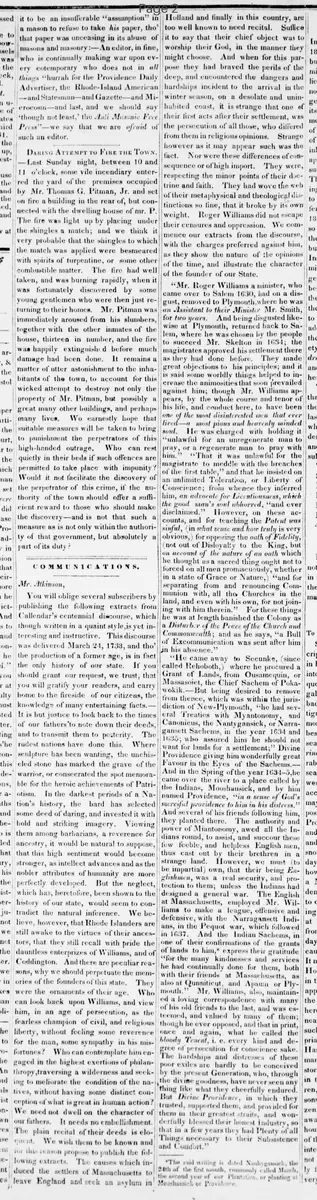
You will oblige several subscribers by publishing the following extracts from Callendar's centennial discourse, which though written in a quaint style, is yet interesting and instructive. This discourse was delivered March 24, 1738, and tho' the production of a former age, is in fact the only history of our state. If you should grant our request, we trust, that you will gratify your readers, and carry home to the fireside of our citizens, the knowledge of many entertaining facts. It is but justice to look back to the times of our fathers' to note down their deeds, and to transmit them to posterity. The rudest nations have done this. Where sculpture has been wanting, the unchiseled stone has marked the grave of the warrior, or consecrated the spot memorable for the heroic achievements of Patriotism. In the darkest periods of a Nation's history, the bard has selected some deed of daring, and invested it with bold and striking imagery. Viewing them among barbarians, a reverence for ancestry, it would be natural to suppose, that this high sentiment would become stronger, as intellect advances and as the nobler attributes of humanity are more perfectly developed. But the neglect, which has, heretofore, been shown to the history of our state, would seem to contradict the natural inference. We believe, however, that Rhode Islanders are still awake to the virtues of their ancestors, that they still recall with pride the dauntless enterprizes of Williams, and of Coddington. And there are peculiar reasons, why we should perpetuate the memories of the founders of this state. They were the ornaments of their age. Who can look back upon Williams, and view him, in an age of persecution, as the fearless champion of civil, and religious liberty, without feeling some reverence for the man, some sympathy in his misfortunes? Who can contemplate him engaged in the highest exertions of philanthropy, traversing a wilderness and seeking to meliorate the condition of the natives, without having some distinct conception of what is great in human action? We need not dwell on the character of our fathers. It needs no embellishment. The plain recital of their deeds is eloquent. We wish them to be known and to this reason propose to publish the following extracts. The causes which induced the settlers of Massachusetts to leave England and seek an asylum in Holland and finally in this country, are too well known to need recital. Suffice it to say that their chief object was to worship their God, in the manner they might choose. And when for this purpose they had braved the perils of the deep, and encountered the dangers and hardships incident to the arrival in the winter season, on a desolate and uninhabited coast, it is strange that one of their first acts after their settlement, was the persecution of all those, who differed from them in religious opinions. Strange however as it may appear such was the fact. Nor were these differences of consequence or of high import. They were, respecting the minor points of their doctrine and faith. They had wove the web of their metaphysical and theological distinctions so fine, that it broke by its own weight. Roger Williams did not escape their censures and oppression. We commence our extracts from the discourse, with the charges preferred against him, as they show the nature of the opinions of the time, and illustrate the character of the founder of our State.
"Mr. Roger Williams a minister, who came over to Salem 1630, had on a disgust, removed to Plymouth, where he was an Assistant to their Minister Mr. Smith. for two years. And being disgusted likewise at Plymouth, returned back to Salem, where he was chosen by the people to succeed Mr. Skelton in 1634; the magistrates approved his settlement there as they had done before. They made great objections to his principles; and it is said some worldly things helped to increase the animosities that soon prevailed against him; though Mr. Williams appears, by the whole course and tenor of his life, and conduct here, to have been one of the most disinterested men that ever lived—a most pious and heavenly minded soul. He was charged with holding it "unlawful for an unregenerate man to pray, or a regenerate man to pray with him." "That it was unlawful for the magistrate to meddle with the breaches of the first table," and that he insisted on an unlimited Toleration, or Liberty of Conscience; from whence they inferred him, an advocate for Licentiousness, which the good man's soul abhorred, "and ever disclaimed." However, on these accounts, and for teaching the Patent was sinful, (in what sense and how truly is very obvious,) for opposing the oath of Fidelity, (not out of Disloyalty to the King, but on account of the nature of an oath which he thought as a sacred thing ought not to be forced on all men promiscuously, whether in a state of Grace or Nature,) "and for separating from and renouncing Communion with, all the Churches in the land, and even with his own, for not joining with him therein." For these things he was at length banished the Colony as a Disturber of the Peace of the Church and Commonwealth; and as he says, "a Bull of Excommunication was sent after him in his absence."
"He came away to Secunke, (since called Rehoboth,) where he procured a Grant of Lands, from Ousamequin, or Massasoiet, the Chief Sachem of Pokawokik.—But being desired to remove from thence, which was within the jurisdiction of New-Plymouth, "he had several Treaties with Miantonomy, and Canonicus, the Nantygansick, or Narragansett Sachems, in the year 1634 and 1635; who assured him he should not want for land for a settlement;" Divine Providence giving him wonderfully great Favour in the Eyes of the Sachems.— And in the Spring of the year 1634-5, he came over the river to a place called by the Indians, Mooshausick, and by him named Providence, "in a sense of God's merciful providence to him in his distress." And several of his friends following him, they planted there. The authority and power of Miantonomy, awed all the Indians round, to assist, and succour these few feeble, and helpless English men, thus cast out by their brethren in a strange land. However, we must (to be impartial) own, that their being Englishmen, was a real security, and protection to them; unless the Indians had designed a general war. The English at Massachusetts, employed Mr. Williams to make a league, offensive and defensive, with the Narragansett Indians, in the Pequot war, which followed in 1637. And the Indian Sachems, in one of their confirmations of the grants of lands to him,* express their gratitude "for the many kindnesses and services he had continually done for them, both with their friends at Massachusetts, as also at Qunniticut, and Apaum or Plymouth." Mr. Williams, also, maintained a loving correspondence with many of his old friends to the last, and was esteemed, and valued by many of them; though he ever opposed, and that in print, once and again, what he called the bloody Tenent, i. e. every kind and degree of persecution for conscience sake. The hardships and distresses of these poor exiles are hardly to be conceived by the present Generation, who, through the divine goodness, have never seen any thing like what they cheerfully endured. But Divine Providence, in which they trusted, supported them, and provided for them in their greatest straits, and wonderfully blessed their honest Industry, so that in a few years they had Plenty of all Things necessary to their Subsistence and Comfort."
*The said writing is dated Nanbygansick, the 24th of the first month, commonly called March, the second year of our Plantation, or planting at Mooshausick or Providence,
Mr. Atkinson,
You will oblige several subscribers by publishing the following extracts from Callendar's centennial discourse, which though written in a quaint style, is yet interesting and instructive. This discourse was delivered March 24, 1738, and tho' the production of a former age, is in fact the only history of our state. If you should grant our request, we trust, that you will gratify your readers, and carry home to the fireside of our citizens, the knowledge of many entertaining facts. It is but justice to look back to the times of our fathers' to note down their deeds, and to transmit them to posterity. The rudest nations have done this. Where sculpture has been wanting, the unchiseled stone has marked the grave of the warrior, or consecrated the spot memorable for the heroic achievements of Patriotism. In the darkest periods of a Nation's history, the bard has selected some deed of daring, and invested it with bold and striking imagery. Viewing them among barbarians, a reverence for ancestry, it would be natural to suppose, that this high sentiment would become stronger, as intellect advances and as the nobler attributes of humanity are more perfectly developed. But the neglect, which has, heretofore, been shown to the history of our state, would seem to contradict the natural inference. We believe, however, that Rhode Islanders are still awake to the virtues of their ancestors, that they still recall with pride the dauntless enterprizes of Williams, and of Coddington. And there are peculiar reasons, why we should perpetuate the memories of the founders of this state. They were the ornaments of their age. Who can look back upon Williams, and view him, in an age of persecution, as the fearless champion of civil, and religious liberty, without feeling some reverence for the man, some sympathy in his misfortunes? Who can contemplate him engaged in the highest exertions of philanthropy, traversing a wilderness and seeking to meliorate the condition of the natives, without having some distinct conception of what is great in human action? We need not dwell on the character of our fathers. It needs no embellishment. The plain recital of their deeds is eloquent. We wish them to be known and to this reason propose to publish the following extracts. The causes which induced the settlers of Massachusetts to leave England and seek an asylum in Holland and finally in this country, are too well known to need recital. Suffice it to say that their chief object was to worship their God, in the manner they might choose. And when for this purpose they had braved the perils of the deep, and encountered the dangers and hardships incident to the arrival in the winter season, on a desolate and uninhabited coast, it is strange that one of their first acts after their settlement, was the persecution of all those, who differed from them in religious opinions. Strange however as it may appear such was the fact. Nor were these differences of consequence or of high import. They were, respecting the minor points of their doctrine and faith. They had wove the web of their metaphysical and theological distinctions so fine, that it broke by its own weight. Roger Williams did not escape their censures and oppression. We commence our extracts from the discourse, with the charges preferred against him, as they show the nature of the opinions of the time, and illustrate the character of the founder of our State.
"Mr. Roger Williams a minister, who came over to Salem 1630, had on a disgust, removed to Plymouth, where he was an Assistant to their Minister Mr. Smith. for two years. And being disgusted likewise at Plymouth, returned back to Salem, where he was chosen by the people to succeed Mr. Skelton in 1634; the magistrates approved his settlement there as they had done before. They made great objections to his principles; and it is said some worldly things helped to increase the animosities that soon prevailed against him; though Mr. Williams appears, by the whole course and tenor of his life, and conduct here, to have been one of the most disinterested men that ever lived—a most pious and heavenly minded soul. He was charged with holding it "unlawful for an unregenerate man to pray, or a regenerate man to pray with him." "That it was unlawful for the magistrate to meddle with the breaches of the first table," and that he insisted on an unlimited Toleration, or Liberty of Conscience; from whence they inferred him, an advocate for Licentiousness, which the good man's soul abhorred, "and ever disclaimed." However, on these accounts, and for teaching the Patent was sinful, (in what sense and how truly is very obvious,) for opposing the oath of Fidelity, (not out of Disloyalty to the King, but on account of the nature of an oath which he thought as a sacred thing ought not to be forced on all men promiscuously, whether in a state of Grace or Nature,) "and for separating from and renouncing Communion with, all the Churches in the land, and even with his own, for not joining with him therein." For these things he was at length banished the Colony as a Disturber of the Peace of the Church and Commonwealth; and as he says, "a Bull of Excommunication was sent after him in his absence."
"He came away to Secunke, (since called Rehoboth,) where he procured a Grant of Lands, from Ousamequin, or Massasoiet, the Chief Sachem of Pokawokik.—But being desired to remove from thence, which was within the jurisdiction of New-Plymouth, "he had several Treaties with Miantonomy, and Canonicus, the Nantygansick, or Narragansett Sachems, in the year 1634 and 1635; who assured him he should not want for land for a settlement;" Divine Providence giving him wonderfully great Favour in the Eyes of the Sachems.— And in the Spring of the year 1634-5, he came over the river to a place called by the Indians, Mooshausick, and by him named Providence, "in a sense of God's merciful providence to him in his distress." And several of his friends following him, they planted there. The authority and power of Miantonomy, awed all the Indians round, to assist, and succour these few feeble, and helpless English men, thus cast out by their brethren in a strange land. However, we must (to be impartial) own, that their being Englishmen, was a real security, and protection to them; unless the Indians had designed a general war. The English at Massachusetts, employed Mr. Williams to make a league, offensive and defensive, with the Narragansett Indians, in the Pequot war, which followed in 1637. And the Indian Sachems, in one of their confirmations of the grants of lands to him,* express their gratitude "for the many kindnesses and services he had continually done for them, both with their friends at Massachusetts, as also at Qunniticut, and Apaum or Plymouth." Mr. Williams, also, maintained a loving correspondence with many of his old friends to the last, and was esteemed, and valued by many of them; though he ever opposed, and that in print, once and again, what he called the bloody Tenent, i. e. every kind and degree of persecution for conscience sake. The hardships and distresses of these poor exiles are hardly to be conceived by the present Generation, who, through the divine goodness, have never seen any thing like what they cheerfully endured. But Divine Providence, in which they trusted, supported them, and provided for them in their greatest straits, and wonderfully blessed their honest Industry, so that in a few years they had Plenty of all Things necessary to their Subsistence and Comfort."
*The said writing is dated Nanbygansick, the 24th of the first month, commonly called March, the second year of our Plantation, or planting at Mooshausick or Providence,
What sub-type of article is it?
Historical
Informative
Reflective
What themes does it cover?
Religion
Constitutional Rights
What keywords are associated?
Roger Williams
Rhode Island History
Religious Liberty
Callendar Discourse
Providence Founding
Narragansett Sachems
Persecution Massachusetts
What entities or persons were involved?
Mr. Atkinson
Letter to Editor Details
Recipient
Mr. Atkinson
Main Argument
request to publish extracts from callendar's 1738 discourse on rhode island history to preserve and transmit knowledge of ancestors' deeds, particularly roger williams' advocacy for religious liberty and founding of providence.
Notable Details
Extracts Detail Roger Williams' Banishment From Massachusetts For Principles On Prayer, Magistrate's Role, And Liberty Of Conscience
Settlement At Providence With Aid From Narragansett Sachems Canonicus And Miantonomy
Reference To Pequot War League And 'Bloody Tenent' Opposition To Persecution