Thank you for visiting SNEWPapers!
Sign up free
Elizabeth Town Gazette
Elizabeth, Union County, New Jersey
What is this article about?
US Secretary Adams writes to Rep. Lowndes on the President's view that the unratified US-Spain treaty on Florida is binding on Spain's honor, allowing negotiation or force for justice. Notes Spanish fears of South American recognition and potential war; advises waiting for new Spanish minister before occupying Florida.
Clipping
OCR Quality
Full Text
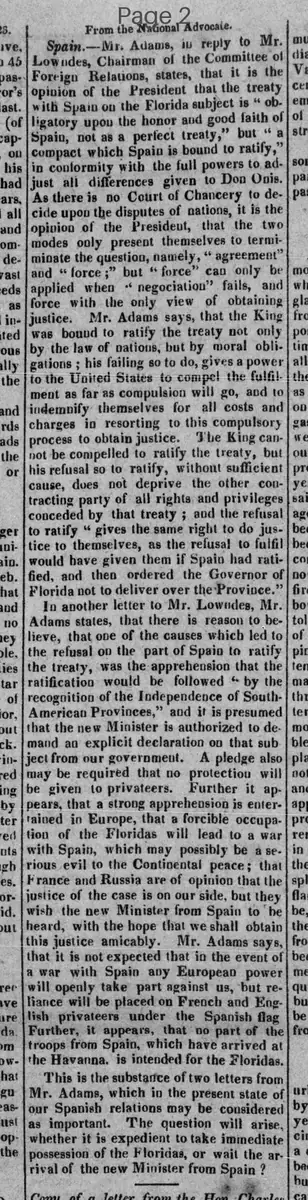
As there is no Court of Chancery to decide upon the disputes of nations, it is the opinion of the President, that the two modes only present themselves to terminate the question, namely, "agreement" and "force;" but "force" can only be applied when "negotiation" fails, and force with the only view of obtaining justice. Mr. Adams says, that the King was bound to ratify the treaty not only by the law of nations, but by moral obligations; his failing so to do, gives a power to the United States to compel the fulfilment as far as compulsion will go, and to indemnify themselves for all costs and charges in resorting to this compulsory process to obtain justice. The King cannot be compelled to ratify the treaty, but his refusal so to ratify, without sufficient cause, does not deprive the other contracting party of all rights and privileges conceded by that treaty; and the refusal to ratify "gives the same right to do justice to themselves, as the refusal to fulfil would have given them if Spain had ratified, and then ordered the Governor of Florida not to deliver over the Province."
In another letter to Mr. Lowndes, Mr. Adams states, that there is reason to believe, that one of the causes which led to the refusal on the part of Spain to ratify the treaty, was the apprehension that the ratification would be followed by the recognition of the Independence of South-American Provinces," and it is presumed that the new Minister is authorized to demand an explicit declaration on that subject from our government. A pledge also may be required that no protection will be given to privateers. Further it appears, that a strong apprehension is entertained in Europe, that a forcible occupation of the Floridas will lead to a war with Spain, which may possibly be a serious evil to the Continental peace; that France and Russia are of opinion that the justice of the case is on our side, but they wish the new Minister from Spain to be heard, with the hope that we shall obtain this justice amicably. Mr. Adams says, that it is not expected that in the event of a war with Spain any European power will openly take part against us, but reliance will be placed on French and English privateers under the Spanish flag.
Further, it appears, that no part of the troops from Spain, which have arrived at the Havanna, is intended for the Floridas.
This is the substance of two letters from Mr. Adams, which in the present state of our Spanish relations may be considered as important. The question will arise, whether it is expedient to take immediate possession of the Floridas, or wait the arrival of the new Minister from Spain?
What sub-type of article is it?
What keywords are associated?
What entities or persons were involved?
Domestic News Details
Key Persons
Outcome
no ratification by spain; us may compel fulfillment or take possession of florida; advised to wait for new minister amid european concerns over war.
Event Details
Mr. Adams replies to Mr. Lowndes on the President's opinion that the US-Spain treaty on Florida is binding on Spain's honor despite not being ratified, allowing the US to use force if negotiations fail to obtain justice. Spanish refusal linked to fears of US recognizing South American independence; European powers favor amicable resolution; no Spanish troops for Florida.