Thank you for visiting SNEWPapers!
Sign up free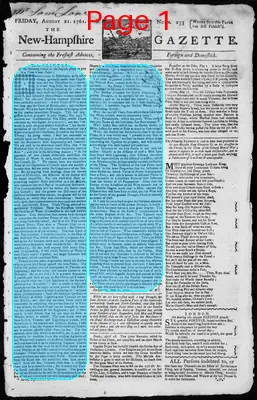
Letter to Editor
August 21, 1761
The New Hampshire Gazette
Portsmouth, Rockingham County, New Hampshire
What is this article about?
A letter refuting an essay by 'Academikus' claiming lightning rods cause drought by altering cloud electrification and preventing rain. The author argues using electrical principles that rods do not affect rain formation and attributes drought to extreme heat rarefying air. From Portsmouth, July 22, 1761.
Clipping
OCR Quality
95%
Excellent
Full Text
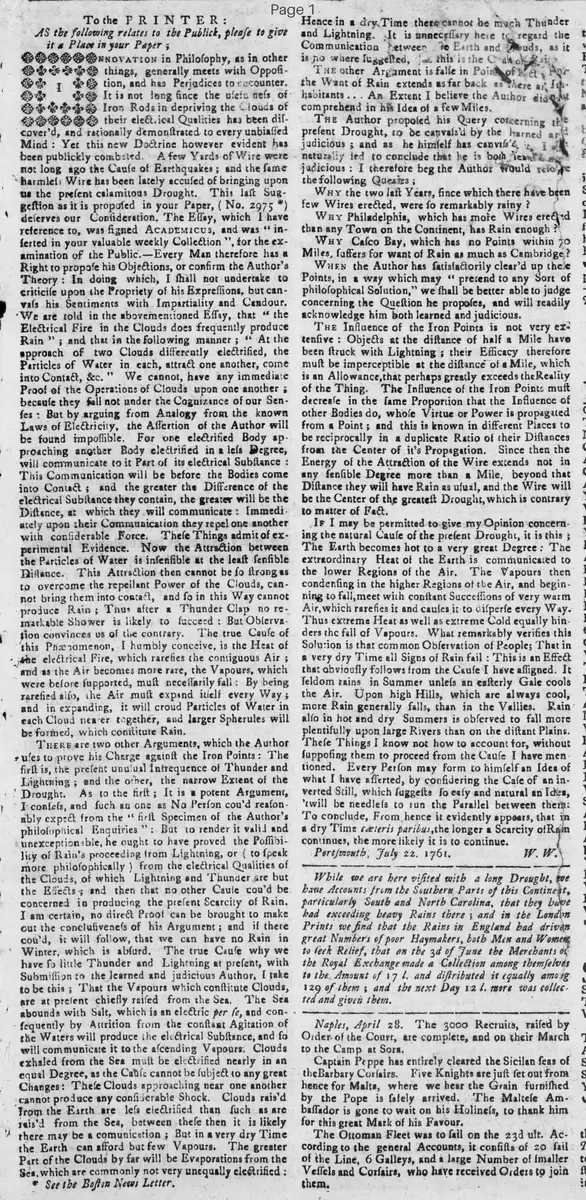
To the PRINTER:
AS the following relates to the Publick, please to give it a Place in your Paper;
Innovation in Philosophy, as in other things, generally meets with Opposition, and has Prejudices to encounter.
It is not long since the useful Ends of pointed Iron Rods in depriving the Clouds of their electrical Qualities has been discover'd, and rationally demonstrated to every unbiassed Mind: Yet this new Doctrine however evident has been publickly contested. A few Yards of Wire were not long ago the Cause of Earthquakes: and the same harmless Wire has been lately accused of bringing upon us the present calamitous Drought. This last Suggestion as it is proposed in your Paper, (No. 2975 *) deserves our Consideration. The Essay, which I have reference to, was signed Academikus, and was "inserted in your valuable weekly Collection", for the examination of the Public. Every Man therefore has a Right to propose his Objections, or confirm the Author's Theory: In doing which, I shall not undertake to criticise upon the Propriety of his Expressions, but canvass his Sentiments with Impartiality and Candour.
We are told in the above-mentioned Essay, that "the Electrical Fire in the Clouds does frequently produce Rain"; and that in the following manner; "At the approach of two Clouds differently electrified, the Particles of Water in each, attract one another, come into Contact, &c." We cannot have any immediate Proof of the Operations of Clouds upon one another; because they fall not under the Cognizance of our Senses: But by arguing from Analogy from the known Laws of Electricity, the Assertion of the Author will be found impossible. For one electrified Body approaching another Body electrified in a less Degree, will communicate to it Part of its electrical Substance: This Communication will be before the Bodies come into Contact; and the greater the Difference of the electrical Substance they contain, the greater will be the Distance, at which they will communicate: Immediately upon their Communication they repel one another with considerable Force. These Things admit of experimental Evidence. Now the Attraction between the Particles of Water is insensible at the least sensible Distance. This Attraction then cannot be so strong as to overcome the repellent Power of the Clouds, cannot bring them into contact, and so in this Way cannot produce Rain; Thus after a Thunder Clap no remarkable Shower is likely to succeed: But Observation convinces us of the contrary. The true Cause of this Phenomenon, I humbly conceive, is the Heat of the electrical Fire, which rarefies the contiguous Air; and as the Air becomes more rare, the Vapours, which were before supported, must necessarily fall: By being rarefied also, the Air must expand itself every Way: and in expanding, it will crowd Particles of Water in each Cloud nearer together, and larger Spherules will be formed, which constitute Rain.
There are two other Arguments, which the Author uses to prove his Charge against the Iron Points: The first is, the present unusual Infrequency of Thunder and Lightning; and the other, the narrow Extent of the Drought. As to the first; It is a potent Argument, I confess, and such an one as no Person cou'd reasonably expect from the "first Specimen of the Author's philosophical Enquiries": But to render it valid and unexceptionable, he ought to have proved the Possibility of Rain's proceeding from Lightning, or (to speak more philosophically) from the electrical Qualities of the Clouds, of which Lightning and Thunder are but the Effects; and then that no other Cause cou'd be concerned in producing the present Scarcity of Rain. I am certain, no direct Proof can be brought to make out the Conclusiveness of his Argument; and if there cou'd, it will follow, that we can have no Rain in Winter, which is absurd. The true Cause why we have so little Thunder and Lightning at present, with Submission to the learned and judicious Author, I take to be this; That the Vapours which constitute Clouds, are at present chiefly raised from the Sea. The Sea abounds with Salt, which is an electric per se, and consequently by Attrition from the constant Agitation of the Waters will produce the electrical Substance, and so will communicate it to the ascending Vapours. Clouds exhaled from the Sea must be electrified nearly in an equal Degree, as the Cause cannot be subject to any great Changes: These Clouds approaching near one another cannot produce any considerable Shock. Clouds rais'd from the Earth are less electrified than such as are rais'd from the Sea, between these then it is likely there may be a communication; But in a very dry Time the Earth can afford but few Vapours. The greater Part of the Clouds by far will be Evaporations from the Seas, which are commonly not very unequally electrified:
#. See the Boston News Letter
Hence in a dry Time there cannot be much Thunder and Lightning. It is unnecessary here to regard the Communication between the Earth and Clouds, as it is no where wanted. If this is the Case.
The other Argument is false in Point of Fact; For the Want of Rain extends as far back as there are Inhabitants. An Extent I believe the Author did not comprehend in his Idea of a few Miles.
The Author proposed his Query concerning the present Drought, to be canvass'd by the learned and judicious; and as he himself has canvass'd it, I am naturally led to conclude that he is both learned and judicious: I therefore beg the Author Would relieve the following Queries;
Why the two last Years, since which there have been few Wires erected, were so remarkably rainy?
Why Philadelphia, which has more Wires erected than any Town on the Continent, has Rain enough?
Why Casco Bay, which has no Points within 20 Miles, suffers for want of Rain as much as Cambridge?
When the Author has satisfactorily clear'd up these Points, in a way which may "pretend to any Sort of philosophical Solution," we shall be better able to judge concerning the Question he proposes, and will readily acknowledge him both learned and judicious.
The Influence of the Iron Points is not very extensive: Objects at the distance of half a Mile have been struck with Lightning: their Efficacy therefore must be imperceptible at the distance of a Mile, which is an Allowance, that perhaps greatly exceeds the Reality of the Thing. The Influence of the Iron Points must decrease in the same Proportion that the Influence of other Bodies do, whose Virtue or Power is propagated from a Point; and this is known in different Places to be reciprocally in a duplicate Ratio of their Distances from the Center of it's Propagation. Since then the Energy of the Attraction of the Wire extends not in any sensible Degree more than a Mile, beyond that Distance they will have Rain as usual, and the Wire will be the Center of the greatest Drought, which is contrary to matter of Fact.
If I may be permitted to give my Opinion concerning the natural Cause of the present Drought, it is this; The Earth becomes hot to a very great Degree: The extraordinary Heat of the Earth is communicated to the lower Regions of the Air. The Vapours then condensing in the higher Regions of the Air, and beginning to fall, meet with constant Successions of very warm Air, which rarefies it and causes it to disperse every Way. Thus extreme Heat as well as extreme Cold equally hinders the fall of Vapours. What remarkably verifies this Solution is that common Observation of People; That in a very dry Time all Signs of Rain fail: This is an Effect that obviously follows from the Cause I have assigned. It Seldom rains in Summer unless an easterly Gale cools the Air. Upon high Hills, which are always cool, more Rain generally falls, than in the Vallies. Rain also in hot and dry Summers is observed to fall more plentifully upon large Rivers than on the distant Plains. These Things I know not how to account for, without supposing them to proceed from the Cause I have mentioned. Every Person may form to himself an Idea of what I have asserted, by considering the Case of an inverted Still, which suggests so easy and natural an Idea, 'twill be needless to run the Parallel between them?
To conclude, From hence it evidently appears, that in a dry Time cæteris paribus, the longer a Scarcity of Rain continues, the more likely it is to continue.
Portsmouth, July 22. 1761.
W. W.
AS the following relates to the Publick, please to give it a Place in your Paper;
Innovation in Philosophy, as in other things, generally meets with Opposition, and has Prejudices to encounter.
It is not long since the useful Ends of pointed Iron Rods in depriving the Clouds of their electrical Qualities has been discover'd, and rationally demonstrated to every unbiassed Mind: Yet this new Doctrine however evident has been publickly contested. A few Yards of Wire were not long ago the Cause of Earthquakes: and the same harmless Wire has been lately accused of bringing upon us the present calamitous Drought. This last Suggestion as it is proposed in your Paper, (No. 2975 *) deserves our Consideration. The Essay, which I have reference to, was signed Academikus, and was "inserted in your valuable weekly Collection", for the examination of the Public. Every Man therefore has a Right to propose his Objections, or confirm the Author's Theory: In doing which, I shall not undertake to criticise upon the Propriety of his Expressions, but canvass his Sentiments with Impartiality and Candour.
We are told in the above-mentioned Essay, that "the Electrical Fire in the Clouds does frequently produce Rain"; and that in the following manner; "At the approach of two Clouds differently electrified, the Particles of Water in each, attract one another, come into Contact, &c." We cannot have any immediate Proof of the Operations of Clouds upon one another; because they fall not under the Cognizance of our Senses: But by arguing from Analogy from the known Laws of Electricity, the Assertion of the Author will be found impossible. For one electrified Body approaching another Body electrified in a less Degree, will communicate to it Part of its electrical Substance: This Communication will be before the Bodies come into Contact; and the greater the Difference of the electrical Substance they contain, the greater will be the Distance, at which they will communicate: Immediately upon their Communication they repel one another with considerable Force. These Things admit of experimental Evidence. Now the Attraction between the Particles of Water is insensible at the least sensible Distance. This Attraction then cannot be so strong as to overcome the repellent Power of the Clouds, cannot bring them into contact, and so in this Way cannot produce Rain; Thus after a Thunder Clap no remarkable Shower is likely to succeed: But Observation convinces us of the contrary. The true Cause of this Phenomenon, I humbly conceive, is the Heat of the electrical Fire, which rarefies the contiguous Air; and as the Air becomes more rare, the Vapours, which were before supported, must necessarily fall: By being rarefied also, the Air must expand itself every Way: and in expanding, it will crowd Particles of Water in each Cloud nearer together, and larger Spherules will be formed, which constitute Rain.
There are two other Arguments, which the Author uses to prove his Charge against the Iron Points: The first is, the present unusual Infrequency of Thunder and Lightning; and the other, the narrow Extent of the Drought. As to the first; It is a potent Argument, I confess, and such an one as no Person cou'd reasonably expect from the "first Specimen of the Author's philosophical Enquiries": But to render it valid and unexceptionable, he ought to have proved the Possibility of Rain's proceeding from Lightning, or (to speak more philosophically) from the electrical Qualities of the Clouds, of which Lightning and Thunder are but the Effects; and then that no other Cause cou'd be concerned in producing the present Scarcity of Rain. I am certain, no direct Proof can be brought to make out the Conclusiveness of his Argument; and if there cou'd, it will follow, that we can have no Rain in Winter, which is absurd. The true Cause why we have so little Thunder and Lightning at present, with Submission to the learned and judicious Author, I take to be this; That the Vapours which constitute Clouds, are at present chiefly raised from the Sea. The Sea abounds with Salt, which is an electric per se, and consequently by Attrition from the constant Agitation of the Waters will produce the electrical Substance, and so will communicate it to the ascending Vapours. Clouds exhaled from the Sea must be electrified nearly in an equal Degree, as the Cause cannot be subject to any great Changes: These Clouds approaching near one another cannot produce any considerable Shock. Clouds rais'd from the Earth are less electrified than such as are rais'd from the Sea, between these then it is likely there may be a communication; But in a very dry Time the Earth can afford but few Vapours. The greater Part of the Clouds by far will be Evaporations from the Seas, which are commonly not very unequally electrified:
#. See the Boston News Letter
Hence in a dry Time there cannot be much Thunder and Lightning. It is unnecessary here to regard the Communication between the Earth and Clouds, as it is no where wanted. If this is the Case.
The other Argument is false in Point of Fact; For the Want of Rain extends as far back as there are Inhabitants. An Extent I believe the Author did not comprehend in his Idea of a few Miles.
The Author proposed his Query concerning the present Drought, to be canvass'd by the learned and judicious; and as he himself has canvass'd it, I am naturally led to conclude that he is both learned and judicious: I therefore beg the Author Would relieve the following Queries;
Why the two last Years, since which there have been few Wires erected, were so remarkably rainy?
Why Philadelphia, which has more Wires erected than any Town on the Continent, has Rain enough?
Why Casco Bay, which has no Points within 20 Miles, suffers for want of Rain as much as Cambridge?
When the Author has satisfactorily clear'd up these Points, in a way which may "pretend to any Sort of philosophical Solution," we shall be better able to judge concerning the Question he proposes, and will readily acknowledge him both learned and judicious.
The Influence of the Iron Points is not very extensive: Objects at the distance of half a Mile have been struck with Lightning: their Efficacy therefore must be imperceptible at the distance of a Mile, which is an Allowance, that perhaps greatly exceeds the Reality of the Thing. The Influence of the Iron Points must decrease in the same Proportion that the Influence of other Bodies do, whose Virtue or Power is propagated from a Point; and this is known in different Places to be reciprocally in a duplicate Ratio of their Distances from the Center of it's Propagation. Since then the Energy of the Attraction of the Wire extends not in any sensible Degree more than a Mile, beyond that Distance they will have Rain as usual, and the Wire will be the Center of the greatest Drought, which is contrary to matter of Fact.
If I may be permitted to give my Opinion concerning the natural Cause of the present Drought, it is this; The Earth becomes hot to a very great Degree: The extraordinary Heat of the Earth is communicated to the lower Regions of the Air. The Vapours then condensing in the higher Regions of the Air, and beginning to fall, meet with constant Successions of very warm Air, which rarefies it and causes it to disperse every Way. Thus extreme Heat as well as extreme Cold equally hinders the fall of Vapours. What remarkably verifies this Solution is that common Observation of People; That in a very dry Time all Signs of Rain fail: This is an Effect that obviously follows from the Cause I have assigned. It Seldom rains in Summer unless an easterly Gale cools the Air. Upon high Hills, which are always cool, more Rain generally falls, than in the Vallies. Rain also in hot and dry Summers is observed to fall more plentifully upon large Rivers than on the distant Plains. These Things I know not how to account for, without supposing them to proceed from the Cause I have mentioned. Every Person may form to himself an Idea of what I have asserted, by considering the Case of an inverted Still, which suggests so easy and natural an Idea, 'twill be needless to run the Parallel between them?
To conclude, From hence it evidently appears, that in a dry Time cæteris paribus, the longer a Scarcity of Rain continues, the more likely it is to continue.
Portsmouth, July 22. 1761.
W. W.
What sub-type of article is it?
Informative
Philosophical
Persuasive
What themes does it cover?
Science Nature
What keywords are associated?
Lightning Rods
Drought
Electricity
Clouds
Rain Formation
Thunder
Philosophical Debate
Academikus Essay
What entities or persons were involved?
W. W.
To The Printer
Letter to Editor Details
Author
W. W.
Recipient
To The Printer
Main Argument
lightning rods do not cause drought by preventing rain through electrical discharge in clouds, as electrical principles lead to repulsion rather than contact; the true cause is extreme heat rarefying the air and dispersing vapors.
Notable Details
References Essay By Academikus In Paper No. 2975
Argues From Electrical Experiments And Analogies
Proposes Queries Challenging The Original Theory
Suggests Heat As Drought Cause, Verified By Observations On Hills, Rivers, And Still Analogy