Thank you for visiting SNEWPapers!
Sign up free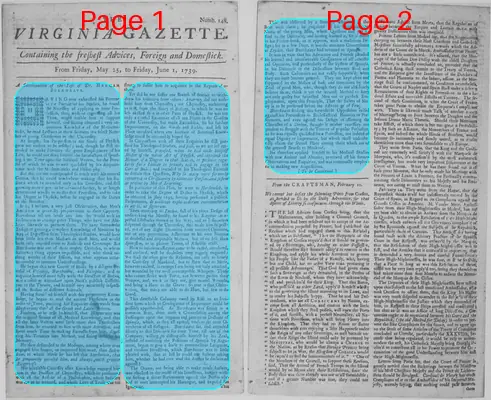
The Virginia Gazette
Richmond, Williamsburg, Richmond County, Virginia
What is this article about?
Continuation of Herman Boerhaave's biography: After exhausting his fortune on studies, he lectures in mathematics, then pursues medicine alongside theology. He studies anatomy, ancient and modern physicians, chemistry, and botany. Obtains MD in 1693 but faces atheism accusations from a boat incident, leading him to focus on medicine.
Merged-components note: Continuation of the biographical narrative on Dr. Herman Boerhaave from page 1 to page 2, indicated by sequential reading order and text flow ending with '[To be Continued.]'.
Clippings
1 of 2
OCR Quality
Full Text
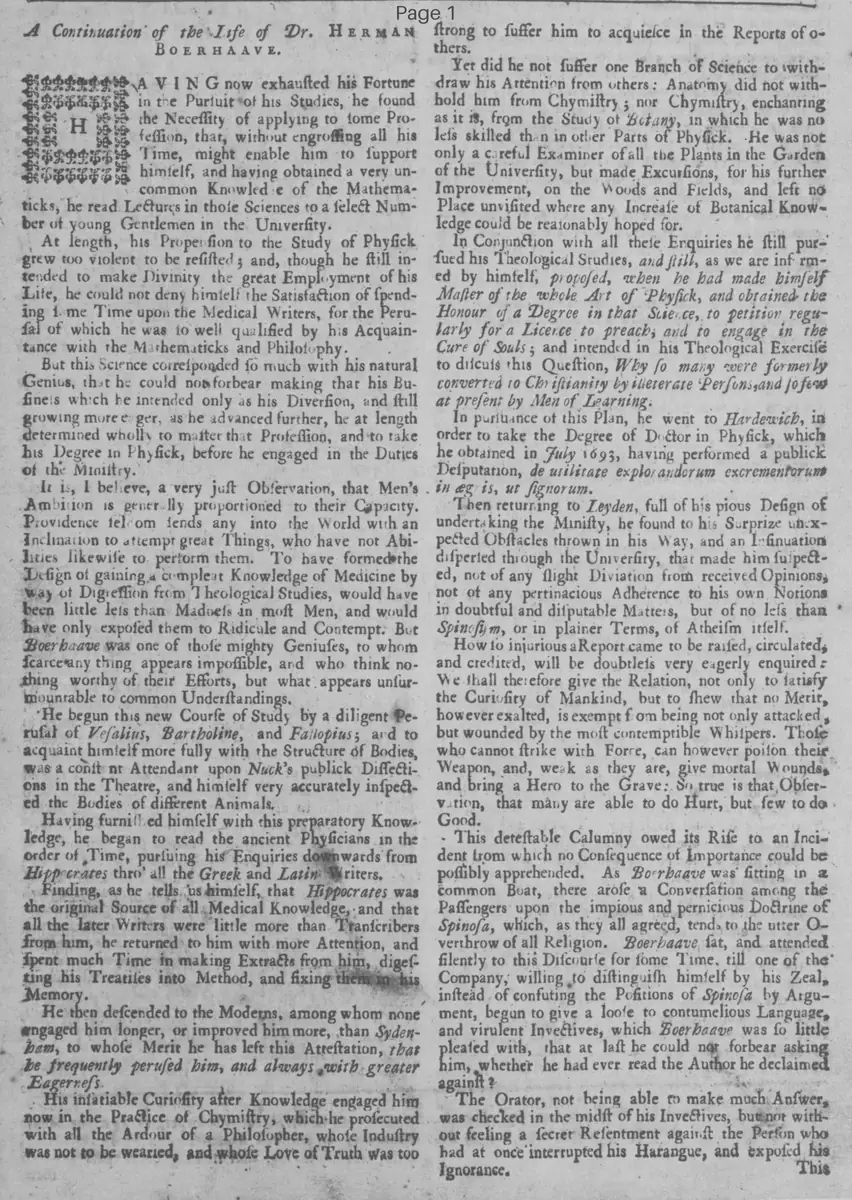
Having now exhausted his Fortune in the Pursuit of his Studies, he found the Necessity of applying to some Profession, that, without engrossing all his Time, might enable him to support himself, and having obtained a very uncommon Knowledge of the Mathematics, he read Lectures in those Sciences to a select Number of young Gentlemen in the University.
At length, his Propension to the Study of Physick grew too violent to be resisted; and, though he still intended to make Divinity the great Employment of his Life, he could not deny himself the Satisfaction of spending some Time upon the Medical Writers, for the Perusal of which he was so well qualified by his Acquaintance with the Mathematics and Philosophy.
But this Science corresponded so much with his natural Genius, that he could not forbear making that his Business which he intended only as his Diversion, and still growing more eager, as he advanced further, he at length determined wholly to master that Profession, and to take his Degree in Physick, before he engaged in the Duties of the Ministry.
It is, I believe, a very just Observation, that Men's Ambition is generally proportioned to their Capacity. Providence seldom sends any into the World with an Inclination to attempt great Things, who have not Abilities likewise to perform them. To have formed the Design of gaining a compleat Knowledge of Medicine by way of Digression from Theological Studies, would have been little less than Madness in most Men, and would have only exposed them to Ridicule and Contempt. But Boerhaave was one of those mighty Geniuses, to whom Scarce any thing appears impossible, and who think nothing worthy of their Efforts, but what appears unsurmountable to common Understandings.
He begun this new Course of Study by a diligent Perusal of Vesalius, Bartholine, and Fallopius; and to acquaint himself more fully with the Structure of Bodies, was a constant Attendant upon Nuck's publick Dissections in the Theatre, and himself very accurately inspected the Bodies of different Animals.
Having furnished himself with this preparatory Knowledge, he began to read the ancient Physicians in the order of Time, pursuing his Enquiries downwards from Hippocrates thro'all the Greek and Latin Writers.
Finding, as he tells us himself, that Hippocrates was the original Source of all Medical Knowledge, and that all the later Writers were little more than Transcribers from him, he returned to him with more Attention, and spent much Time in making Extracts from him, digesting his Treatises into Method, and fixing them in his Memory.
He then descended to the Moderns, among whom none engaged him longer, or improved him more, than Sydenham, to whose Merit he has left this Attestation, that he frequently perused him, and always with greater Eagerness.
His insatiable Curiosity after Knowledge engaged him now in the Practice of Chymistry, which he prosecuted with all the Ardour of a Philosopher, whose Industry was not to be wearied, and whose Love of Truth was too strong to suffer him to acquiesce in the Reports of others.
Yet did he not suffer one Branch of Science to withdraw his Attention from others: Anatomy did not withhold him from Chymistry; nor Chymistry, enchanting as it is, from the Study of Botany, in which he was no less skilled than in other Parts of Physick. He was not only a careful Examiner of all the Plants in the Garden of the University, but made Excursions, for his further Improvement, on the Woods and Fields, and left no Place unvisited where any Increase of Botanical Knowledge could be reasonably hoped for.
In Conjunction with all these Enquiries he still pursued his Theological Studies, and still, as we are informed by himself, proposed, when he had made himself Master of the whole Art of Physick, and obtained the Honour of a Degree in that Science, to petition regularly for a Licence to preach; and to engage in the Cure of Souls; and intended in his Theological Exercise to discuss this Question, Why So many were formerly converted to Christianity by illiterate Persons, and so few at present by Men of Learning.
In pursuance of this Plan, he went to Hardewick, in order to take the Degree of Doctor in Physick, which he obtained in July 1693, having performed a publick Disputation, de utilitate explorandorum excrementorum in egis, ut ignorum.
Then returning to Leyden, full of his pious Design of undertaking the Ministry, he found to his Surprize unexpected Obstacles thrown in his Way, and an Intimation dispersed through the University, that made him suspected, not of any slight Deviation from received Opinions not of any pertinacious Adherence to his own Notions in doubtful and disputable Matters, but of no less than Spinoism, or in plainer Terms, of Atheism itself.
How to injurious a Report came to be raised, circulated, and credited, will be doubtless very eagerly enquired: We shall therefore give the Relation, not only to satisfy the Curiosity of Mankind, but to shew that no Merit, however exalted, is exempt from being not only attacked but wounded by the most contemptible Whispers. Those who cannot strike with Force, can however poison their Weapon, and, weak as they are, give mortal Wounds, and bring a Hero to the Grave: So true is that Observation, that many are able to do Hurt, but few to do Good.
This detestable Calumny owed its Rise to an Incident from which no Consequence of Importance could be possibly apprehended. As Boerhaave was sitting in a common Boat, there arose a Conversation among the Passengers upon the impious and pernicious Doctrine of Spinoza, which, as they all agreed, tends to the utter Overthrow of all Religion. Boerhaave sat, and attended silently to this Discourse for some Time, till one of the Company, willing to distinguish himself by his Zeal, instead of confuting the Positions of Spinoza by Argument, begun to give a loose to contumelious Language, and virulent Invectives, which Boerhaave was so little pleased with, that at last he could not forbear asking him, whether he had ever read the Author he declaimed against?
The Orator, not being able to make much Answer, was checked in the midst of his Invectives, but not without feeling a secret Resentment against the Person who had at once interrupted his Harangue, and exposed his Ignorance.
This was observed by a Stranger who was in the Boat with them; he enquired of his Neighbour the Name of the young Man, whose Question had put an End to the Discourse, and having learned it, set it down in his Pocket-book, as it appears, with a malicious Design; for in a few Days, it was the common Conversation at Leyden, that Boerhaave had revolted to Spinoza. It was in vain that his Advocates and Friends pleaded his learned and unanswerable Confutation of all atheistical Opinions, and particularly of the System of Spinoza, in his Discourse of the Distinction between Soul and Body. Such Calumnies are not easily suppressed, when they are once become general. They are kept alive and supported by the Malice of bad, and sometimes by the Zeal of good Men, who, though they do not absolutely believe them, think it yet the surest Method to keep not only guilty but suspected Men out of publick Employments, upon this Principle, That the Safety of Many is to be preferred before the Advantage of Few. Boerhaave finding this formidable Opposition raised against his Pretensions to Ecclesiastical Honours or Preferments, and even against his Design of assuming the Character of a Divine, thought it neither necessary nor prudent to struggle with the Torrent of popular Prejudice, as he was equally qualified for a Profession, not indeed of equal Dignity or Importance, but which must undoubtedly claim the second Place among those which are of the greatest Benefit to Mankind. He therefore applied himself to his Medical Studies with new Ardour and Alacrity, reviewed all his former Observations and Enquiries, and was continually employed in making new Acquisitions.
[To be Continued.]
What sub-type of article is it?
What themes does it cover?
What keywords are associated?
Literary Details
Title
A Continuation Of The Life Of Dr. Herman Boerhaave.
Form / Style
Biographical Narrative In Prose
Key Lines